Thyroid and Weight: Is My Thyroid the Reason I Can't Lose Weight?
En español: Tiroides y peso — cuánto explica realmente la tiroides, qué pasa con el peso al tratar el hipotiroidismo y qué dice la evidencia sobre TSH, obesidad y programas GLP-1.
Watch the related video
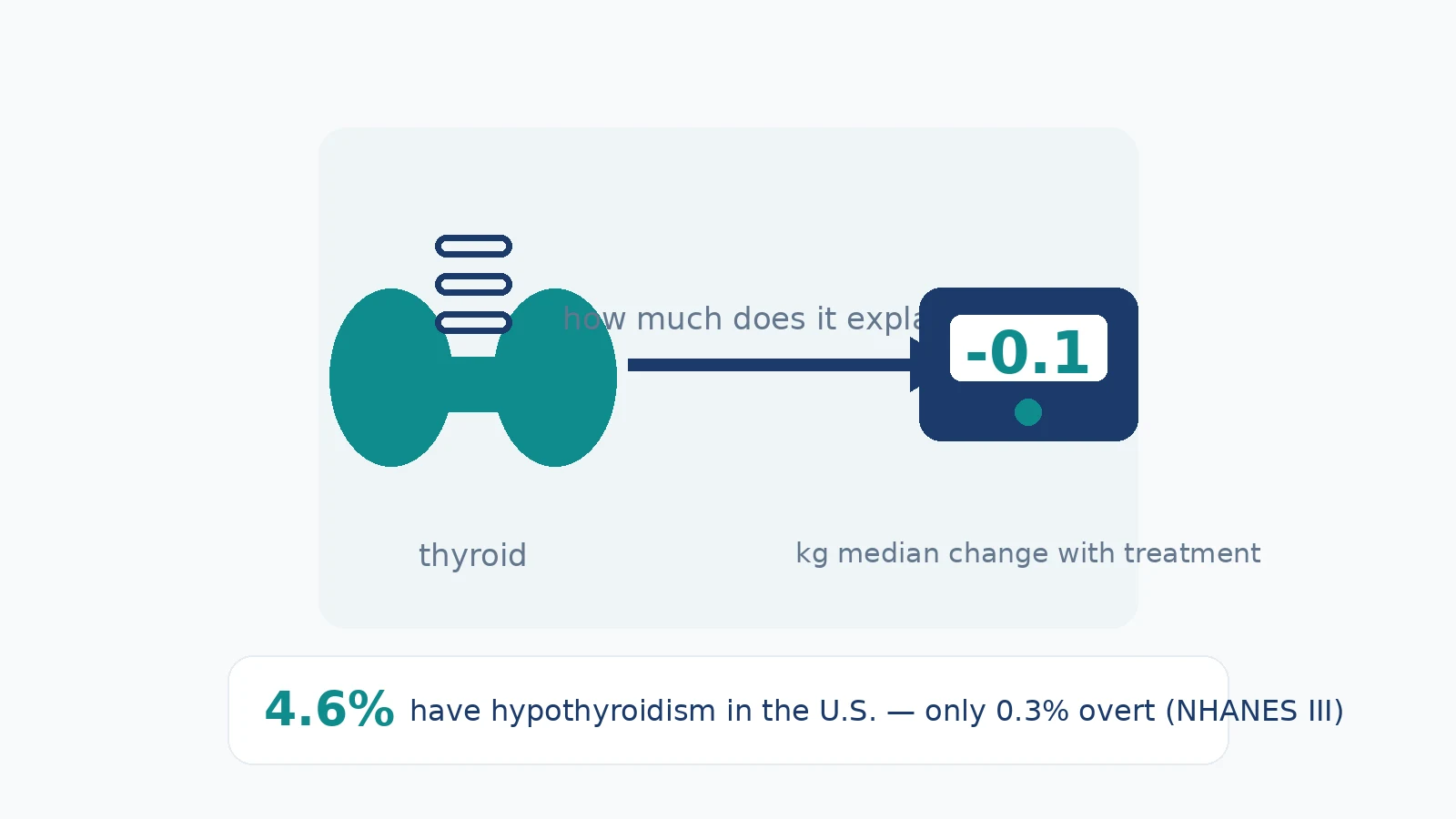
In a Boston Medical Center study of 101 adults newly diagnosed with hypothyroidism, published in Endocrine Practice, the median weight change after the thyroid was normalized with levothyroxine was −0.1 kg. Only half lost any weight at all, and that half lost an average of 3.8 kg (8.4 lb). The other half lost nothing or gained. And in the TRUST trial, published in The New England Journal of Medicine with 737 adults with mild hypothyroidism, a year of levothyroxine changed neither tiredness nor symptoms compared with placebo.
If you have spent months trying to lose weight and someone told you "it must be your thyroid," this article is for you. The thyroid does influence weight. But the relationship is much smaller, and much more interesting, than most people believe. We are going to separate what is true, what is myth, and what you can do with that information.
By the end you will know when it makes sense to check your thyroid, what a TSH result means, why obesity can raise TSH without the thyroid being sick, and what role all of this plays if you are on a GLP-1 program. With real numbers and sources you can verify.
Key points
- In the United States, 4.6% of the population has hypothyroidism, according to the NHANES III survey (JCEM, 2002). But only 0.3% has the clinical form, with truly low hormones. The remaining 4.3% is the mild or "subclinical" form: slightly high TSH, normal hormones.
- Treating hypothyroidism does not slim you down the way people expect. In 101 patients with a TSH of 10 or higher, the median weight change after normalizing the thyroid was −0.1 kg (Endocrine Practice, 2014). And in the study that measured body composition, the weight that came off was retained water, not fat (JCEM, 2011).
- Mild hypothyroidism is not treated for weight. A guideline in The BMJ (2019) reviewed 21 trials with 2,192 people and found no effect on body mass index or symptoms. Its recommendation is strong: in almost all adults, do not give thyroid hormone.
- The arrow also points the other way: obesity raises TSH. Leptin, a hormone made by fat, stimulates the thyroid axis. When a person loses weight, TSH returns to normal without medication (Molecular and Cellular Endocrinology, 2009).
- American Thyroid Association guidelines are clear: thyroid hormone is not used for weight loss in people with a normal thyroid. At high doses it can affect the heart and bones, and the weight lost is muscle and water.
- If you have a personal or family history of medullary thyroid cancer, or MEN 2 syndrome, GLP-1 medications are contraindicated. It is one of the first questions a clinician asks before starting a program. Individual results vary and are not guaranteed.
In this article
- What the thyroid does, explained without jargon
- What TSH means and why it is the main test
- How many people truly have hypothyroidism
- How much weight the thyroid explains: the real numbers
- Mild hypothyroidism: why it is not treated for weight
- When it is the other way around: obesity raises TSH
- Why thyroid hormone is not a weight-loss pill
- Signs that do justify checking your thyroid
- What changes if you are on a GLP-1 program
- What this evidence does NOT say
- Who is this NOT for?
- Frequently asked questions
- Sources
What the thyroid does, explained without jargon
The thyroid is a small, butterfly-shaped gland at the base of the neck. It makes two hormones, T4 and T3, that travel through the blood and tell every cell in the body how fast to work. Think of it as the body's background throttle: it regulates how much energy you burn at rest, your temperature, your heart rhythm, the speed of your gut and even how moist your skin is.
When the thyroid makes too little, everything slows down. That is hypothyroidism. When it makes too much, everything speeds up. That is hyperthyroidism. This article is about the first one, because it is the one people associate with gaining weight or being unable to lose it.
Why hypothyroidism is linked to weight
When thyroid hormone is low, resting energy expenditure drops. That is real and it has been measured. But there is a second effect almost nobody mentions, and it explains much of the "thyroid weight": the body holds on to water and salt in the tissues. That is called myxedema. It is swelling, not fat. And when the thyroid is corrected, that water leaves. This detail matters a lot when we get to the numbers.
What TSH means and why it is the main test
TSH is not made by the thyroid. It is made by the pituitary, a gland in the brain that acts as the boss. When the pituitary notices there is too little thyroid hormone in the blood, it raises TSH to order the thyroid to work harder. When there is enough, it lowers it.
That is why TSH is such a useful test. It works like a thermostat. If TSH is high, the brain is asking for more hormone, which suggests the thyroid is not keeping up. If T4 is also low, the hypothyroidism is clear, or "overt." If TSH is slightly high but T4 is still normal, it is called mild or subclinical hypothyroidism. These are two very different situations, and confusing them is the root of most misunderstandings about thyroid and weight.
Some context: in the U.S. population without thyroid disease, mean TSH was 1.50 mIU/L in NHANES III. Among Mexican Americans it was 1.43. The reference range most labs use runs roughly from 0.4 to 4.5, although it varies by lab and by age. A TSH of 3 is not "almost hypothyroid." It is normal.
How many people truly have hypothyroidism
The NHANES III survey measured TSH, T4 and thyroid antibodies in 17,353 people representing the U.S. population by age, sex and ethnicity. It found hypothyroidism in 4.6% of the population. But when you separate it by type, the number changes meaning. Only 0.3% had the overt form, with truly low hormones. The other 4.3% had the mild form.
In plain terms: out of every 100 people, fewer than one has hypothyroidism that actually lowers their hormones. It is more common in women, rises with age, and is more frequent in white and Mexican American people than in Black people. The same study found thyroid antibodies in 11.3% of the population, a sign that the immune system is attacking the gland, although many of those people had normal hormones.
One more thing worth saying. That study concluded that a large share of the population has laboratory evidence of thyroid disease without knowing it. So checking the thyroid does make sense when there are signs. What does not make sense is assuming the thyroid is the cause of every pound.
How much weight the thyroid explains: the real numbers
Here is the part that surprises people most. If hypothyroidism caused a lot of weight gain, treating it should cause a lot of weight loss. That is what people expect. Let's look at what happened when researchers measured it.
The Boston study (2014)
Lee, Braverman and Pearce, at Boston Medical Center, reviewed the records of 101 adults newly diagnosed with primary hypothyroidism. These were not borderline cases: the initial TSH had to be 10 or higher, and the median was 18.3. They were given levothyroxine until TSH fell below 5. And weight was measured.
The result: a median weight change of −0.1 kg. Only 52% lost weight, and that group lost an average of 3.8 kg. The other 48% did not lose or gained. Neither initial TSH, nor initial weight, nor age, nor sex predicted who would lose. The authors put it plainly: "contrary to popular belief," there was no significant weight change after starting treatment.
The Danish study (2011): what kind of weight is lost
Karmisholt and colleagues, in JCEM, did something more precise. They took 12 patients with severe hypothyroidism (mean TSH of 102, when normal is below 4.5) and measured body composition with DEXA before and after a year of treatment. Weight fell from 83.7 to 79.4 kg, about 4 kg. But fat did not change. Neither did bone. All of the lost weight came out of "lean mass," which in this case means the water held in the tissues by myxedema.
That is the key finding of this article. Even in very severe hypothyroidism, the "thyroid weight" is mostly water. When the thyroid is corrected, that water leaves. The fat stays. That is why treating the thyroid is necessary for health, but it is not a treatment for body fat.
What this means for you
If you have overt hypothyroidism and you treat it, it is reasonable to expect a difference of 0 to 4 kg, most of it water. The rest depends on the same things as for anyone else: what you eat, how you sleep, how much you move, your appetite hormones and your history. That is not bad news. It is news that puts you back in control, because the tools that actually move fat are within your reach.
Mild hypothyroidism: why it is not treated for weight
Subclinical hypothyroidism is by far the most common form. Slightly high TSH, normal hormones. Many people with excess weight get that result and leave the lab convinced they found the cause. Let's go to what the trials say.
The TRUST trial (2017)
It is the largest trial on this question. Stott and colleagues randomly assigned 737 adults aged 65 and older with confirmed subclinical hypothyroidism (TSH between 4.6 and 19.99 on two measurements) to levothyroxine or placebo for one year. TSH fell in the treated group, from 6.40 to 3.63. And symptoms did not change. Not the hypothyroid score, not the tiredness score, not grip strength, not weight, not waist circumference. Taking the pill corrected the number, but it did not correct anything the person could feel.
The BMJ guideline (2019)
After TRUST, an international panel reviewed all randomized trials: 21 studies with 2,192 participants. The conclusion, published in The BMJ, was that in adults with subclinical hypothyroidism, thyroid hormones do not improve quality of life, symptoms, depressive symptoms, fatigue or body mass index. With moderate to high quality evidence. That is why they issued a strong recommendation: in almost all adults with subclinical hypothyroidism, do not give thyroid hormone. The exceptions are women trying to become pregnant, people with a TSH above 20, and possibly young adults or those with severe symptoms.
This does not mean ignoring a high TSH. It means monitoring it. Some people with a slightly high TSH normalize on their own over the following months, and others progress to true hypothyroidism. Repeating the test is the right move. Starting a lifelong pill "to lose weight" is not.
When it is the other way around: obesity raises TSH
This is the point that helps most in understanding the confusion. The relationship between the thyroid and weight runs in two directions. We have seen that the thyroid moves weight very little. Now let's see how weight moves the thyroid.
Reinehr, in a review in Molecular and Cellular Endocrinology, explains that in people with obesity it is common to find TSH slightly elevated, with T3 at the upper end of normal. And that this appears to be a consequence of obesity, not its cause. The proof: when the person loses weight, TSH returns to normal without any thyroid medication.
The role of leptin
The most likely link is leptin. Leptin is a hormone produced by fat. The more fat there is, the more leptin circulates. And leptin stimulates the axis that runs from the brain to the thyroid. In other words, stored fat tells the brain to make more TSH. It appears to be the body's attempt to burn more energy, an adaptation, not a disease.
That explains a very common situation in the clinic: a person with excess weight, a TSH of 5 or 6, normal hormones, who believes their thyroid caused the weight. In many of those cases, it was the weight that raised the TSH. And the way to bring that TSH down is to lose weight, not to take levothyroxine.
A side effect of rapid loss
The same review mentions something useful for people on a program. When weight comes off quickly, TSH and T3 also fall a little, and with them resting energy expenditure. It is part of the body's adaptation, and it can contribute to plateaus and to the difficulty of keeping weight off. It is not hypothyroidism. It is the body adjusting the throttle. We explain it in more detail in our guide on weight-loss plateaus.
Why thyroid hormone is not a weight-loss pill
Every so often the idea comes up of using levothyroxine, or T3, or "desiccated thyroid," to speed up metabolism in people with a normal thyroid. The American Thyroid Association's guidelines for the treatment of hypothyroidism, published in Thyroid in 2014, are clear on this: thyroid hormone should not be used to treat obesity in people with normal thyroid function.
The reasons are concrete. First, in a person with a normal thyroid, extra hormone does not burn fat in any useful way: it speeds up the heart, can trigger arrhythmias, and over time weakens bone. Second, the weight lost at high doses is muscle and water, the opposite of what you want. Third, extra hormone shuts down the thyroid's own production, so when it is stopped, the body is worse off than at the start. It is a bad tool for a problem that has better tools.
Signs that do justify checking your thyroid
None of the above means you should not check your thyroid. It means you should check it for the right reasons. These are signs a clinician takes seriously:
- Persistent tiredness that does not improve with sleep, along with feeling cold all the time when others do not.
- Dry skin, brittle or shedding hair, fragile nails, new constipation.
- Puffiness in the face or legs, a hoarser voice, a slow heart rate.
- Heavier or irregular periods, difficulty becoming pregnant.
- Family history of thyroid disease, or an autoimmune condition of your own such as type 1 diabetes, celiac disease or vitiligo.
- A lump or visible swelling in the neck.
None of these signs is a diagnosis on its own. They are reasons to order a TSH and, if it is abnormal, a free T4 and sometimes antibodies. We explain what each test measures in our guide Signs your weight is hormonal, which is also the place to start if your broader question is whether your weight could be hormonal.
What changes if you are on a GLP-1 program
There are three things worth knowing. First: if you have diagnosed and treated hypothyroidism, you can be on a weight program like anyone else. What matters is that TSH is controlled, because untreated hypothyroidism slows everything down, including progress. If you lose a lot of weight, your levothyroxine dose may need adjusting, because it is calculated partly by weight. Your clinician checks that with a test; you do not change it on your own.
Second is a safety question that comes up at the start of any evaluation. GLP-1 medications such as semaglutide and tirzepatide carry a warning on their FDA label about thyroid C-cell tumors, observed in rodent studies. That is why they are contraindicated in people with a personal or family history of medullary thyroid carcinoma, and in multiple endocrine neoplasia syndrome type 2 (MEN 2). It is a mandatory question and it must be answered honestly. If you do not have that history, the warning does not exclude you.
Third is what the data show in people. A meta-analysis published in Annals of Internal Medicine pooled 48 randomized trials with 94,245 participants. For thyroid cancer, the result was an odds ratio of 1.37 with an interval of 0.82 to 2.31, meaning no statistical difference, with an estimated range of 1 fewer to 9 more cases per 10,000 people treated. The authors rated it "probably little or no effect," with moderate certainty. It is not zero risk, because nothing is. It is a risk the current evidence cannot distinguish from placebo.
Once you start your program, a licensed physician reviews your case — habits, medical history, goals — and orders labs only if they consider it necessary. Eligibility is determined by medical evaluation.
GLP-1 programs with FDA-approved medications (Wegovy®, Foundayo™, Ozempic®) from $149 a month, by telemedicine, in Spanish and English.
What this evidence does NOT say
Let's be explicit, because the thyroid is a topic where real data gets mixed with promises.
It does not say the thyroid doesn't matter. Overt hypothyroidism is a real disease that affects the heart, cholesterol, mood, fertility and energy. It is always treated. What the evidence says is that treating it corrects health, not body fat.
It does not say a high TSH should be ignored. It says a slightly high TSH with normal hormones is monitored and repeated, and that in most adults it is not treated with pills, because the trials found no benefit.
It does not say weight is the person's fault. What it shows is that the relationship between fat and thyroid runs mostly in the opposite direction from what people believe: fat raises TSH. The mechanism belongs to the body, not to willpower.
And it does not say GLP-1s are for everyone. The contraindication for medullary thyroid cancer and MEN 2 is firm, and the decision about any program is made by a clinician with your full history.
Who is this NOT for?
This article is not for you if you have a diagnosis of hyperthyroidism, Graves' disease, thyroid nodules or thyroid cancer. Those cases have their own management and are handled by an endocrinologist.
It is also not for you if you are pregnant or trying to conceive. In pregnancy the thyroid is managed with different, stricter targets, and mild hypothyroidism may be treated. That is decided by your obstetrician or endocrinologist.
And it is not for you if you want a thyroid pill to make you lose weight with a normal thyroid. Guidelines advise against it, the risks are real, and the weight lost is not fat. Sometimes the answer is no, and that answer is worth as much as a prescription.
It is for you if you have been fighting with your weight for a while, you were told or you suspect "it's the thyroid," and you want to understand with real data how much it explains, how much it doesn't, and what to do with that answer.
Frequently asked questions
Does hypothyroidism cause a lot of weight gain?
Less than people think. In 101 adults with clear hypothyroidism, the median weight change after treatment was −0.1 kg, and only half lost anything, averaging 3.8 kg (Endocrine Practice, 2014). When body composition was measured, the weight lost was retained water, not fat (JCEM, 2011).
If my TSH is slightly high, should I take levothyroxine to lose weight?
According to the 2019 BMJ guideline, based on 21 trials with 2,192 people, no. In adults with subclinical hypothyroidism, thyroid hormone did not improve body mass index or symptoms. The right step is to repeat the test and monitor. Exceptions are decided by your clinician, especially if you are trying to conceive or your TSH is above 20.
Can obesity raise TSH?
Yes. Leptin, a hormone produced by fat, stimulates the thyroid axis, and in many people with obesity TSH is slightly elevated without the thyroid being sick. When they lose weight, TSH normalizes on its own (Molecular and Cellular Endocrinology, 2009).
Can I take thyroid hormone to speed up my metabolism?
Not if your thyroid is normal. American Thyroid Association guidelines advise against it: it does not burn fat in any useful way, it can cause arrhythmias and bone loss, and the weight lost is muscle and water.
How common is hypothyroidism?
In the United States, 4.6% of the population, according to NHANES III. But only 0.3% has the overt form, with low hormones. The rest is the mild form. It is more common in women, rises with age, and is somewhat more frequent in Mexican American and white people.
Do GLP-1s cause thyroid cancer?
C-cell tumors were seen in rodents, which is why the FDA label contraindicates them in people with a personal or family history of medullary thyroid carcinoma or MEN 2. In people, a meta-analysis of 48 trials with 94,245 participants (Annals of Internal Medicine) found no statistical difference from placebo: between 1 fewer and 9 more cases per 10,000 people treated.
What labs are ordered for this?
A clinician decides that. Once you start your program, a licensed physician reviews your case — habits, medical history, goals — and orders labs only if they consider it necessary. Eligibility is determined by medical evaluation.
Do you offer care in Spanish?
Yes. All of our content and our care are available in Spanish and English.
Sources
- Hollowell JG, Staehling NW, Flanders WD, et al. Serum TSH, T4, and thyroid antibodies in the United States population (1988 to 1994): NHANES III. The Journal of Clinical Endocrinology & Metabolism. 2002;87(2):489-499. — DOI · via PubMed
- Lee SY, Braverman LE, Pearce EN. Changes in body weight after treatment of primary hypothyroidism with levothyroxine. Endocrine Practice. 2014;20(11):1122-1128. — DOI · via PubMed
- Karmisholt J, Andersen S, Laurberg P. Weight loss after therapy of hypothyroidism is mainly caused by excretion of excess body water associated with myxoedema. The Journal of Clinical Endocrinology & Metabolism. 2011;96(1):E99-E103. — DOI · via PubMed
- Stott DJ, Rodondi N, Kearney PM, et al. Thyroid Hormone Therapy for Older Adults with Subclinical Hypothyroidism (TRUST). The New England Journal of Medicine. 2017;376(26):2534-2544. — DOI · via PubMed
- Bekkering GE, Agoritsas T, Lytvyn L, et al. Thyroid hormones treatment for subclinical hypothyroidism: a clinical practice guideline. The BMJ. 2019;365:l2006. — DOI · via PubMed
- Reinehr T. Obesity and thyroid function. Molecular and Cellular Endocrinology. 2010;316(2):165-171. — DOI · via PubMed
- Jonklaas J, Bianco AC, Bauer AJ, et al. Guidelines for the treatment of hypothyroidism: prepared by the American Thyroid Association Task Force on Thyroid Hormone Replacement. Thyroid. 2014;24(12):1670-1751. — DOI · via PubMed
- Risk for Cancer With Glucagon-Like Peptide-1 Receptor Agonists and Dual Agonists: A Systematic Review and Meta-analysis. Annals of Internal Medicine. 2026;179(2):216-229. — DOI · via PubMed
- U.S. Food and Drug Administration. Wegovy (semaglutide) prescribing information: boxed warning on risk of thyroid C-cell tumors; contraindicated in patients with a personal or family history of medullary thyroid carcinoma or MEN 2. — FDA
Your trust is worth more than a sale.
This article is informational and is not medical advice. SCTS1 does not prescribe medication. All medical care, prescriptions, and treatment plans are provided by licensed healthcare providers through our partner platform. Treatment eligibility is determined by a licensed provider. Compounded medications contain the same active ingredient class but are not FDA-approved finished pharmaceuticals. Individual results vary and are not guaranteed.