Weight-loss plateaus: why the scale stalls and what to do
Meseta de peso: por qué la báscula se detiene y qué hacer
For the first few months the scale was your ally. It dropped a little every week, your clothes started fitting differently, and for the first time in years effort and result seemed to walk together. Then, without warning, the needle stopped. Same food, same walks, same discipline — and three straight weeks with the same number staring back at you.
What follows is almost always one of two stories. Either you blame yourself ("I must be doing something wrong"), or you blame your body ("my metabolism is broken, this stopped working"). Both stories feel true. Both, according to the evidence, are incomplete.
The weight plateau is one of the most studied — and worst explained — phenomena in weight management. There are mathematical models that put it under the microscope, a famous study that followed television's most punished metabolisms for six years, and modern GLP-1 trials where the plateau shows up right on schedule, as part of the script. This article puts those pieces together, with real numbers and the sources at the end.
Key points
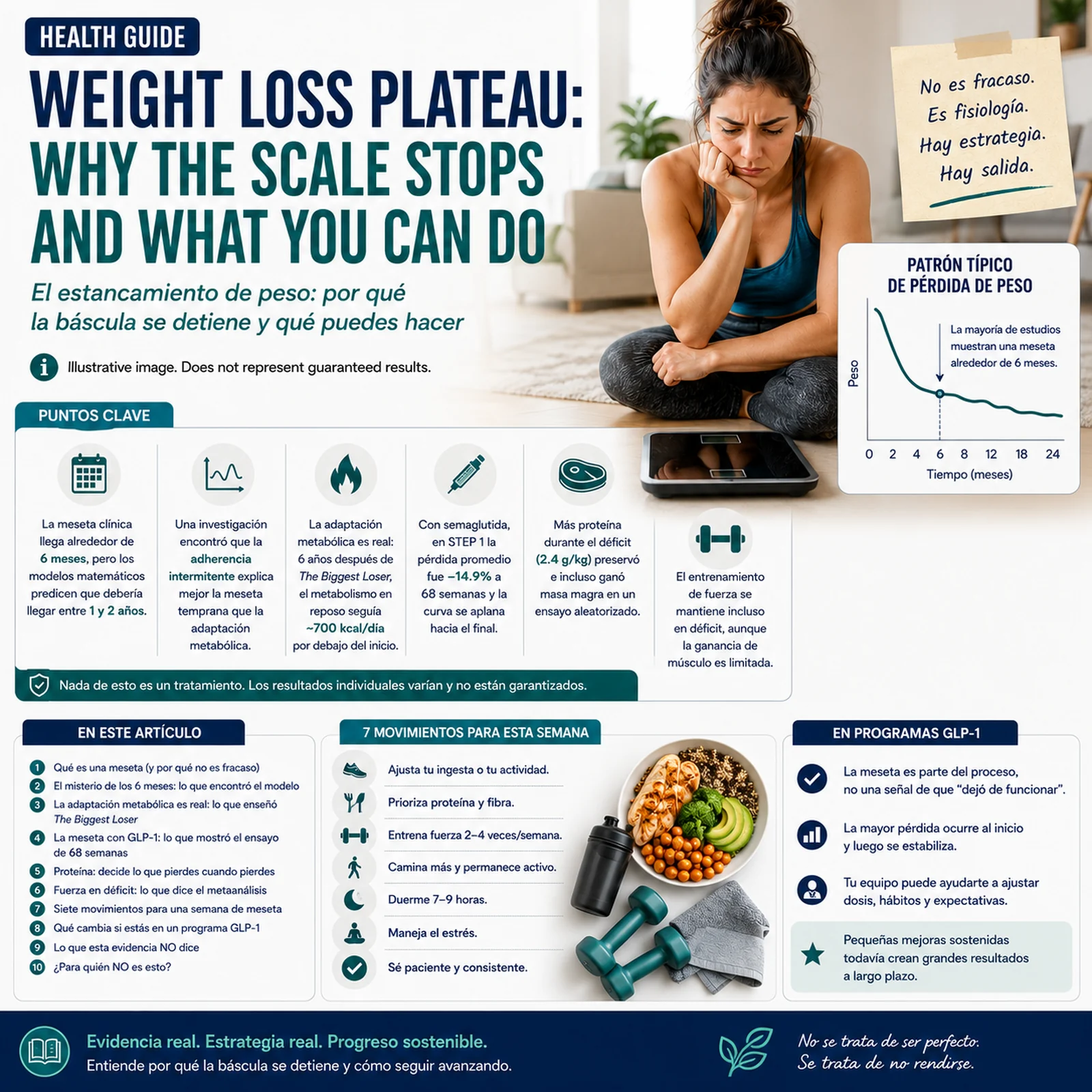
- The typical clinical plateau arrives around 6 months — but validated mathematical models predict that, on physiology alone, it should arrive between 1 and 2 years. That gap has an explanation.
- A model published in the American Journal of Clinical Nutrition found that intermittent adherence — small, oscillating deviations from planned intake, often invisible to the person themselves — explains the early plateau better than metabolic adaptation.
- Metabolic adaptation is real: six years after The Biggest Loser, participants' resting metabolic rate was still about 700 kcal/day below baseline. But that was an extreme case — and even there, adaptation didn't explain who regained weight.
- With semaglutide, in the STEP 1 trial, average loss was −14.9% at 68 weeks — and the curve flattens toward the end. A plateau on treatment is an expected new equilibrium, not a failure.
- Two evidence-backed levers to protect progress: more protein during the deficit (2.4 g/kg preserved and even gained lean mass in a randomized trial) and strength training — which holds up even in a deficit, though muscle gain is limited.
- None of this is a treatment. Individual results vary and are not guaranteed.
In this article
- What a plateau is (and why it isn't failure)
- The 6-month mystery: what the mathematical model found
- Metabolic adaptation is real: what The Biggest Loser taught
- The plateau on GLP-1: what the 68-week trial showed
- Protein: it decides what you lose when you lose
- Strength in a deficit: what the meta-analysis says
- Seven moves for a plateau week
- What changes if you're on a GLP-1 program
- What this evidence does NOT say
- Who is this NOT for?
What a plateau is (and why it isn't failure)
A plateau is a period — weeks, sometimes months — when weight stops dropping even though you're sticking to the plan. It's not the same as a bad weekend or normal daily variation: the body fluctuates two to four pounds on water, salt, hormones and gut contents without it meaning anything. A plateau is when the average of several weeks stays flat.
The first thing to say is that the plateau is not an anomaly: it's the mathematical consequence of losing weight. A smaller body spends less energy — less mass to move, less tissue to maintain — so the same menu that created a generous deficit at the start creates a smaller and smaller one, until the deficit reaches zero and weight stabilizes. So far, simple physics.
The interesting question is different: why does the plateau arrive so early? And that's where the story gets good.
The 6-month mystery: what the mathematical model found
Weight-loss clinical trials repeat a pattern with almost boring punctuality: weight drops for about six months and then flattens. But when researchers feed the same data into validated energy-balance models — models that predict supervised studies well — the physics says the plateau should arrive much later: between one and two years.
That contradiction is exactly what a team led by Diana Thomas, with researchers from the Pennington Biomedical Research Center and the Mayo Clinic, set out to resolve in a study published in the American Journal of Clinical Nutrition. They built two models based on the first law of thermodynamics and set them against each other: one where the early plateau is caused by metabolic adaptation (the metabolism slowing to defend itself), and one where it's caused by intermittent adherence — intake that oscillates around the plan, with deviations that come and go.
The result is uncomfortable for both of the stories we started with. The metabolic-adaptation model changed final weight but could not move the plateau up to six months. The intermittent-adherence model, on the other hand, reproduced the 6-month plateau — and along the way generated those oscillating weight graphs that anyone who has weighed themselves for months recognizes instantly.
And here is the nuance that saves the study from being a scolding: the authors show the plateau appears even with what anyone would call high adherence. We're not talking about abandoning the plan. We're talking about the natural drift of human intake: the good week, the birthday, the portion that grew without anyone measuring it. Small, intermittent deviations, largely invisible to the person — enough, accumulated, to stop the needle. The practical conclusion is not "try harder": it's that the gap between what we think we eat and what we eat is a data point, not a moral defect, and measuring it without judgment for a few days usually says more than any theory about your metabolism.
Metabolic adaptation is real: what The Biggest Loser taught
None of the above means metabolic adaptation is a myth. It means it needs to be put in its place. And for that, the most famous — and most extreme — study ever done on the subject is useful.
A team at the National Institutes of Health (NIH), led by Erin Fothergill and Kevin Hall, tracked down 14 of the 16 contestants from a season of The Biggest Loser, the extreme weight-loss reality show, and measured their body composition and resting metabolic rate six years after the competition. During the show they had lost an average of 58.3 kg (128 lb) in 30 weeks — a brutal pace, with hours of daily exercise and severe restriction.
That number went around the world, and rightly so: it showed the metabolic slowdown can persist for years. But the study has a second finding almost nobody cites, and it changes the moral: metabolic adaptation at the end of the competition did not predict who regained weight. In fact, those maintaining the most weight loss at six years showed more concurrent metabolic slowing — the authors read it as the body's proportional response to sustained effort, not the cause of the rebound.
The honest reading for someone in a normal plateau is this: your metabolism does adjust when you lose weight, and the adjustment is larger the more extreme and rapid the loss. But if your program is moderate and supervised, that adjustment is a fraction of what the contestants experienced — and per the model in the previous section, it isn't even what explains your scale stopping at month five. Your metabolism isn't broken. It's responding, in proportion, to what you're asking of it.
The plateau on GLP-1: what the 68-week trial showed
What if you're on a medication program? The big GLP-1 trials draw plateaus too — and seeing them coming changes how they're lived.
In the STEP 1 trial, published in the New England Journal of Medicine, 1,961 adults with overweight or obesity received weekly 2.4 mg semaglutide or placebo, both alongside a lifestyle intervention, for 68 weeks. The headline result is well known: −14.9% of body weight on average with the medication, versus −2.4% with placebo. 86.4% of those on semaglutide lost at least 5% of their weight.
What matters for this article is the shape of the curve: the descent is fast in the first months, moderates afterward, and flattens toward the end of the trial. That flattening doesn't mean the medication "stopped working" — it means the appetite-intake-expenditure system found its new equilibrium. From there, the program's job changes its name: it's no longer called losing, it's called maintaining — and maintaining, as the same body of trials shows, requires the treatment and the habits to continue.
If you're in a program and your plateau arrived after months of real progress, the first conversation isn't "raise my dose": it's reviewing with your provider where you are relative to your own expected curve, what happened to your muscle, and which habit levers — the ones in the next two sections — are on your side.
Protein: it decides what you lose when you lose
The scale counts pounds, but it doesn't say what they're made of. And during a plateau, the question "what am I losing?" matters as much as "how much?". That's where protein comes in.
A randomized trial from McMaster University, published in the American Journal of Clinical Nutrition, put 40 young men in a marked caloric deficit (~40% below needs) for 4 weeks, with intense resistance and interval training 6 days a week. Half ate 1.2 g of protein per kilo per day; the other half, 2.4 g/kg.
It was an intense protocol, in young men, fully supervised — not a recipe to copy at home. But the direction of the finding is consistent with the rest of the literature: during a deficit, high protein protects muscle, and muscle is metabolically active tissue — losing it deepens the expenditure slowdown. In a plateau, checking the protein on your plate is one of the first levers with evidence behind it.
Strength in a deficit: what the meta-analysis says
The other lever is strength training — and here it helps to have expectations calibrated by data, because the deficit changes what you can expect from it.
A meta-analysis published in the Scandinavian Journal of Medicine & Science in Sports reviewed randomized trials of resistance training performed in an energy deficit of at least 3 weeks. The result: the deficit limits lean mass gain — the meta-regression found that a deficit of about 500 kcal/day essentially eliminates the muscle gain the same training would produce with adequate food. But strength improved anyway, with and without a deficit.
Practical translation for a plateau week: don't expect to gain much muscle while in a deficit — expect to keep it, which is already a metabolic win, and expect to get stronger, which is measurable and motivating when the scale won't cooperate. And a warning in the other direction: if your response to a plateau is cutting more food, consider that larger deficits worsen exactly the variable — muscle — that sustains your expenditure. Cutting more is not always advancing more.
Seven moves for a plateau week
None of this requires buying anything. Everything points at the mechanisms we just covered.
1. Confirm it's a real plateau
Weigh yourself 3-4 times a week, same time of day, and look at the weekly average, not the day. Two flat weeks after months of losing aren't a plateau; they're noise. Four to six flat weeks are.
2. Measure a few days, without judgment
The central finding of the Thomas model is that the deviations stopping the scale are usually invisible to the person eating them. Three honest days of writing everything down — changing nothing, just looking — are worth more than a month of theories about your metabolism.
3. Check protein before calories
Before cutting, redistribute: protein at every meal, starting with breakfast. It protects the muscle that sustains your expenditure.
4. Do strength work 2-3 times a week
In a deficit you won't build much muscle — you'll keep what you have and gain strength, which the meta-analysis shows does improve. Squats, pushes, pulls; weights, bands or your own body.
5. Walk, and count what the scale doesn't
Waist, clothes, photos, stairs without getting winded, blood pressure. Recomposition — losing fat while keeping muscle — can look flat on the scale and real on the tape measure.
6. Treat sleep as part of the plan, not leftovers
Short sleep pushes appetite and next-day food decisions. If your sleep is broken, this article is your next read.
7. If you've been flat 4-6 weeks with reasonable adherence, ask about it
A long plateau with symptoms — unusual fatigue, feeling cold, hair loss — or in the middle of a medication program deserves a clinical conversation, not another solo turn of the screw.
What changes if you're on a GLP-1 program
GLP-1 medications work on appetite and satiety — they turn down the volume of hunger so habits can do their work. What they don't do is decide what you eat with the appetite that remains, or train for you, or sleep for you. That's why the big trials always studied them alongside a lifestyle intervention, and why a plateau on treatment is managed like any other: protein, strength, sleep, honest data — plus a clinical conversation about your curve.
In practice, here is how it works with us: once you start your program, a licensed physician through our partner platform reviews your case — habits, stress, sleep and medical history — and orders labs only if they consider it necessary. Eligibility is determined by medical evaluation. Sometimes the answer is that a medication isn't what you need yet, and that answer is worth as much as a prescription.
GLP-1 programs with FDA-approved medications (Wegovy®, Foundayo™, Ozempic®) from $149/month. Care in English and Spanish, 100% via telemedicine.
What this evidence does NOT say
Let's be explicit, because this topic is full of half-truths.
It does not say your metabolism is broken. Metabolic adaptation exists and is proportional to the size and speed of the loss. In The Biggest Loser it was enormous because the loss was extreme. In a moderate program, it's a fraction of that — and it doesn't explain the 6-month plateau.
It does not say the plateau is your fault. The intermittent-adherence model shows the plateau appears even with high adherence. The deviations that generate it are small, human and largely invisible. It's a data point to measure, not an accusation.
It does not say eating less is always the answer. Larger deficits accelerate muscle loss — the variable that sustains your expenditure. Sometimes the right lever is redistributing (protein, strength, sleep), not cutting.
It does not say muscle magically "speeds up your metabolism." Muscle's effect on resting expenditure is real but modest. Its main value is in function, strength, and not deepening the slowdown — not in licenses to eat more.
And it does not say these studies are the last word. The Thomas model is a model — elegant and validated against four datasets, but a model. The Biggest Loser study followed 14 people from an extreme context. The protein trial lasted 4 weeks in young men. They show converging mechanisms, not closed truths.
Who is this NOT for?
This article is not for you if your relationship with the scale has crossed into clinical territory: extreme restriction, binges, purging, or a distress about weight that won't leave you alone. That isn't solved with adherence levers; it deserves an evaluation with a health professional, and asking for it is the right step, not a failure.
It's also not for you if your plateau came with symptoms: fatigue that won't lift, cold intolerance, hair loss, skin changes, or a total stall after minimal loss. That combination can point to something medical — thyroid, medications, other conditions — and needs a clinician, not an article.
It's not for you if you're looking for the trick that breaks the plateau in a week. It isn't here, and be suspicious of anyone selling it.
It is for you if you've spent weeks looking at the same number and needed to know that the plateau has known mechanics, that your metabolism is responding and not sabotaging, and that the levers — honest data, protein, strength, sleep, and a timely clinical conversation — are within reach.
GLP-1 programs with FDA-approved medications (Wegovy®, Foundayo™, Ozempic®) from $149/month, by telemedicine, in Spanish and English.
Frequently asked questions
Why did my weight stall if I'm still doing everything the same?
A mathematical model published in the American Journal of Clinical Nutrition found that the typical 6-month plateau is mainly explained by oscillating adherence — small, intermittent deviations from planned intake, often invisible to the person themselves — and not by a broken metabolism. Metabolic adaptation exists, but in that model it changes how much weight you lose at the end, not when the plateau arrives.
Is metabolic adaptation real or a myth?
It's real. In the follow-up study of The Biggest Loser contestants, six years later resting metabolic rate was still about 700 calories per day below baseline, with a metabolic adaptation of about 500 calories daily. But that was an extreme case: very fast, very large losses. In moderate, supervised weight loss, the adaptation is smaller and does not by itself explain the early plateau.
Do plateaus happen on GLP-1 medications too?
Yes, and they are expected. In the STEP 1 trial with semaglutide, average loss was 14.9% of body weight at 68 weeks, and the curve flattens toward the end: the body reaches a new equilibrium. A plateau on medication doesn't mean the treatment stopped working; it means you've reached the point where maintaining is also the program's job.
How much protein should I eat during a plateau?
In a randomized trial, men in a marked deficit who ate 2.4 grams of protein per kilo per day gained 1.2 kg of lean mass and lost 4.8 kg of fat in 4 weeks, versus 0.1 kg of lean mass and 3.5 kg of fat at 1.2 g/kg. It was an intense, supervised protocol; the general point is that more protein during a deficit protects muscle. The right amount for you is defined by your provider.
Is lifting weights worth it if I'm eating less?
Yes. A meta-analysis found that a caloric deficit limits lean mass gain during resistance training — at deficits near 500 calories daily, gains are essentially eliminated — but strength improves anyway. Training in a deficit isn't wasted time: it protects what you have and keeps your metabolism active.
Should I eat even less to break the plateau?
It's not the first lever. Cutting more enlarges the deficit, and very large deficits accelerate muscle loss and are harder to sustain. Before cutting, the evidence suggests checking real adherence (measuring a few days without judgment), protein, sleep and strength. If you're in a program, that decision is made with your provider.
When should I talk to a doctor about a plateau?
If the plateau has lasted more than 4-6 weeks with reasonable adherence, if it came with unusual fatigue, hair loss, cold intolerance or other symptoms, or if you're in a medication program and something changed. Once you start your program, a licensed physician reviews your case and orders labs only if they consider it necessary.
Do you offer care in Spanish?
Yes. All our content and care are available in Spanish and English.
Sources
- Thomas DM, Martin CK, Redman LM, et al. Effect of dietary adherence on the body weight plateau: a mathematical model incorporating intermittent compliance with energy intake prescription. Am J Clin Nutr. 2014;100(3):787-795. — DOI · via PubMed
- Fothergill E, Guo J, Howard L, et al. Persistent metabolic adaptation 6 years after "The Biggest Loser" competition. Obesity (Silver Spring). 2016;24(8):1612-1619. — DOI · via PubMed
- Wilding JPH, Batterham RL, Calanna S, et al. Once-Weekly Semaglutide in Adults with Overweight or Obesity (STEP 1). N Engl J Med. 2021;384(11):989-1002. — DOI · via PubMed
- Longland TM, Oikawa SY, Mitchell CJ, Devries MC, Phillips SM. Higher compared with lower dietary protein during an energy deficit combined with intense exercise promotes greater lean mass gain and fat mass loss: a randomized trial. Am J Clin Nutr. 2016;103(3):738-746. — DOI · via PubMed
- Murphy C, Koehler K. Energy deficiency impairs resistance training gains in lean mass but not strength: A meta-analysis and meta-regression. Scand J Med Sci Sports. 2022;32(1):125-137. — DOI · via PubMed
Related articles
Semaglutide vs. tirzepatide: what’s the difference? → Managing GLP-1 side effects → Sublingual vs. injectable GLP-1 →Your trust is worth more than a sale.
This article is informational and is not medical advice. SCTS1 does not prescribe medications. All medical care, prescriptions and treatment plans are provided by licensed physicians through our partner platform. Eligibility is determined by medical evaluation. Compounded medications contain the same class of active ingredient but are not FDA-approved finished pharmaceutical products. Individual results vary and are not guaranteed. If you suspect an eating disorder, seek professional help; in the United States you can call or text 988.