Insulin resistance: the signs that show up before diabetes
Resistencia a la insulina: las señales que aparecen antes de la diabetes
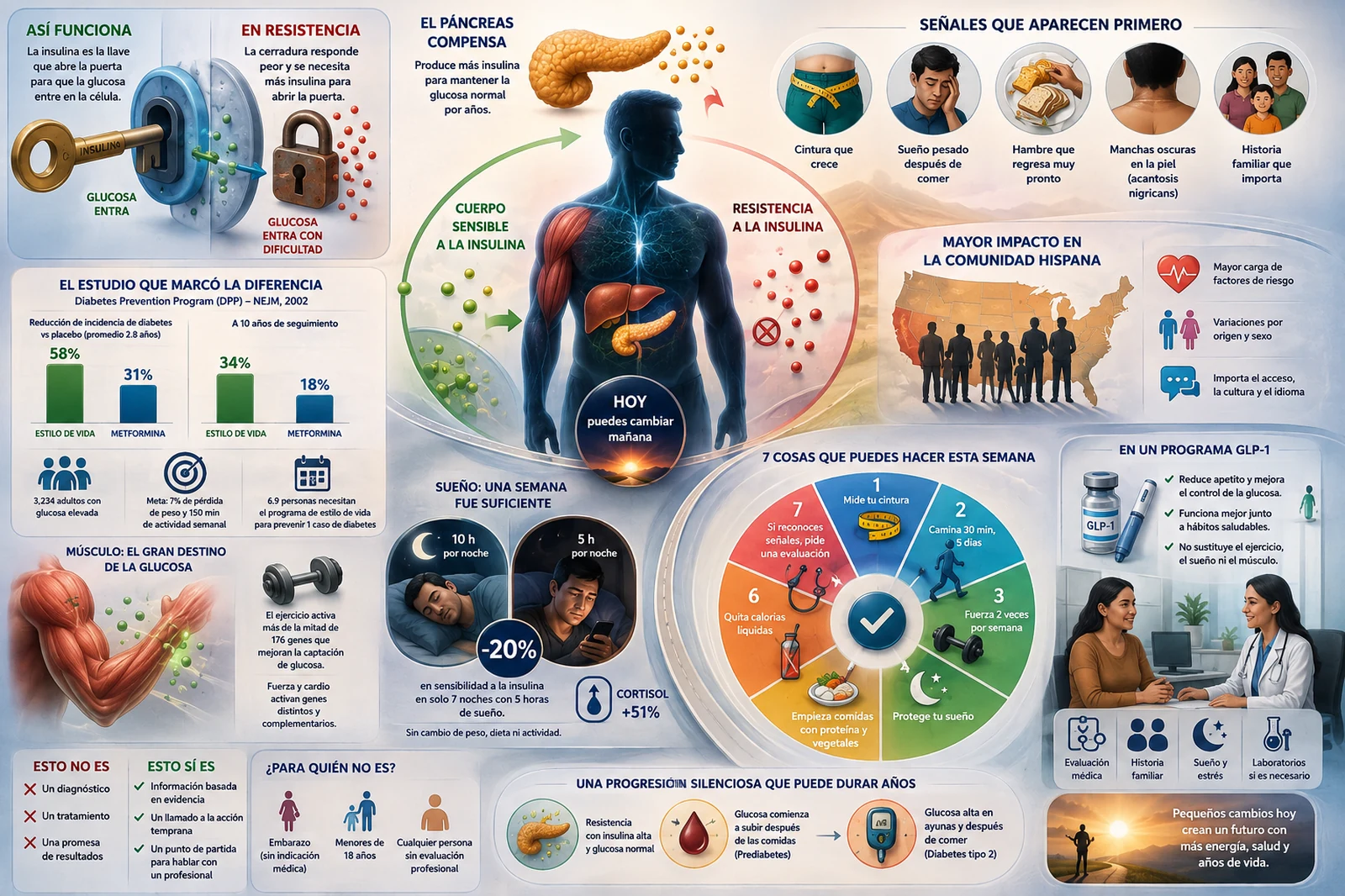
Almost nobody remembers the day it started. There's no pain to warn you, no fever, no morning when you wake up feeling different. What there is, at most, are scattered details that each get their own separate explanation: the waist that grew even though the scale barely moved, the heavy drowsiness that arrives half an hour after lunch, the hunger that returns two hours after eating, that dark patch on your neck you've spent years scrubbing thinking the dirt won't come off.
Each of those details has its own excuse. Together, sometimes, they tell a different story: a body that has been working twice as hard for years to do something it used to do effortlessly.
That's insulin resistance. And what makes it matter isn't that it's dangerous on day one — it isn't — but that it's silent and early. It begins years before any lab result says the word "diabetes," and it's precisely during those years that the most can be done.
This article is about those years. With real numbers, the sources at the end, and the honest part about what the evidence can and cannot promise you.
Key points
- Insulin is the key that opens cells so glucose can enter. In insulin resistance the lock responds worse, and the pancreas compensates by making more — which is why blood sugar can look normal for years.
- In the Diabetes Prevention Program, with 3,234 adults with elevated glucose, a lifestyle program (targets: 7% weight loss and 150 min of weekly activity) reduced diabetes incidence by 58%, versus 31% with metformin. Habits outperformed the drug.
- At 10 years of follow-up the benefit persisted: 34% less diabetes in the lifestyle group and 18% with metformin, even though weight was partly regained.
- Sleeping 5 hours a night for one week reduced insulin sensitivity by about 20% in healthy men. No weight gain and no dietary change were required.
- Muscle is the main destination for glucose after a meal. A systematic review identified 176 muscle glucose-uptake genes, and more than half respond to exercise.
- HCHS/SOL documented a sizeable burden of cardiovascular risk factors, including diabetes, across all US Hispanic/Latino groups, with marked variation by background and sex.
- None of this is a diagnosis or a treatment. Individual results vary and are not guaranteed.
In this article
- What insulin resistance is, in plain words
- Why it's silent: the pancreas that compensates
- The signs that show up first
- The trial that cut diabetes by 58% without medication
- And at ten years? What happened next
- Muscle: the organ almost nobody mentions
- Sleep: one week was enough
- Why this weighs more on the Hispanic community
- Seven things you can do this week
- What changes if you're on a GLP-1 program
- What this evidence does NOT say
- Who is this NOT for?
What insulin resistance is, in plain words
When you eat, carbohydrates become glucose and glucose enters your blood. But glucose in the blood is no use there: it has to get into cells — muscle, liver, fat — to be used or stored. What opens that door is insulin, a hormone made by the pancreas.
The image that works best is a key and a lock. Insulin is the key; the receptor on the cell is the lock. In a body with good sensitivity, one key opens the door without trouble.
In insulin resistance, the lock stiffens. The key is still the right one, but one is no longer enough: it takes two, then five, then ten to get the same effect. The pancreas, which doesn't give up easily, starts manufacturing more insulin to compensate.
And here's the detail that changes everything: as long as the pancreas can compensate, your blood sugar will look normal. A fasting glucose test can come back perfect for years while, underneath, your body is working three times as hard to keep that perfect number. The problem isn't a lack of insulin. It's that more and more is needed.
Why it's silent: the pancreas that compensates
This is why so many people find out late. The typical progression isn't a switch flipping; it's a long slope.
First there's resistance with high insulin and normal glucose — everything "comes back fine" on routine labs. Then, as the pancreas begins to tire, glucose rises a little: first after meals, later while fasting too. That's when the words "prediabetes" or "impaired glucose" appear. And only at the end, when compensation no longer suffices, is the threshold of type 2 diabetes crossed.
It's worth saying plainly: a normal glucose result does not rule out resistance. It means the system is still compensating. That's good news — there's room — not permission to stop looking.
The signs that show up first
None of these signs diagnoses anything on its own. They are reasons to talk to a clinician and consider labs, not to self-diagnose online on a Sunday night.
A waist that grows faster than your weight
Fat that accumulates around the organs — visceral fat — is metabolically different from the fat under the skin. Many people notice clothes tightening at the waist even though the scale barely moves. The tape measure sometimes reports what the scale leaves out.
Heavy sleepiness after eating
A marked energy crash half an hour to an hour after lunch, especially after a high-carbohydrate meal, is a pattern many people recognize. It proves nothing on its own, but it's worth mentioning to your provider.
Hunger that returns too soon
Eating and being hungry again two hours later, with a specific craving for bread, rice or something sweet, fits a system where glucose enters cells poorly and the body asks for more fuel even though it just received some.
Dark, velvety patches of skin
It's called acanthosis nigricans: areas of darker, thickened, velvety-textured skin, typically on the neck, armpits, groin or knuckles. Many people spend years scrubbing it believing it's dirt. It doesn't come off with soap because it isn't dirt: it's a skin change associated with high insulin levels. If you have this, show a clinician.
History that counts
Type 2 diabetes in parents or siblings, gestational diabetes in a previous pregnancy, a baby over 9 pounds at birth, or polycystic ovary syndrome: all raise the probability, and a clinician will want to know.
The trial that cut diabetes by 58% without medication
If one study changed how this topic is understood, it's the Diabetes Prevention Program (DPP), published in the New England Journal of Medicine in 2002.
The design was direct. They enrolled 3,234 adults without diabetes but with elevated glucose both fasting and after a sugar load — people exactly in the silent phase this article is about. Mean age 51, mean body mass index 34, 68% women, and 45% from minority groups. They were randomly assigned to three arms: placebo, metformin (850 mg twice daily), or an intensive lifestyle program with two concrete goals — lose at least 7% of body weight and do at least 150 minutes of physical activity per week.
Three things about this trial are worth underlining.
First, the targets were modest. A 7% weight loss in a 200-pound person is about 14 pounds. That's not a transformation; it's a reachable goal. And 150 minutes a week is 30 minutes, five days — walking counts.
Second, the number needed to treat was remarkably low. The authors calculated that only 6.9 people needed to take part in the lifestyle program for three years to prevent one case of diabetes. For metformin it took 13.9.
Third, nearly half the participants were from minority groups. That matters because many large trials are not, and their results extrapolate poorly. This one doesn't have that problem.
And at ten years? What happened next
A result at 2.8 years is interesting. The next question is whether it lasts. The DPP team followed participants and published 10-year results in The Lancet.
The honest answer has two parts. First: the lifestyle group lost weight and then partly regained it — something anyone who has tried this will recognize, and which the study reports without dressing up. Second: even so, the benefit persisted. Over the 10 years since randomization, diabetes incidence was 34% lower in the lifestyle group and 18% lower with metformin, compared with placebo.
There's a nuance the authors highlight that's worth understanding: during the follow-up phase the lifestyle program was offered to all groups, including the original placebo arm. That's why annual rates converged between groups in that second phase. What stayed different was cumulative incidence: the advantage gained in the early years was not lost.
The practical reading: preventing or delaying diabetes with habits is a real and durable effect, not a short-term mirage. And "delaying" is not a consolation prize — it's years of life without a chronic disease.
Muscle: the organ almost nobody mentions
When blood sugar comes up, the conversation usually revolves around the pancreas and the liver. The lead actor is missing: skeletal muscle is the main destination for glucose after a meal.
That makes muscle more than aesthetics or strength: it's storage surface. More active muscle means more room to put the glucose that just arrived. Less muscle, or inactive muscle, means the opposite.
A systematic review published in the Journal of Cellular Biochemistry set out to map this at the molecular level: it identified 176 genes whose manipulation alters glucose uptake in skeletal muscle, then cross-referenced them with data on exercise-induced gene expression. The finding: more than half of those genes — or the proteins they produce — are regulated by exercise. And endurance and resistance exercise triggered some shared but mostly distinct changes.
Translated into practice: exercise improves insulin sensitivity through its own pathways, which operate even when weight doesn't change. If your scale isn't moving but you're training, you're not wasting time — you're working on a mechanism the scale doesn't measure.
Sleep: one week was enough
Of all the lifestyle factors, sleep is the most underestimated. And there's an experiment that makes this uncomfortably clear.
Researchers at Brigham and Women's Hospital ran a 12-day inpatient study in 20 healthy men aged 20 to 35. First they spent several nights with 10 hours in bed — the sleep-replete condition — then 7 nights with only 5 hours. Diet and physical activity were controlled throughout. At the end of each condition they measured insulin sensitivity with an intravenous glucose tolerance test and with a euglycemic-hyperinsulinemic clamp, the reference method.
What's striking is what was not needed to produce that effect: no weight gain, no dietary change, no drop in activity. Just one week of five-hour nights. The authors also tested whether a wakefulness-promoting drug (modafinil) protected against the effect. It did not — feeling awake is not the same as having slept.
It's a small study in young men, so take it for what it is: a demonstration of mechanism, not a population law. But it moves sleep out of the "generally healthy habit" category and into the "measurable metabolic variable" category. If sleep is your weak spot, this article is your next read.
Why this weighs more on the Hispanic community
The Hispanic Community Health Study / Study of Latinos (HCHS/SOL) is the largest population study of cardiovascular health in US Hispanic and Latino adults. A review published in Current Atherosclerosis Reports summarizes what has been learned so far.
The central finding for this article: the study documented a sizeable burden of cardiovascular risk factors across all major Hispanic/Latino groups in the country — hypertension, high cholesterol, diabetes, obesity and smoking — with marked variation in prevalence by country of origin and by sex.
That second part deserves attention, because it dismantles the stereotype: "Hispanic" is not a single metabolic category. Risk is not the same for someone of Mexican, Puerto Rican, Cuban, Dominican, Central American or South American background, nor the same between men and women. The study also identified sociodemographic, lifestyle and sociocultural characteristics associated with those risk factors.
The practical conclusion isn't alarmist, it's about access: if you have family history and belong to a group with higher documented prevalence, the conversation with a clinician is worth having before symptoms appear — precisely in the silent window. And that conversation should be possible in your own language, without you having to translate your own medical history.
Seven things you can do this week
None of this requires buying anything, and all of it points at the mechanisms above.
1. Measure your waist, not just your weight
Tape measure at navel height, not pulled tight, on the exhale. Write it down. It's a data point the scale doesn't give you and it tracks metabolically active fat.
2. Walk 30 minutes, five days
That's the DPP's 150 minutes — the exact dose that produced the 58%. It isn't a number invented by a magazine; it's the protocol of a randomized trial.
3. Add strength work twice a week
Muscle is where glucose goes. Weights, bands or bodyweight; squats, pushes, pulls. You don't need a gym to start.
4. Protect sleep like a medical appointment
One week at five hours moved insulin sensitivity 20% in healthy people. If you're chronically short on sleep, this is probably your largest and cheapest lever.
5. Start meals with protein and vegetables
Eating protein and fiber first and leaving starch for later moderates that meal's glucose rise. It's a change of order, not of menu — and it costs nothing to try.
6. Cut liquid calories before solid ones
Sodas, juices and sweet coffees arrive fast and satisfy little. For most people it's the highest effort-to-benefit reduction available.
7. If you recognized yourself in the signs, ask for an evaluation
Growing waist, sleepiness after meals, hunger returning early, dark patches on the neck, family history. Not to frighten you: to get data.
What changes if you're on a GLP-1 program
GLP-1 medications act on appetite and satiety, and several have documented effects on glycemic control. What they don't do is sleep for you, train for you, or build the muscle where glucose ends up. That's why the large trials always studied them alongside a lifestyle intervention — never alone.
In practice, a serious program asks about your sleep, your activity and your family history, not just your weight. Once you start your program, a licensed physician through our partner platform reviews your case — habits, stress, sleep and medical history — and orders labs only if they consider it necessary. Eligibility is determined by medical evaluation. Sometimes the answer is that a medication isn't what you need yet, and that answer is worth as much as a prescription.
GLP-1 programs with FDA-approved medications (Wegovy®, Foundayo™, Ozempic®) from $149/month. Care in English and Spanish, 100% via telemedicine.
What this evidence does NOT say
Let's be explicit, because this is a topic thick with snake oil.
It does not say you can diagnose yourself. None of the signs in this article confirms insulin resistance. It's confirmed with clinical evaluation and labs, interpreted by a professional who knows your full picture.
It does not say insulin resistance is diabetes. They're different points on the same road, and being at the first doesn't mean you'll reach the second. That is precisely the DPP's point.
It does not say there's a food, supplement or tea that reverses it. None of the studies cited here evaluated supplements. What was evaluated was weight, activity, sleep and, in one arm, metformin.
It does not say carbohydrates are the enemy. The DPP did not use a low-carbohydrate diet: it used a weight-loss target and a physical-activity target. Quality and quantity matter; demonizing one macronutrient is not in these data.
And it does not say these studies are the last word. The sleep study had 20 young men. The 176-gene review describes molecular mechanisms, not clinical outcomes. HCHS/SOL is observational and does not prove causation. They are converging pieces, not closed truths.
Who is this NOT for?
This article is not for you if you already have a type 1 or type 2 diabetes diagnosis and are in treatment. Your plan is directed by your medical team, and no article should modify it — least of all adjust medication.
It's also not for you if you have symptoms needing prompt attention: intense constant thirst, urinating a great deal, rapid unexplained weight loss, recent blurred vision or extreme fatigue. That combination isn't managed by reading; it's managed with a doctor this week.
It's not for you if you're looking for a lab number to order on your own and self-interpret. Insulin resistance indices are read in context, and out of context they generate more anxiety than information.
It is for you if you recognized yourself in the opening scene — the waist, the post-meal sleepiness, the hunger that returns, the patch on the neck — and nobody had explained that those scattered details can belong to the same story, that the story has a long silent phase, and that this phase is exactly where the evidence shows the most room to act.
GLP-1 programs with FDA-approved medications (Wegovy®, Foundayo™, Ozempic®) from $149/month, by telemedicine, in Spanish and English.
Frequently asked questions
What exactly is insulin resistance?
Insulin is the key that opens your cells so glucose can get in. In insulin resistance the lock responds worse: the pancreas has to produce more insulin to get the same effect. For years blood sugar can look normal because the pancreas compensates. The problem isn't a lack of insulin; it's that more and more is needed.
Which signs show up first?
The most common are: increased fat around the waist, marked tiredness after eating, more hunger and carbohydrate cravings, and in some people dark, velvety patches of skin on the neck, armpits or groin (acanthosis nigricans). None of these diagnoses anything on its own: they are reasons to ask for labs, not to self-diagnose.
Can insulin resistance be reversed?
It can be substantially improved, and this is some of the strongest evidence in the field. In the Diabetes Prevention Program, a trial of 3,234 adults with elevated glucose, a lifestyle program targeting 7% weight loss and 150 minutes of activity per week reduced diabetes incidence by 58%, versus 31% with metformin. Habits outperformed the medication.
Why is this more common in the Hispanic community?
The Hispanic Community Health Study/Study of Latinos documented a sizeable burden of cardiovascular risk factors — including diabetes — across all major Hispanic/Latino groups in the US, with marked variation by country of origin and by sex. It is a combination of genetics, environment, access to care and sociocultural factors, not a single cause.
How much does sleep matter?
More than most people imagine. In a controlled study, healthy men who slept 5 hours a night for one week showed roughly a 20% reduction in insulin sensitivity measured by intravenous glucose tolerance test. One week of short sleep, in healthy people, was enough to move the needle.
Does exercise help even if I don't lose weight?
Yes. Skeletal muscle is the main destination for glucose after a meal, and exercise improves muscle insulin sensitivity through pathways that operate even without weight change. A systematic review identified 176 genes related to muscle glucose uptake, and more than half are regulated by exercise.
Which labs are ordered for this?
A clinician decides that, not an article or a questionnaire. Once you start your program, a licensed physician reviews your case — habits, medical history, symptoms — and orders labs only if they consider it necessary. Eligibility is determined by medical evaluation.
Do you offer care in Spanish?
Yes. All our content and care are available in Spanish and English.
Sources
- Knowler WC, Barrett-Connor E, Fowler SE, et al. Reduction in the incidence of type 2 diabetes with lifestyle intervention or metformin. N Engl J Med. 2002;346(6):393-403. — DOI · via PubMed
- Diabetes Prevention Program Research Group; Knowler WC, Fowler SE, Hamman RF, et al. 10-year follow-up of diabetes incidence and weight loss in the Diabetes Prevention Program Outcomes Study. Lancet. 2009;374(9702):1677-1686. — DOI · via PubMed
- Buxton OM, Pavlova M, Reid EW, Wang W, Simonson DC, Adler GK. Sleep restriction for 1 week reduces insulin sensitivity in healthy men. Diabetes. 2010;59(9):2126-2133. — DOI · via PubMed
- Verbrugge SAJ, Alhusen JA, Kempin S, et al. Genes controlling skeletal muscle glucose uptake and their regulation by endurance and resistance exercise. J Cell Biochem. 2022;123(2):202-214. — DOI · via PubMed
- Pirzada A, Cai J, Cordero C, et al. Risk Factors for Cardiovascular Disease: Knowledge Gained from the Hispanic Community Health Study/Study of Latinos. Curr Atheroscler Rep. 2023;25(11):785-793. — DOI · via PubMed
Related articles
Fatty liver: the organ that complains in silence → Menopause, estradiol, and weight → Losing weight after 40 →Your trust is worth more than a sale.
This article is informational and is not medical advice or a diagnostic tool. SCTS1 does not prescribe medications. All medical care, prescriptions and treatment plans are provided by licensed physicians through our partner platform. Eligibility is determined by medical evaluation. Compounded medications contain the same class of active ingredient but are not FDA-approved finished pharmaceutical products. Individual results vary and are not guaranteed. If you have symptoms such as intense thirst, excessive urination, unexplained weight loss or blurred vision, seek medical care promptly.