LONGEVITY
Whole milk isn't the villain: in January 2026 the official US guidance stopped asking for skim
La leche entera no es la villana: en enero de 2026 la guía oficial de EE. UU. dejó de pedir descremada
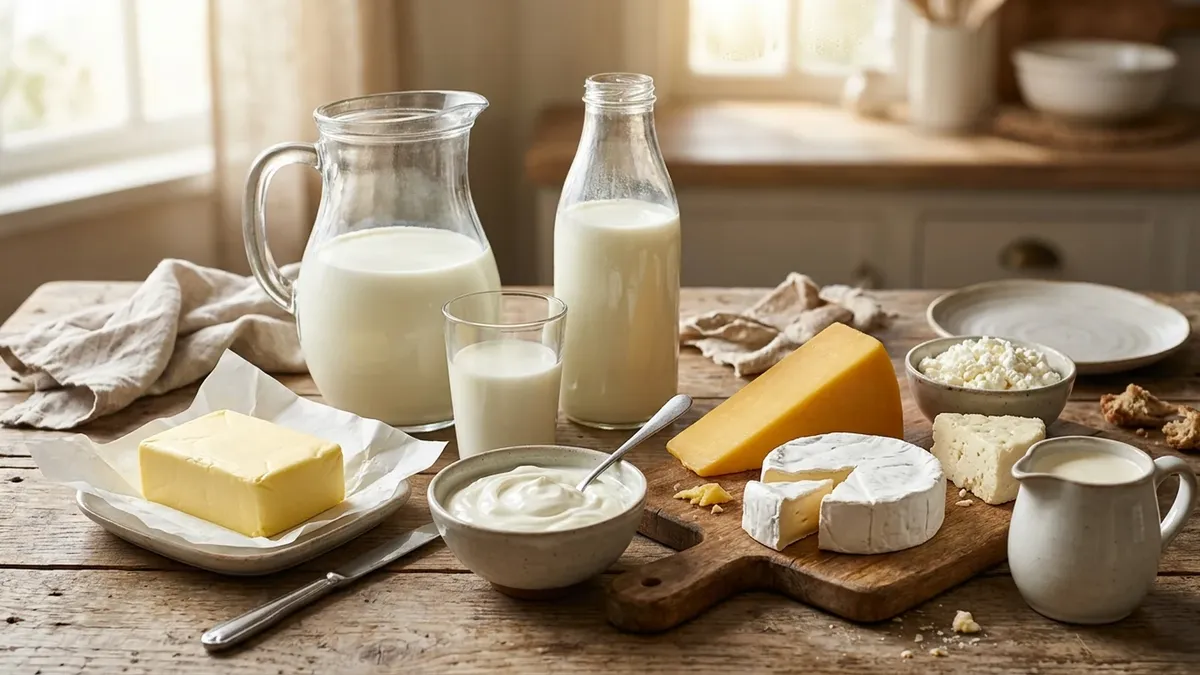
Illustrative image. Does not represent guaranteed results.
Key points
- If you grew up hearing that only skim is healthy, you didn't make that up. It was the official recommendation. The 2020-2025 edition of the US dietary guidelines asked, in those words, for "fat-free or low-fat milk, yogurt, and cheese".
- That changed in January 2026. The 2025-2030 edition tells adults to "include full-fat dairy with no added sugars", and keeps three daily dairy servings in a 2,000-calorie pattern.
- And it didn't change on a whim. Across 136,384 people in 21 countries followed about 9 years, more than two dairy servings a day was linked to 16% less of the combined outcome of death and major cardiovascular events —and 17% lower total mortality— compared with none at all.
- The cleanest data come from blood, not a questionnaire. In 63,682 people with 15,180 new cases of type 2 diabetes, the higher the dairy fat measured in blood, the lower the risk of developing it.
- When whole and reduced-fat were separated, they behaved the same. In 45,009 Italians followed nearly 15 years, whole and reduced-fat milk gave similar results to each other, and neither showed a clear relationship with mortality.
- Now the other half, which almost nobody mentions. The scientific committee that reviewed the evidence for this same edition recommended staying with low-fat dairy, and the departments that sign the guidelines did not adopt that recommendation. The change is a policy decision, not a verdict from the science.
- And one study points the other way: in 30,239 adults, more whole milk was linked to 56% higher cancer mortality. It's below, with its context.
- All the favourable evidence is observational. Linked to. Not causes. That distinction is the whole article.
- If you're losing weight, a different number rules: about 150 calories per cup versus about 80. No study cancels that.
In this article
- What is actually inside milk fat
- The January 2026 change, word for word
- 136,384 people in 21 countries
- The trick that fixed the questionnaire problem
- When whole and reduced-fat were separated
- What doesn't fit: the committee and the awkward study
- How to choose, concretely
- So your expectations are the right ones
- Who is this NOT for?
- Where this fits if you're losing weight
- Frequently asked questions
- Sources
What is actually inside milk fat
Let's start with something your body already does well, because it's the point that got lost along the way.
For forty years, "saturated fat" worked as a single word. A gram of saturated fat from a doughnut and a gram from a glass of milk counted the same, in the same box on the label. The logic was clean: saturated fat raises LDL cholesterol, high LDL is linked to heart attacks, so less saturated fat is better. By that arithmetic, whole milk lost.
The trouble is that your body doesn't eat boxes on a label. It eats food.
Milk fat is not a uniform block. It is more than four hundred different fatty acids, wrapped in a structure — the milk fat globule membrane — that decides how fast they are absorbed and what arrives alongside them. And that company matters: in a glass of milk, that fat comes with high-quality protein, calcium, phosphorus, potassium, magnesium and vitamin B12. Nutrition calls this the food matrix, and it is why the same fat, in two different foods, may not behave the same way.
Inside that mixture there are two fatty acids that arrive almost nowhere else: 15:0 and 17:0. Your body barely makes them. Keep them in mind, because further down they become the best tool we have for measuring this question properly.
The January 2026 change, word for word
The US dietary guidelines are published every five years, and they are the document that shapes school menus, federal nutrition programmes and much of what your doctor tells you. For decades their message on dairy was one thing only: choose it fat-free or low-fat.
The 2020-2025 edition put it this way, describing the healthy dietary pattern: "fat-free or low-fat milk, yogurt, and cheese".
The 2025-2030 edition, dated January 2026, puts it differently. For adults: "include full-fat dairy with no added sugars". For children: "full-fat dairy products are important for children to help meet energy needs and support brain development". And from twelve months of age, instead of infant formula, it recommends giving them whole milk.
Notice the condition travelling with the change, because that's the useful part: no added sugars. It doesn't say fat is good. It says the thing to watch in the dairy aisle moved. A flavoured low-fat yogurt can carry more sugar than a dessert; a plain whole-milk yogurt carries none. For years the "low-fat" label unintentionally gave that a pass.
That side effect is acknowledged in the guidelines' own scientific report, which notes that the emphasis on limiting saturated fat "may have inadvertently promoted the selection of highly processed foods". Taking the fat out of a food leaves a gap, and in industry that gap is nearly always filled with sugar, starch or thickeners.
136,384 people in 21 countries
The study that moved this conversation most is called PURE, and its value lies in who it looked at. Almost all nutrition research is done in the United States and western Europe. PURE followed 136,384 adults aged 35 to 70 in 21 countries across five continents, including low- and middle-income countries where dairy intake looks very different. Over a mean of 9.1 years it recorded 10,567 events: 6,796 deaths and 5,855 major cardiovascular events.
Comparing those taking more than two servings a day of dairy with those taking none:
| Outcome | Risk |
|---|---|
| Death or major cardiovascular event (composite) | 0.84 (0.75–0.94) |
| Total mortality | 0.83 (0.72–0.96) |
| Major cardiovascular disease | 0.78 (0.67–0.90) |
| Stroke | 0.66 (0.53–0.82) |
| Myocardial infarction | 0.89 (0.71–1.11) — not significant |
Translated: in that set of people, taking dairy was linked to 16% less of the composite outcome, 17% lower total mortality and 34% less stroke. And it's worth saying what did not show up: there was no significant difference in heart attack. Product by product, milk and yogurt were linked to lower risk; cheese did not reach significance, and butter didn't either — there, intake was low, so that result says "we don't know", not "it makes no difference".
This is a large, well-conducted observational study. That means it assigns nobody to drink milk: it observes what people already do. And people who take dairy daily across 21 different countries resemble each other in many other ways — purchasing power, access to fresh food, stability — that also protect. The authors adjusted for what they could measure. Nobody can adjust for what they didn't measure.
The trick that fixed the questionnaire problem
This is where the story gets genuinely interesting.
The weak point of almost all nutrition research is the questionnaire. Asking you how many glasses of milk you drank last year produces a poor answer, and not through any fault of yours: nobody remembers, and we all lean toward answering what we believe we ought to be doing. If the measuring instrument is blurry, so is the result.
That's where 15:0 and 17:0 come in. Because your body barely makes them and they arrive mostly with dairy fat, their level in your blood works like a receipt for what you ate. It doesn't depend on your memory.
Two large pieces of work used that receipt.
Type 2 diabetes: 63,682 people
Sixteen studies from twelve countries pooled their individual-level data and measured those markers in 63,682 people, with 15,180 new cases of type 2 diabetes over a mean of 9 years. The higher the dairy fat in blood, the lower the risk:
That adjustment for weight and waist matters, because it rules out the easiest explanation: it isn't simply that thinner people drink more milk. The association was somewhat stronger in women than in men.
Heart: 18 studies
The second piece measured 15:0 in 4,150 Swedish adults and followed them a median of 16.6 years, with 578 cardiovascular events and 676 deaths. More 15:0 was linked to lower cardiovascular risk, in a linear fashion: 0.75 per interquintile range. They then pooled their cohort with others to reach 18 studies: comparing the highest third with the lowest, cardiovascular risk was 12% lower with 15:0 and 14% lower with 17:0.
And now the caveat, which the authors themselves put up front: the third marker, trans-palmitoleic acid, was not associated with anything (1.01). Dairy fat markers were not associated with total mortality across the pooled studies. And their conclusion was that clinical and experimental studies are needed to establish whether these relationships are causal. In other words: the authors of the study most favourable to dairy fat ended by asking for more evidence, not by declaring victory.
When whole and reduced-fat were separated
One question remains that the studies above don't answer directly: whole or skim? For that you need a study that separated them.
EPIC-Italy did. It followed 45,009 people for a median of 14.9 years, recorded 2,468 deaths, and analysed total, full-fat and reduced-fat milk separately, along with yogurt, cheese, butter and dairy calcium.
The result has two parts, and both are useful. First: in the fully adjusted models no clear relationship appeared between milk consumption and mortality, and no dose-response. There was a 25% reduction in a middle band of intake, but not in the highest — which is exactly the pattern you expect from chance rather than from a real effect.
The second part is the one that matters for today's headline: the associations for full-fat and reduced-fat milk were similar to each other. It isn't that whole won. It's that they couldn't be told apart.
And that, at bottom, is the honest finding of this whole topic. The question "whole or skim?" was treated for forty years as though the answer were enormous. When it is finally measured carefully, the difference is small, and sometimes isn't found at all.
What doesn't fit: the committee and the awkward study
If we only told you the above, we'd be selling you something. Two things point the other way and both are solid.
The scientific committee recommended the opposite
Every edition of the dietary guidelines rests on an advisory committee that reviews the evidence and delivers recommendations. For this edition, that committee recommended keeping the emphasis on fat-free and low-fat dairy, and recommended fat-free and low-fat dairy from age 2.
The departments that sign the guidelines did not adopt either of those recommendations. They did partially adopt the one about giving whole milk to children from twelve months.
This matters and can't be dressed up: the January 2026 change is a policy decision that departed from the advice of the committee that reviewed the science. That the official guidance today says "full-fat" is a verifiable fact. That the science has settled the debate is not. The two sentences sound similar and mean very different things.
The study that points the other way
In the REGARDS study, with 30,239 US adults and 2,966 deaths, the highest-consuming fifth was compared with the lowest:
| Whole milk | Risk |
|---|---|
| Cancer mortality | 1.56 (1.17–2.08) |
| All-cause mortality | 1.13 (0.95–1.35) |
| Non-fat milk | Risk |
| All-cause mortality | 0.75 (0.61–0.93) |
56% higher cancer mortality with more whole milk, and lower total mortality with non-fat milk. That is exactly the opposite pattern to the studies above.
How do these hold together? Honestly: it is an observational study, in a single population, and cancer mortality was not its primary question. When you measure many things, some come out significant by chance. It does not match PURE or the blood markers, which are far larger bodies of evidence. But it exists, it is published in a peer-reviewed journal, and the direction is the reverse. Anyone who covers this topic without mentioning it is telling you the half that suits them.
The reasonable reading of the whole set isn't "whole is better". It is: the gap between whole and skim is far smaller than you were taught, and the field is not closed.
How to choose, concretely
None of this helps unless it reaches the fridge. Four practical rules:
- Added sugar outranks fat. It's the condition the guidance itself attached. Plain yogurt, unflavoured milk, cheese without sweet additives. A low-fat strawberry yogurt with 18 grams of sugar is a worse choice than plain whole-milk yogurt, under any version of this argument.
- Minimally processed, within each group. The guidelines' scientific report notes that some highly processed dairy products were associated with higher all-cause mortality, which is where the advice to choose the least processed option within each food group comes from. Real milk, yogurt and cheese — not dairy desserts.
- Count calories where they count. A cup of whole milk carries about 150 calories; skim, about 80. At three servings a day, choosing whole adds more than 200 calories daily. If you're losing weight, that arithmetic outweighs every nuance above.
- Prioritise the protein. Whole or skim, the dairy protein is the same and it is among the best you'll find. If you're protecting muscle — and after 40 you should be — that's the main reason for dairy to be on your plate.
Yogurt deserves its own paragraph. It was the product that performed best in PURE, and it's also the one most people tolerate when milk doesn't sit well. If you had to pick a single dairy food to add to your day, plain unsweetened yogurt is the bet with the most evidence behind it.
So your expectations are the right ones
Three sentences to take with you, no fine print:
- What the evidence supports is permission, not a prescription. If you like whole milk and it fits your calories, the large human studies give no strong reason to avoid it. That is different from saying you should switch to whole: nobody has shown that.
- All the favourable evidence is observational. Linked to. There is no long trial that assigned thousands of people to whole or skim milk and counted heart attacks years later. Until one exists, this remains a consistent signal, not proof.
- And the effect, if real, is modest. We're talking about a 16-17% difference in relative risk in an observational study, not a transformation. Strength, sleep, body weight and not smoking are still playing in another league.
Put in scale, this is a quiet piece of good news. It isn't that you've found a miracle food. It's that a prohibition you carried for years, and that probably made you feel guilty at the table, was considerably weaker than it looked. That counts: one less rule to police is energy you can spend on what actually moves the needle.
Who is this NOT for?
Milk is a food, not a medicine, but it isn't neutral for everyone.
- If your LDL cholesterol is high or you have established cardiovascular disease. This is the most important item on the list. The historical concern with dairy fat was LDL, and the studies above don't measure your LDL: they measure populations. If your doctor asked you to lower saturated fat, that advice is for your case and a general article doesn't replace it. Talk to them before changing anything.
- If you take statins or are being treated for your heart. Same criterion. Your plan is yours and it's already tuned to your numbers.
- If you're lactose intolerant. There's no reason to feel unwell: lactose-free milk exists, fermented yogurt is tolerated better, and aged cheeses contain very little lactose. And if dairy doesn't agree with you, it isn't mandatory.
- If you're allergic to milk protein. That's not the same as intolerance, and here there are no nuances: it's avoided.
- If you're tracking calories closely. The 70-calorie difference per cup is real and it accumulates. "Whole isn't bad any more" does not mean "whole has no calories".
- Children. The guidance recommends whole milk from twelve months, but a child's diet is decided by their pediatrician, who knows their growth and their case. Not by a general guideline, and not by this article.
- Butter and cream are not part of this conversation. In PURE, butter intake was low and not significantly associated with outcomes, which means we don't know. They are close to pure fat, without the protein and calcium of the rest of the dairy group.
- And none of this applies to dairy desserts. Ice cream and plain whole-milk yogurt are not the same food, even though both come from a cow.
Where this fits if you're losing weight
To be clear: whole milk is not a weight-loss treatment, and none of the evidence above measured that. The real overlap is elsewhere, and it is useful.
When someone starts a weight plan with a GLP-1 medication, two things happen at once: they eat considerably less, and they risk losing muscle along with fat. In that situation every bite has to work. Dairy is one of the easiest and cheapest ways to get high-quality protein and calcium into a day with little appetite, and plain yogurt often goes down when other meals won't.
The choice between whole and skim there is about calories, not the heart. With appetite reduced, many people do well choosing the version that lets them reach their protein target without spending the calorie budget. What matters is that the dairy is there, not its fat percentage.
And what genuinely shares ground with your long-term health is body weight itself: when there is excess, bringing it down moves blood pressure, blood sugar and the liver considerably more than any food on this list.
SCTS1 offers GLP-1 programs with FDA-approved medications (Wegovy®, Foundayo™, Ozempic®) from $149 a month, by telemedicine, in Spanish and English. The journey is this: you pay and start your program first; then a licensed physician reviews your case —habits, stress, sleep and medical history— and orders labs only if they consider it necessary. There is no free evaluation.
Eligibility is determined by medical evaluation. Results vary from person to person.
Frequently asked questions
So can I go back to whole milk?
If you enjoy it and it fits your calories, the human evidence gives no strong reason to avoid it, and the official US guidance from January 2026 now includes it. What that evidence does not say is that whole is better than skim for your health. It says something quieter: the gap between the two is far smaller than you were taught, and what matters most is that the dairy comes without added sugar.
Why did the guidance change if the science didn't change overnight?
Here we have to be honest. The scientific advisory committee that reviewed the evidence for this edition recommended keeping the emphasis on fat-free and low-fat dairy. The departments that sign the guidelines did not adopt that recommendation. So the change is a policy decision that departed from the advice of its own committee. That the guidance now says "full-fat" is a fact; that the science has settled the question is not.
Doesn't milk fat raise cholesterol?
That was exactly the original concern, and it is why the low-fat recommendation existed for decades. What has changed is that when you follow people for years and count deaths and heart attacks instead of only cholesterol, whole-fat dairy does not show up as the villain that logic predicted. Both things can be true at once, which is why this remains an open question. If your cholesterol is high or you already take statins, have this conversation with your doctor, not with an article.
What does measuring dairy fat in the blood mean?
It is the trick that fixed the biggest problem in these studies. Asking someone how much milk they drank last year produces poor answers: people don't remember, and they tend to say what they think they should. Two fatty acids, 15:0 and 17:0, are barely made by your body and arrive mostly with dairy fat, so their level in blood works like a receipt. Measuring them is far more reliable than a questionnaire. Their limit: they tell you how much dairy fat you ate, but not whether it came from milk, cheese or yogurt.
Whole or skim if I'm losing weight?
Here the answer is about calories, not the heart. A cup of whole milk carries roughly 150 calories; the same cup of skim, about 80. At three servings a day that is more than 200 calories of difference, and that does move the scale. Nothing you read above cancels that arithmetic. Choose whichever lets you hit your protein target without overspending calories, and remember that plain milk and yogurt with no added sugar work in your favour in both versions.
Is there any evidence pointing the other way?
Yes, and we are not going to hide it. In a study of 30,239 US adults, those who drank the most whole milk had higher cancer mortality: 56% higher in the top fifth versus the bottom. In the same study, non-fat milk was linked to lower all-cause mortality. It is a single observational study, it does not prove cause, and it does not match what the larger studies above found. But it exists, it is published, and anyone who covers this topic without mentioning it is telling you half the story.
Does this apply to children?
The January 2026 guidance says to give whole milk from 12 months of age, and that full-fat dairy products are important for children to help meet energy needs and support brain development. That said, your child's diet is decided by their pediatrician, who knows their case, not by an article or a general guideline.
What if I'm lactose intolerant?
None of this is a reason to feel unwell. Lactose intolerance is very common, and lactose-free milk exists, fermented yogurt is tolerated better by many people, and aged cheeses contain very little lactose. If dairy doesn't sit well with you, dairy is not mandatory: protein and calcium are available by other routes.
Does this mean butter is fine too?
It can't be stretched that far. In the 21-country study butter intake was low and was not significantly associated with outcomes: that is a "we don't know", not a "yes". Milk, yogurt and cheese are foods; butter is close to pure fat, without the protein and calcium that come with the rest. They are not in the same conversation.
Sources
- Dehghan M, Mente A, Rangarajan S, et al. Association of dairy intake with cardiovascular disease and mortality in 21 countries from five continents (PURE): a prospective cohort study. Lancet. 2018;392(10161):2288-2297. — DOI
- Imamura F, Fretts A, Marklund M, et al. Fatty acid biomarkers of dairy fat consumption and incidence of type 2 diabetes: a pooled analysis of prospective cohort studies. PLoS Med. 2018;15(10):e1002670. — DOI
- Trieu K, Bhat S, Dai Z, et al. Biomarkers of dairy fat intake, incident cardiovascular disease, and all-cause mortality: a cohort study, systematic review, and meta-analysis. PLoS Med. 2021;18(9):e1003763. — DOI
- Pala V, Sieri S, Chiodini P, et al. Associations of dairy product consumption with mortality in the European Prospective Investigation into Cancer and Nutrition (EPIC)-Italy cohort. Am J Clin Nutr. 2019;110(5):1220-1230. — DOI
- Um CY, Judd SE, Flanders WD, et al. Associations of calcium and dairy products with all-cause and cause-specific mortality in the REasons for Geographic and Racial Differences in Stroke (REGARDS) prospective cohort study. Nutr Cancer. 2017;69(8):1185-1195. — DOI
- U.S. Departments of Agriculture and Health and Human Services. Dietary Guidelines for Americans, 2025-2030. January 2026. — Official document (PDF)
- U.S. Departments of Agriculture and Health and Human Services. The Scientific Foundation for the Dietary Guidelines for Americans — includes the advisory committee recommendations that were not adopted. — Scientific report (PDF)
- U.S. Departments of Agriculture and Health and Human Services. Dietary Guidelines for Americans, 2020-2025 — the edition that recommended "fat-free or low-fat milk, yogurt, and cheese". — dietaryguidelines.gov
Related articles
Your trust is worth more than a sale.
This article is informational and is not medical advice. SCTS1 does not prescribe or dispense medications. All medical care, prescriptions and treatment plans are provided by licensed physicians through our partner platforms. Eligibility for treatment is determined by a licensed provider through medical evaluation. Milk is a food, not a treatment: it is not intended to diagnose, treat, cure or prevent any disease. All the favourable evidence cited here is observational and shows association, not causation; there is no long-term randomized trial comparing whole with skim milk measuring heart attacks or deaths. The scientific advisory committee for the 2025-2030 dietary guidelines recommended keeping the emphasis on fat-free and low-fat dairy, and that recommendation was not adopted by the departments that sign the guidelines. A prospective study in 30,239 adults found higher cancer mortality associated with whole milk consumption. If you have high LDL cholesterol, cardiovascular disease, milk protein allergy, or take heart or cholesterol medications, consult your physician before changing your dairy intake, and never replace a prescribed treatment with a food. A child's diet is determined by their pediatrician. Results vary from person to person.