Which labs should I ask for? The numbers that tell you how you're aging
¿Qué laboratorios debo pedir?
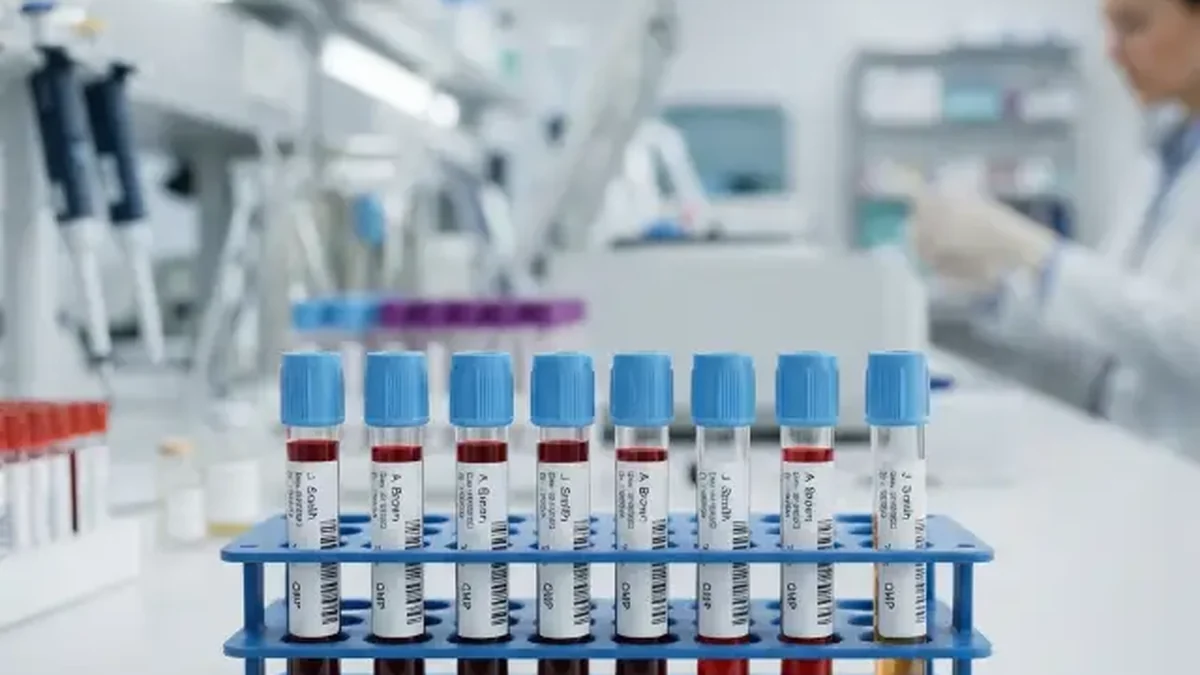
Illustrative image. Does not represent guaranteed results.
Here is something your body already does well: it keeps score. Every day leaves a trace in your blood — how much sugar is circulating, how many cholesterol particles are in play, how well your kidneys are filtering, whether there is low-grade inflammation running in the background. That trace can be read. It does not take an exotic or expensive test. Most of those numbers sit in basic panels that have existed for decades.
And there is a second piece of good news, which is the one that actually matters: almost everything that moves those numbers is in things you can do. Eat more fiber. Lift something heavy twice a week. Sleep. That is not generic encouragement — there are trials with concrete figures, and they are listed below with their links.
This article is the list. Each test, what it measures, in plain language, with a link to its official page at MedlinePlus — the public library of the U.S. National Library of Medicine — and, where a large study sits behind a number, with the DOI so you can open it yourself.
One thing to say up front: labs do not diagnose on their own. A number outside the reference range, without clinical context, is not a diagnosis — and a number inside the range does not rule a problem out. Who decides which tests make sense in your case is a physician, not an article.
Key points
- A comprehensive metabolic panel (CMP) checks glucose, electrolytes, kidney function and liver function from a single sample.
- Hemoglobin A1c reflects your average glucose over the past two to three months, not this morning's.
- A complete blood count (CBC) evaluates red cells, white cells and platelets — anemia is a common cause of fatigue.
- The lipid panel is the foundation of cardiovascular risk assessment. ApoB goes one step further: it counts how many particles there are, not how much cholesterol they carry.
- Lp(a) is largely genetic, barely changes across your whole life, and — where it is indicated — is measured once.
- Kidney function takes two cheap tests: filtration (eGFR) in blood, and albumin in urine. The second is rarely ordered and has no threshold — risk rises continuously.
- TSH is the usual first thyroid test, and the thyroid mimics many symptoms people put down to age.
- A single value says little. A trend says far more than a point.
In this article
- Why these numbers and not others
- The four that are almost always worth it
- One step beyond lipids: apoB and Lp(a)
- The inflammation you cannot feel
- Kidney and liver: two organs that warn you late
- Thyroid: the one that most often changes the conversation
- The ones that depend on your case
- What actually moves these numbers
- How to read a result without panicking
- So your expectations are the right ones
- Who is this NOT for?
Why these numbers and not others
Aging is not a total mystery. A handful of processes explain much of how a body wears down over the years: how it handles sugar, how many cholesterol particles stick to its arteries, how much background inflammation it carries, how well the kidneys filter, and how much muscle reserve is left. We cover the whole picture in what longevity really means.
What is interesting is that nearly all of those processes leave a measurable trace, and nearly all of those traces sit in routine tests. Not in a 90-marker panel. In four or five tests that cost very little.
That is why this list is short. Not because information is missing, but because the numbers that actually change a decision are few. The rest, in most cases, is noise that frightens without adding anything.
The four that are almost always worth it
Comprehensive metabolic panel (CMP)
A group of tests from a single sample: glucose, calcium, electrolytes such as sodium and potassium, markers of kidney function and liver enzymes. It gives a broad view of general function for very little money. If you could only do one thing, this covers more ground than anything else.
Hemoglobin A1c
It reflects average blood glucose over the past two to three months. That makes it more useful than an isolated glucose reading, which only tells you what happened that morning and depends on whether you had breakfast.
There is a figure here worth knowing, and it is among the best documented that exists. In a meta-analysis published in the BMJ that pooled 53 prospective studies and 1,611,339 people, with a median follow-up of 9.5 years, cardiovascular risk was already rising before the diabetes threshold. With an A1c in the prediabetes range (5.7–6.4%), cardiovascular disease risk was 21% higher and coronary heart disease risk 15% higher than with a normal A1c.
Two honest caveats, because this figure is often misquoted. First: in that same analysis, that A1c band was not associated with higher all-cause mortality or more stroke — only with the cardiovascular and coronary outcomes. Second: these are relative risks in large populations, not a prediction about you. What the finding does say, and this is the point, is that prediabetes is not "almost nothing": it is a stage where moving still works. And prediabetes responds well to habit change. That is covered in insulin resistance.
Complete blood count (CBC)
It evaluates red cells, white cells and platelets. Anemia — a very common cause of fatigue, especially in women — shows up here. It is one of the tests where a finding changes the plan immediately, which is why it almost always goes in.
Lipid panel
Total cholesterol, LDL, HDL and triglycerides. It is the foundation of cardiovascular risk assessment and it sits in any basic panel. It works, and it is right that it is the starting point. But it is not the end of the story, and the next section explains why.
One step beyond lipids: apoB and Lp(a)
ApoB: how many particles, not how much cholesterol
The LDL figure on your panel measures how much cholesterol is inside the particles. Apolipoprotein B measures how many particles there are, because each one carries exactly one apoB molecule. These are different things, and sometimes they disagree: you can have a reassuring LDL spread across many small particles.
When the two measures disagree, the one that tracks risk is apoB. In a study of 9,191 patients with coronary artery disease already on statins, followed for a median of five years, those with high apoB and low LDL had 40% more heart attacks (HR 1.40; 95% CI 1.04–1.88). And the reverse — high LDL with low apoB — was not associated with more heart attacks. The particle count beat the cholesterol content.
In healthy populations the pattern points the same way. The ATTICA study followed 3,042 adults free of cardiovascular disease for 20 years: elevated apoB predicted 20-year risk beyond what non-HDL cholesterol and Lp(a) explained. The authors summarize it by saying what counts is the number of apoB-containing particles, not the cholesterol they carry.
What this does not mean: that your lipid panel is useless, or that you need apoB. In most people LDL and apoB tell the same story, and the basic panel is enough. ApoB helps when there is genuine doubt — intermediate risk, high triglycerides, a family history that does not match apparently normal lipids. It is a test for refining, not for replacing. And whether it adds anything in your case is your physician's call.
Lp(a): measured once, and done
Lipoprotein(a) is a particle similar to LDL but with an extra protein that makes it stickier and more prone to clotting. It has three features that make it unlike anything else on this list, according to the consensus statement of the Nouvelle Société Francophone d'Athérosclérose:
- Its level is determined mostly by genes. Diet does not move it.
- It stays essentially constant for life. The value you have at 30 is very close to the one you will have at 60.
- Between one person and another it can vary up to a thousandfold. This is not a marker that drifts slightly: either yours is high or it is not.
Hence the most convenient practical consequence on this entire list: measuring it once is enough. And hence its limit too — the consensus does not recommend measuring it in everyone, but in specific situations: high cardiovascular risk with premature coronary disease, familial hypercholesterolemia, a family history of coronary heart disease, or coronary disease that recurs despite treatment. If none of those describe you, it probably changes nothing in your plan.
If any of that sounds like your family, it is exactly the kind of thing worth raising at a visit.
The inflammation you cannot feel: high-sensitivity CRP
C-reactive protein rises when there is inflammation. The "high-sensitivity" version (hs-CRP) detects the low, chronic inflammation that produces no symptoms — the background kind associated with aging worse, which we cover in chronic inflammation and longevity.
The evidence base is large. The Emerging Risk Factors Collaboration pooled individual records from 160,309 people with no prior vascular disease, across 54 prospective studies, with 1.31 million person-years of follow-up. For each one-standard-deviation rise in log CRP — that is, a threefold higher value — coronary heart disease risk was 63% higher adjusting for age and sex alone.
And here is the part almost nobody quotes, which is the part that saves you money: after adjusting for the usual risk factors — blood pressure, cholesterol, smoking, diabetes — that 63% fell to 37%. After further adjusting for fibrinogen, to 23%. The authors themselves conclude that the association with vascular disease "depends considerably on conventional risk factors."
Translated: CRP adds something, but considerably less than it appears once you already know your blood pressure, your cholesterol and your blood sugar. It is a useful marker in the hands of a physician using it to decide something specific. It is not a number to monitor for sport. And it rises with any passing infection, so a single high value after a recent cold means nothing.
Kidney and liver: two organs that warn you late
The kidney is two tests, and usually only one gets ordered
Kidney function is measured two different, complementary ways. The first is estimated glomerular filtration rate (eGFR), calculated from blood creatinine, already included in your CMP. The second is albumin in urine, usually as an albumin-to-creatinine ratio (ACR): it measures whether the kidney is leaking protein. It is a urine test, it is cheap, and it is the one that almost never gets ordered.
The collaborative meta-analysis from the Chronic Kidney Disease Prognosis Consortium, published in The Lancet, pooled 105,872 participants with measured ACR across 14 studies and 1,128,310 with dipstick measurements across another seven. Two findings change how a report should be read:
- eGFR has a flat zone. Between 75 and 105 mL/min/1.73 m² mortality risk does not change. It starts rising below that: compared with an eGFR of 95, risk was 18% higher at 60, 57% higher at 45 and more than threefold at 15. Which means an eGFR of 80 is not "nearly bad" — it is in the flat zone.
- Urine albumin has no threshold. Risk rises continuously from values many reports flag as normal. Compared with an ACR of 0.6 mg/mmol, mortality risk was 20% higher at 1.1, 63% higher at 3.4 and more than double at 33.9.
The two tests multiply each other: they add information independently. Which is why ordering creatinine alone leaves half the picture out. If you are going to order one urine test in your life, this is the one with the best return per dollar.
The liver: you already have ALT
Liver enzymes come in the CMP, so there is nothing extra to order. The most informative one in this context is ALT, which when persistently somewhat elevated usually points to fat in the liver — not to serious liver disease. It is a common finding, closely tied to insulin resistance, and among the most reversible things there is. We cover it separately in fatty liver.
Thyroid: the one that most often changes the conversation
TSH is the usual first test of thyroid function. It earns its own section for a practical reason: the symptoms of a thyroid that is not working well — fatigue, weight changes, feeling cold, hair loss, low mood, constipation — look a great deal like what people attribute to sex hormones, or simply to getting older.
It is a cheap test that redirects the problem often. That is why we keep insisting on it: of this whole list, it is the one that most often turns "I think it's just my age" into something with a name and a treatment. NIDDK, part of the National Institutes of Health, publishes clear material on which thyroid tests exist and how they are interpreted. It is linked below. There is more context in thyroid and weight.
The ones that depend on your case
These are no longer universal. They are ordered based on symptoms, age, sex and history, and the physician decides:
- Male hormone panel — total and free testosterone, SHBG, estradiol. We cover it in men's hormonal health.
- Female hormone panel — FSH, estradiol and others, depending on the stage. Context in progesterone in perimenopause.
- Vitamin D — frequently low, even in Florida.
- Vitamin B12 and ferritin — relevant when the reason for the visit is fatigue.
- Hormone safety — PSA and hematocrit, if testosterone therapy is being considered.
- ApoB, Lp(a) or high-sensitivity CRP — when cardiovascular risk lands in an intermediate zone and needs refining.
What actually moves these numbers
This is the section that really matters, and the reason measuring makes sense at all: nearly everything above responds to things within your reach. Not an exotic supplement. Fiber, strength and sleep.
The most concrete figure that exists is the one for fiber. A systematic review with meta-analyses published in PLOS Medicine pooled 42 controlled trials with 1,789 adults with prediabetes or diabetes, plus two cohorts of 8,300 adults followed for a mean of 8.8 years. Raising fiber lowered:
- hemoglobin A1c by 2.00 mmol/mol (33 trials),
- fasting glucose by 0.56 mmol/L (34 trials),
- LDL cholesterol by 0.17 mmol/L (21 trials),
- and C-reactive protein, markedly, across the 7 trials that measured it.
And in the cohorts: eating 35 g of fiber a day instead of 19 g was associated with 14 fewer deaths per 1,000 people (95% CI 4–19) over the follow-up, with a clear dose-response relationship. The authors propose raising intake by 15 g a day, or reaching 35 g, as a reasonable target.
Two caveats: those trials were done in people who already had prediabetes or diabetes, so the effect in someone with normal glucose is not necessarily the same; and the change in each individual marker is modest taken one at a time. What is not modest is that a single lever — food — moves four markers at once, all in the same direction.
The rest of the toolkit has its own article, and they all point at the same numbers:
- Protein and muscle and strength training — for glucose and for muscle reserve.
- VO2 max and longevity — for aerobic capacity.
- Sleep — because sleeping badly worsens the following week's glucose.
- Stress and cortisol — the factor most often ignored.
How to read a result without panicking
Three ideas that save a lot of anxiety.
"Out of range" does not mean "sick"
Reference ranges describe most of a reference population, not you. A value slightly outside may have no clinical relevance at all. And in a panel with twenty markers, the probability that at least one falls outside by pure chance is high. That is not a signal — it is statistics.
"In range" does not close the case either
If you have symptoms and the numbers come back normal, the correct response is to keep looking for the cause — not to force a treatment. This matters: some clinics use the opposite argument, "normal but not optimal," to justify treating people with normal labs. We do not work that way.
A trend says more than a point
Two measurements separated in time are more informative than one. Almost all of these markers vary from day to day, and some — CRP, triglycerides — vary a lot. A value that surprises you almost always deserves repeating before any decision is made. Which is why it is worth keeping your results: a lab's value grows with the number of years you have been measuring it.
So your expectations are the right ones
Measuring is information, not treatment. Four things worth being clear about from the start:
- No panel tells you which treatment you need. It gives you data. The decision is clinical and depends on your symptoms and your history, not on numbers alone.
- Study figures are population averages. A 21% higher relative risk across 1.6 million people is not a prediction about your life.
- More tests is not better. A huge panel generates incidental findings that frighten, lead to more tests, and rarely change anything.
- Habit changes take time. A1c moves over two to three months because that is what it measures. Repeating it after three weeks makes no sense.
That said: within what medicine can offer today, this group of tests is among the cheapest and best studied there is. And what moves them is, to a large extent, in your hands.
Who is this NOT for?
If you have acute symptoms — chest pain, difficulty breathing, severe abdominal pain — this is not the place. That is immediate medical care, not a lab panel.
If you expect a panel to tell you exactly which treatment you need, it does not work that way. Labs are an input of information. Interpretation is clinical.
If your plan is to order a panel and interpret it yourself online, you will either frighten yourself for no reason or reassure yourself for no reason. Both are worse than not measuring.
If you are pregnant, have known kidney or liver disease, or are in cancer treatment, the ranges and priorities in this article are not yours — your medical team already has a different plan, and that is the one that counts.
And if what you are looking for is a number to justify starting a treatment you have already decided on, the honest thing is to say it: that is not what these tests are for.
GLP-1 programs with medical oversight
At SCTS1 we run GLP-1 weight-management programs with FDA-approved medications (Wegovy®, Foundayo™, Ozempic®) from $149 a month, by telemedicine, in Spanish and English. Eligibility is determined by medical evaluation.
How it works, in the real order: once you start your program, a licensed physician reviews your case — habits, stress, sleep and medical history — and orders labs only if they consider it necessary. Not everyone needs them, and they are not an automatic requirement. When they are ordered, they go through Quest or Labcorp and are reviewed with you. Sometimes the answer is that no treatment is needed at all, and that answer is worth as much as a prescription.
Individual results vary and are not guaranteed.
Frequently asked questions
Do I need to fast?
It depends on the test. Lipid panels and glucose are often ordered fasting; A1c does not require it, and apoB does not strictly either. You will be told when the panel is ordered.
How often should I repeat them?
It depends on your age, your history and whether any treatment is under way. There is no single frequency for everyone, and your physician determines it. Two useful anchors: A1c reflects two to three months, so repeating it sooner adds nothing; and Lp(a), where indicated, is measured once because it does not change.
What if everything comes back normal?
That is a good result, and it is also useful information. If you have symptoms with normal labs, the right move is to keep looking for the cause — sleep, stress, mood, food — rather than starting a treatment without an indication.
Can I order labs without seeing a physician?
In many cases a physician's order is required. In our programs, a licensed physician orders them when they consider it clinically necessary, after reviewing your case.
What does "normal but not optimal" mean?
It is an argument sometimes used to justify treating people whose labs are within range. We do not use it. If your numbers are normal and you have symptoms, the honest answer is to look for the cause elsewhere.
Is a 100-marker panel worth paying for?
Generally, no. Almost all of the yield is in the four or five tests in this article. A huge panel mostly adds incidental findings: odd numbers that mean nothing, that frighten, and that lead to more tests. More data is not more clarity.
Should I ask for apoB if my LDL is fine?
Possibly, and that is exactly the case where it adds something: when LDL is reassuring but other signals are not — high triglycerides, low HDL, a family history — apoB sometimes tells a different story. In most people with a clean profile and no family history, it changes nothing. It is a question for your physician, not a purchase.
What's the catch?
That a full panel can generate incidental findings that frighten and mean nothing. And that a single odd value is almost always read as worse than it is. Which is why results get reviewed with a professional, not in a search engine.
Do these labs measure "biological age"?
No, and it is worth saying plainly. These markers measure specific processes — sugar, particles, filtration, inflammation — that are associated with disease in large studies. Tests sold as "biological age" or "epigenetic age" are a different thing, and today they do not have enough evidence to guide a medical decision.
Do you offer care in Spanish?
Yes. All of our content and our care are available in Spanish and English.
Sources
- Comprehensive Metabolic Panel (CMP). — MedlinePlus · U.S. National Library of Medicine
- Hemoglobin A1C (HbA1c) Test. — MedlinePlus · U.S. National Library of Medicine
- Complete Blood Count (CBC). — MedlinePlus · U.S. National Library of Medicine
- Cholesterol Levels. — MedlinePlus · U.S. National Library of Medicine
- TSH (Thyroid Stimulating Hormone) Test. — MedlinePlus · U.S. National Library of Medicine
- Thyroid Tests. — NIDDK · National Institutes of Health
- Albumin in Urine. — MedlinePlus · U.S. National Library of Medicine
- Huang Y, Cai X, Mai W, Li M, Hu Y. Association between prediabetes and risk of cardiovascular disease and all cause mortality: systematic review and meta-analysis. BMJ. 2016;355:i5953. — DOI · via PubMed
- Li TY, Zhu P, Song Y, et al. Discordance analysis for apolipoprotein and lipid measures for predicting myocardial infarction in statin-treated patients with coronary artery disease: a cohort study. J Geriatr Cardiol. 2023;20(12):845-854. — DOI · via PubMed
- Giannakopoulou SP, Antonopoulou S, Barkas F, et al. Concordance-discordance between apolipoprotein B and lipid biomarkers in predicting 20-year atherosclerotic cardiovascular disease risk: The ATTICA study (2002-2022). Eur J Clin Invest. 2025;55(10):e70077. — DOI · via PubMed
- Durlach V, Bonnefont-Rousselot D, Boccara F, et al. Lipoprotein(a): Pathophysiology, measurement, indication and treatment in cardiovascular disease. A consensus statement from the Nouvelle Société Francophone d'Athérosclérose (NSFA). Arch Cardiovasc Dis. 2021;114(12):828-847. — DOI · via PubMed
- Emerging Risk Factors Collaboration; Kaptoge S, Di Angelantonio E, Lowe G, et al. C-reactive protein concentration and risk of coronary heart disease, stroke, and mortality: an individual participant meta-analysis. Lancet. 2010;375(9709):132-140. — DOI · via PubMed
- Chronic Kidney Disease Prognosis Consortium; Matsushita K, van der Velde M, Astor BC, et al. Association of estimated glomerular filtration rate and albuminuria with all-cause and cardiovascular mortality in general population cohorts: a collaborative meta-analysis. Lancet. 2010;375(9731):2073-2081. — DOI · via PubMed
- Reynolds AN, Akerman AP, Mann J. Dietary fibre and whole grains in diabetes management: Systematic review and meta-analyses. PLoS Med. 2020;17(3):e1003053. — DOI · via PubMed
The risk figures cited are relative risks from population studies and are not a forecast of your individual result. Units for A1c, glucose, cholesterol and albumin are given as the original studies published them; your lab report may use different units.
Related articles
Your trust is worth more than a sale.
This article is informational and is not medical advice. SCTS1 does not prescribe medications. All medical care, prescriptions and treatment plans are provided by licensed physicians through our partner platform, and compounded preparations are dispensed by licensed pharmacies. Eligibility is determined by a licensed provider through medical evaluation. The risk figures cited come from studies in specific populations and are averages, not a forecast for your case. No laboratory test diagnoses on its own, and no value in this article should be used to start, change or stop a treatment on your own. If you have kidney or liver disease, are pregnant, or are in cancer treatment, the priorities described here do not apply to your case. Compounded medications contain the same class of active ingredient but are not FDA-approved finished pharmaceutical products. Individual results vary and are not guaranteed.