The Wegovy pill vs Zepbound: what each one is, and who decides
La pastilla de Wegovy vs Zepbound: qué es cada una y quién decide
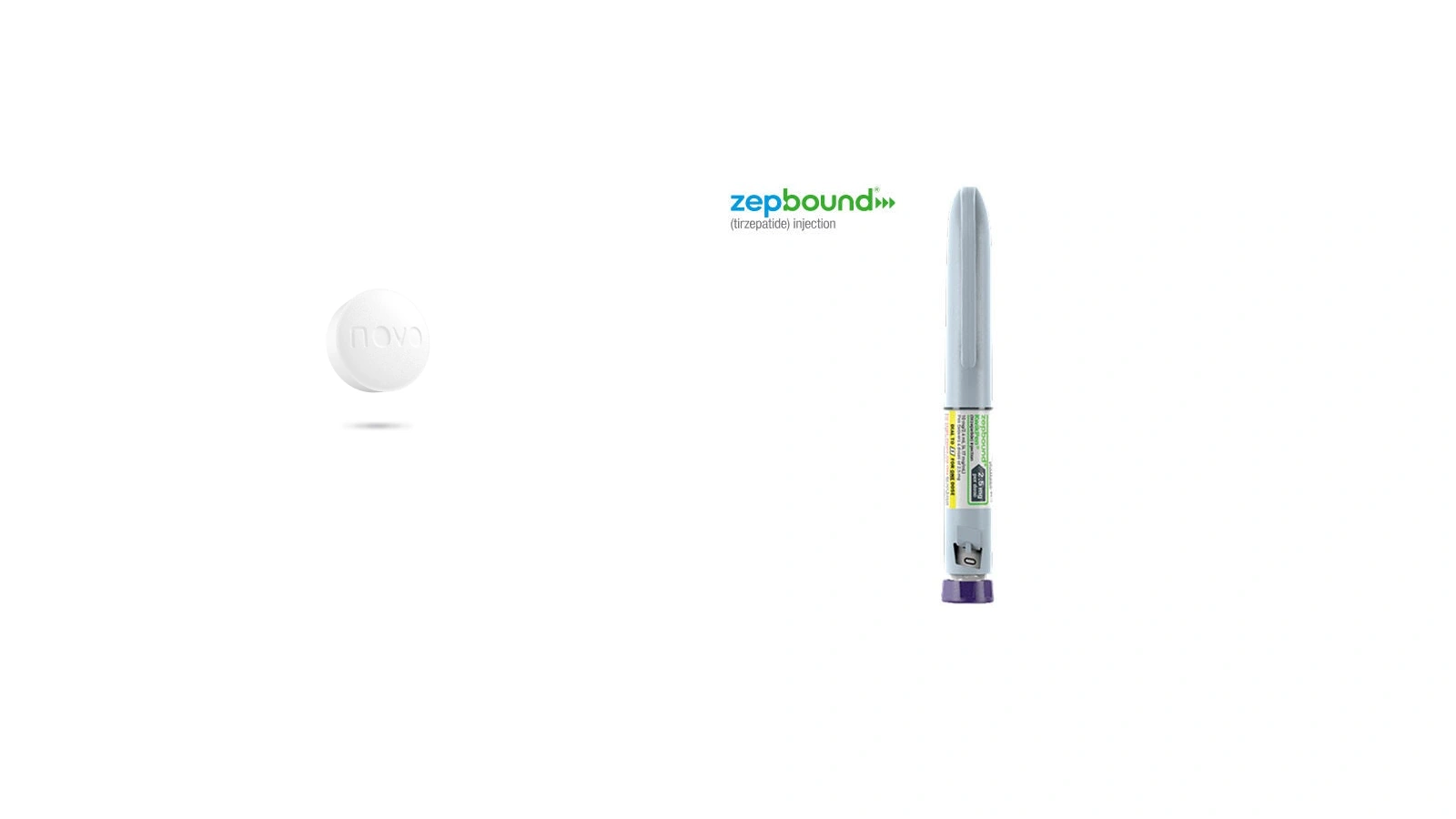
Illustrative image. Does not represent guaranteed results.
Key points
- Four brands, two molecules. Ozempic and Wegovy are semaglutide. Mounjaro and Zepbound are tirzepatide. What changes between the brands in a pair is the approved use, not the active ingredient.
- The Wegovy pill is oral semaglutide, 25 mg once a day. It is the first pill in this family that the FDA approved for weight management.
- Zepbound is tirzepatide, injected once a week.
- In its trial, the pill produced −13.6% body weight at week 64, against −2.2% on placebo.
- In the one head-to-head trial between the two molecules —injection versus injection, 72 weeks— tirzepatide gave −20.2% and semaglutide −13.7%.
- No trial has compared the pill against Zepbound directly. Putting those two numbers side by side means comparing across separate studies, which is not the same thing.
- In routine care at 6 months the gap between the molecules was smaller: about 2.3 percentage points.
- Zepbound has something the pill does not: FDA approval for moderate-to-severe obstructive sleep apnea in adults with obesity.
- Yes, you can get the brands through us. A licensed provider at Scientists One Health (SOH) writes the prescription and the manufacturer's own pharmacy sells and ships it to you — NovoCare® for Wegovy® and Ozempic®, LillyDirect® for Zepbound® and Mounjaro®. A compounded route through Altro Health also exists, from $88.99/month, which is a different regulatory category.
In this article
- Four brands, two molecules
- What the Wegovy pill is
- What Zepbound is
- What each trial actually measured
- In real life the gap is smaller
- The difference almost nobody mentions
- Which one is better?
- The two ways to get it through SCTS1
- Setting the right expectations
- Who is this NOT for?
- How it works at SCTS1
- GLP-1 programs: brand-name or compounded
- Frequently asked questions
- Sources
Four brands, two molecules
There is one confusion that comes up in almost every appointment, and it is nobody's fault: brand names hide what is actually inside.
Here is what it is:
| Brand | Molecule | How it is taken |
|---|---|---|
| Ozempic | Semaglutide | Weekly injection |
| Wegovy (injection) | Semaglutide | Weekly injection |
| Wegovy (pill) | Semaglutide | Daily pill |
| Mounjaro | Tirzepatide | Weekly injection |
| Zepbound | Tirzepatide | Weekly injection |
Ozempic and Wegovy carry the same molecule. So do Mounjaro and Zepbound. What differs inside each pair is what the FDA approved it for and the dose range: Ozempic and Mounjaro are approved for type 2 diabetes, Wegovy and Zepbound for weight management.
That is why one person can say "my doctor started me on Zepbound" and another "my doctor started me on Mounjaro" and both be on tirzepatide. It is not a marketing trick — they are separate approval labels for the same molecule.
If you want the two molecules compared against each other in detail, we have that here: semaglutide vs tirzepatide.
What the Wegovy pill is
It is semaglutide — the same molecule as the Wegovy injection — formulated to be swallowed. The FDA approved it as the first pill in this family for weight management in adults with obesity, or with overweight plus a weight-related complication.
It is taken once a day. You do not start at the top dose: treatment begins at 1.5 mg and your prescriber raises it roughly every 30 days, as tolerated, up to a 25 mg maximum. Your prescriber may keep you on one step longer if your body asks for it.
And it comes with a daily routine worth knowing before you decide, because this is the part people do not expect:
- Take it in the morning, on an empty stomach.
- With a sip of plain water, up to 4 ounces. Water only, nothing else.
- Then wait 30 minutes before eating, drinking anything else, or taking other oral medicines.
- Swallow it whole. Do not crush, cut, chew or dissolve it.
That half hour, every single morning, is real. For some people it is a non-issue. For others — someone who leaves the house at five in the morning, or who takes other pills on waking — it is exactly the detail that decides whether the treatment survives the first month. It is worth thinking about honestly up front, not later.
In that same trial, gastrointestinal effects were the most common finding: 74.0% of people on the drug reported them, against 42.2% on placebo. Mostly nausea. That is the signature of this whole family, not a surprise specific to the pill.
What Zepbound is
Zepbound is tirzepatide. It is injected once a week, under the skin, with a pen.
Tirzepatide works on two receptors instead of one: GLP-1 and GIP. That is the underlying difference from semaglutide, which acts on GLP-1 alone. In practice it shows up as the numbers in the next section.
It is FDA-approved for chronic weight management and, in addition, for moderate-to-severe obstructive sleep apnea in adults with obesity. We will come back to that, because it is the most useful difference between the two and the one that gets mentioned least.
What each trial actually measured
This is where care is needed, and where most of the comparisons circulating online go wrong.
A head-to-head trial between the two molecules does exist. It is called SURMOUNT-5, it ran 72 weeks, and it compared the two injections in adults with obesity and without diabetes. The result: −20.2% body weight with tirzepatide and −13.7% with semaglutide. Tirzepatide won, and the margin was clear.
But there is a detail that changes the conclusion:
So can you line the pill's −13.6% up against tirzepatide's −20.2% and conclude something? Not really. Those are different trials, with different people, in different years, under different rules. Comparing that way is called cross-trial inference. It is useful for orientation, not for deciding.
The honest version is simply this: for now, nobody has measured it. When someone shows you a table with those two figures side by side as though it were a race, you now know what is missing from it.
In real life the gap is smaller
Here is something that rarely makes the headlines, and it is the most useful part of all.
When you look at what happens in actual practice — not in a trial, but in the medical records of real people — tirzepatide's advantage over semaglutide is still there, but it shrinks considerably.
In a study of more than 2,300 US adults followed for 6 months, average weight reduction was 11.15% with tirzepatide and 8.83% with semaglutide. The adjusted difference: 2.32 percentage points. In a review pooling 11 studies and roughly 62,700 people, real-world differences ranged from about 2.3 to 4.4 points.
So: the advantage is real, and it repeated in every study that tested it. And at the same time it is more modest than the trial's 6.5-point gap suggests. Both things are true at once.
Why? In real life people do not always reach the maximum dose, tolerance sets the pace, there are interruptions for cost or supply, and life gets in the way. A trial measures a drug's ceiling. Clinical practice measures what happens when that drug meets your actual week.
The difference almost nobody mentions
If you snore heavily, wake up tired after a full eight hours, or someone has told you that you stop breathing in your sleep, this is the important section of the article.
In December 2024 the FDA approved Zepbound for moderate-to-severe obstructive sleep apnea in adults with obesity. It was the first medication ever approved for that condition.
What backs it are two 52-week phase 3 trials. Participants began with an average of about 50 breathing pauses per hour of sleep, which is a lot. On tirzepatide that number fell by 25.3 per hour in the group not using a positive airway pressure machine, and by 29.3 in the group that was using one. In the placebo groups it fell by around 5. Overnight oxygen levels, blood pressure and patient-reported sleep improved as well.
The Wegovy pill does not carry that approval. That does not mean it does nothing: it means it was not studied for this and the FDA has not approved it for this. The distinction matters.
And one more thing, said plainly: sleep apnea is diagnosed with a sleep study, not with an article and not with a quick visit. If the description above sounds like you, that is a conversation with a physician.
Which one is better?
It is the question everyone asks, and it is the wrong one. Not because it is foolish, but because it is not yours to answer.
You do not choose the medication. You choose a licensed physician, and they decide with your case in front of them. And what is in front of them is a good deal more than a percentage:
- Your medical history. Some histories rule out this entire family.
- What else you take and at what hour. With a daily pill and its 30-minute wait, this carries weight.
- Whether you have diagnosed sleep apnea. That changes the whole conversation.
- How you tolerate gastrointestinal effects, which are the number one reason people stop treatment.
- Needles, or no needles. It sounds minor. It is not: the best treatment in the world does not work if you never take it.
- Coverage and supply, which are part of the treatment even though they are not clinical.
Someone who is frightened of needles and eats breakfast at nine can sustain the pill for a year. Someone who runs out the door at five in the morning with three other pills in hand may do better with a weekly injection. Both decisions are correct, and neither comes out of a percentage.
The point of this article is that you arrive at that appointment knowing what is being discussed — not that you decide before you walk in.
The two ways to get it through SCTS1
We are saying this here, in the middle of the article rather than buried at the end, because it is the question that arrives every day.
Yes, you can get the brands through us. Wegovy®, Ozempic®, Zepbound®, Mounjaro® and Foundayo™ are available by the brand route. A compounded route also exists. They are two paths with two prices and two different regulatory categories, and we will explain both.
The brand route
This route is handled by Scientists One Health (SOH). A licensed SOH provider reviews your case and, where appropriate, writes the prescription. From there the manufacturer's own pharmacy sells you the medicine and ships it: NovoCare® Pharmacy for Wegovy® and Ozempic®, LillyDirect® for Zepbound®, Mounjaro® and Foundayo™.
You pay that pharmacy directly, at the manufacturer's self-pay program price: from $149 a month for the pill, from $199 for injectable semaglutide and from $299 for tirzepatide, for eligible patients. Membership is separate.
So: it is the brand-name medicine, the one from the advert, FDA-approved and made by its manufacturer. We provide the evaluation, the prescription and the follow-up; the pharmacy provides the product. SCTS1 does not sell or dispense medication.
Have insurance? The medication may be covered, subject to approval and to your plan's terms.
The compounded route
This route is handled by Altro Health, an independent licensed clinical platform. It is semaglutide or tirzepatide prepared by a licensed pharmacy, at the dose a physician writes, from $88.99 a month.
And here is the distinction you are entitled to understand, said plainly: a compounded preparation is not a finished, FDA-approved medicine. It carries the same active ingredient, but it is a different category. It is not "the generic" of Zepbound or "the cheap version" of Wegovy, and anyone selling it to you with those words is not informing you.
Which of the two fits you is not decided by price: it is decided by the physician who reviews your history, with you in the room.
Setting the right expectations
Four things, without drama:
One. Trial numbers are group averages. Inside every group there were people who lost far more and people who lost considerably less. Your case is not in that table.
Two. The difference between the two molecules is real, and it is smaller in real life than in the trial. It is worth knowing both figures, not one.
Three. Every one of those trials included changes to food and physical activity alongside the medication. The drug alone was never what got measured.
Four. Gastrointestinal effects are common, not rare. Three in four people in the pill's trial reported them. They are usually mild to moderate, but they are part of the deal and you should know that going in.
A treatment explained properly is a treatment you can trust.
Who is this NOT for?
This section is not negotiable, and we write it in full even though it does not sell.
- If you have a personal or family history of medullary thyroid carcinoma, or MEN 2 syndrome. This family of medications does not belong here.
- If you have had a serious allergic reaction to semaglutide, tirzepatide or another medication in this family.
- If you are pregnant, trying to become pregnant, or breastfeeding.
- If you have a history of pancreatitis and nobody has reviewed your case.
- If you have gastroparesis or another significant stomach-emptying problem.
- If your expectation is that nothing else changes. That is not a judgment: it is that this was never studied that way.
- If what you want is a guaranteed number. That does not exist, and anyone promising it is lying to you.
- If you are under 18, unless a specialist is managing your case.
If you are in one of these boxes and someone sells to you anyway, that someone is not looking after your health.
How it works at SCTS1
Here is the real order, with no fine print.
SCTS1 does not prescribe or dispense medication. We work with two companies: Scientists One Health (SOH) for brand-name medications, and Altro Health, an independent licensed clinical platform, for compounded preparations. Once you start your program, a licensed physician reviews your case — habits, stress, sleep and medical history — and orders labs only if they consider it necessary. Eligibility is determined by medical evaluation. The order is this: you start, the physician reviews, and only then is it decided what applies.
And one more thing, because it is what defines us: if your case points toward a different path, we will tell you so.
GLP-1 programs: brand-name or compounded
Real clinical oversight, in English and Spanish, with ongoing follow-up. If your case calls for going slowly, we go slowly. Cancel whenever you want, in one click.
Brand-name, with Scientists One Health (SOH): a prescription from a licensed provider, with the manufacturer's pharmacy selling and shipping the medicine, from $149 a month paid directly to that pharmacy. Compounded, with Altro Health: semaglutide or tirzepatide from a licensed pharmacy, from $88.99 a month.
Eligibility is determined by medical evaluation. Individual results vary and are not guaranteed.
See the programsFrequently asked questions
Is the Wegovy pill the same as the Wegovy injection?
It is the same molecule, semaglutide, in two different presentations. The pill is 25 mg once daily, on an empty stomach, with a 30-minute wait. The injection is weekly. They are not interchangeable dose for dose: switching between them is a physician's decision.
Does Zepbound work better than the Wegovy pill?
It has not been measured in the same trial, so the honest answer is that nobody knows for certain. What does exist is a head-to-head between the two injections at 72 weeks: −20.2% with tirzepatide against −13.7% with semaglutide. In routine care the gap between the molecules was about 2.3 points at 6 months.
Why did someone mention Ozempic when I want to lose weight?
Because Ozempic carries the same molecule as Wegovy. The difference is that Ozempic is approved for type 2 diabetes and Wegovy for weight management. Which one applies to your case is for your physician to determine.
Does the pill avoid gastrointestinal side effects?
No. In its trial 74.0% of people reported them, against 42.2% on placebo. They are usually mild to moderate and show up mainly when the dose goes up.
Can SCTS1 get me Zepbound or the Wegovy pill?
Yes. A licensed provider at Scientists One Health (SOH) reviews your case and, where appropriate, writes the prescription; the manufacturer's pharmacy — NovoCare® Pharmacy or LillyDirect® — sells you the medicine and ships it, and you pay that pharmacy directly. SCTS1 does not sell or dispense medication, and membership is separate. A compounded route through Altro Health also exists from $88.99 a month: same active ingredient, but not an FDA-approved medicine.
Does it help with sleep apnea?
Zepbound is FDA-approved for moderate-to-severe obstructive sleep apnea in adults with obesity; the Wegovy pill does not carry that approval. Sleep apnea is diagnosed with a sleep study, and that is a medical conversation.
Sources
- Wharton S, Lingvay I, Bogdanski P, et al. Oral semaglutide at a dose of 25 mg in adults with overweight or obesity. N Engl J Med. 2025;393(11):1077-1087. — DOI
- Mohamed Abdalla SA, Gharbawi L, Elshaikh N, et al. Comparative efficacy and safety of tirzepatide versus semaglutide for obesity: a systematic review. Cureus. 2026;18(8):e114454. — DOI
- le Roux CW, Done N, Brnabic AJM, et al. Comparative effectiveness of tirzepatide and semaglutide for obesity management in US clinical practice: a 6-month retrospective cohort study. J Endocrinol Invest. 2026;49(2):413-423. — DOI
- Malhotra A, Grunstein RR, Fietze I, et al. Tirzepatide for the treatment of obstructive sleep apnea and obesity. N Engl J Med. 2024;391(13):1193-1205. — DOI
- U.S. Food and Drug Administration. FDA approves first medication for obstructive sleep apnea. December 20, 2024. — FDA
- Novo Nordisk. Wegovy® pill guide and dosing information (administration instructions). — wegovy.com
Related articles
Your trust is worth more than a sale.
This article is informational and is not medical advice. SCTS1 does not prescribe or dispense medication: brand-name prescriptions are issued by Scientists One Health (SOH) and those medicines are sold and dispensed by the manufacturer's pharmacy; compounded preparations are handled through Altro Health and dispensed by licensed pharmacies. Wegovy®, Ozempic®, Zepbound®, Mounjaro® and Foundayo™ are registered trademarks of their respective manufacturers. All medical care, prescriptions, and treatment plans are provided by licensed healthcare providers through our partner platform. Treatment eligibility is determined by a licensed provider through medical evaluation. Medications prepared by licensed compounding pharmacies are not FDA-approved. The figures cited are averages from specific populations and are not a prediction for your case. Individual results vary and are not guaranteed.