Health Guide
Wegovy pill or Foundayo pill: one asks for 30 fasting minutes, the other can be taken any time of day
Pastilla de Wegovy o pastilla de Foundayo: una pide 30 minutos en ayunas, la otra se toma a cualquier hora
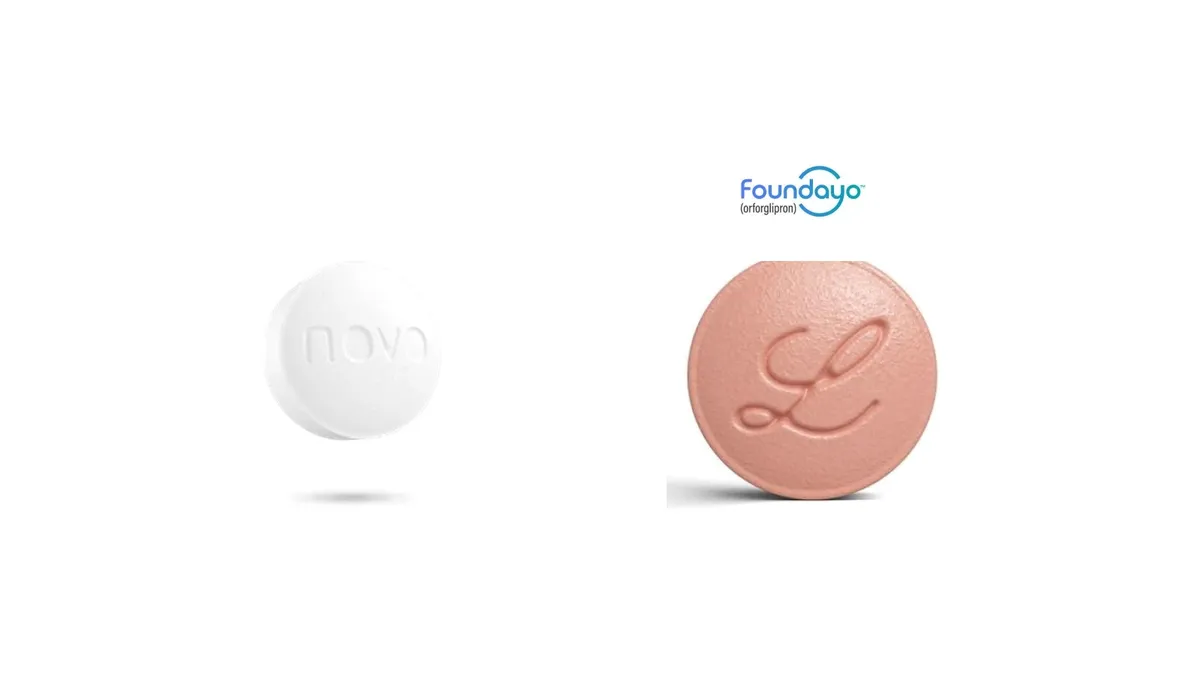
Illustrative image. Does not represent guaranteed results.
Key points
- For the first time there are two FDA-approved GLP-1 pills for weight, and they are not the same thing. The Wegovy pill (oral semaglutide 25 mg) was approved in December 2025. Foundayo (orforglipron) followed in April 2026.
- The difference you will feel every single day is not the percentage — it is how you take them. The Wegovy pill asks for an empty stomach first thing in the morning, no more than 4 oz of plain water, and a 30-minute wait before you eat, drink anything else, or take another pill. Foundayo is taken any time of day, with or without food.
- That difference is chemistry, not marketing. Semaglutide is a peptide and your stomach breaks peptides down easily; orforglipron is a small molecule that needs no such protection.
- In its own trial, oral semaglutide 25 mg produced 16.6% body-weight loss among those who stayed on treatment for 64 weeks, and 13.6% counting every participant.
- In its own trial, orforglipron 36 mg produced 11.2% at 72 weeks, and 54.6% of people lost 10% or more.
- What nobody can tell you yet: which one is better. No trial has ever compared them head to head, and their numbers come from different studies. Below we explain why subtracting one from the other is not valid.
- Eligibility is determined by medical evaluation. A licensed physician decides whether either one is right for you, and which.
In this article
- Two pills, two different molecules
- How each one is taken
- What the Wegovy pill trial measured
- What the Foundayo trial measured
- Why you cannot subtract the two percentages
- Which one fits your day?
- Side effects: what the trials reported
- So your expectations are the right ones
- Who is this NOT for?
- How this gets decided at SCTS1
- Frequently asked questions
- Sources
There is good news worth saying first, because it got lost under the headlines: if injections were never going to happen for you, there are now two real options in pill form. Not one. Two. And both are FDA-approved for weight management — not supplements, not "similar" versions of something else.
For years, GLP-1 came with a needle. For a lot of people that ended the conversation: fear of needles, a job with nowhere to refrigerate anything, travel, or simply not wanting to inject yourself every week. That obstacle now has two ways around it.
But they are different ways, and the difference that matters is not the one you would expect. It is not on the scale. It is in your morning.
Two pills, two different molecules
Both act on the same receptor, the GLP-1 receptor — the hormone your gut releases when you eat, the one that tells your brain you have had enough. So far, identical. What differs is what they are made of.
Semaglutide is a peptide. That means a chain of amino acids: chemically, a relative of the protein on your plate. And your stomach is built precisely to take protein apart. That is why semaglutide started out as an injection: dropped into the stomach, it is destroyed before it reaches the bloodstream. To work as a pill it has to be protected and given a clean window — no food, no other liquids — long enough to be absorbed.
Orforglipron is not a peptide. It is what pharmacology calls a small molecule: a chemical compound that fits the same receptor without resembling a protein. Your stomach does not recognise it as food and does not break it down. That is why it needs no fasting, no window and no measured glass of water.
This is not a footnote on a data sheet. It is the entire reason one of these pills asks you to rearrange breakfast and the other does not.
How each one is taken
Here is the comparison you will actually live with:
| Wegovy pill | Foundayo | |
|---|---|---|
| Molecule | Semaglutide (peptide) | Orforglipron (small molecule) |
| When | First thing, fasting | Any time of day |
| With food | No | Yes, with or without |
| Water | 4 oz maximum, plain water | No restriction |
| Wait before eating | 30 minutes | None |
| FDA approval | December 2025 | April 2026 |
Those 30 minutes deserve a pause, because this is the part people underestimate. The instruction for the Wegovy pill is to take it first thing in the morning, before eating or drinking anything else, with no more than 4 oz of plain water — water only, no coffee, no juice — and then wait at least half an hour before breakfast, any other drink, or any other medication.
And this is not a politeness. If you shorten the wait, you absorb less medication. The pill still goes down the same way, but less of the dose reaches your blood. It is the quietest way for a treatment to look like it is not working.
Foundayo removed that problem entirely. Any time of day, with or without food, no water restriction. Swallow it whole, once a day, done.
What the Wegovy pill trial measured
The study behind the approval is called OASIS 4. It ran 64 weeks and enrolled 307 adults with obesity, or with overweight plus at least one weight-related health problem. It compared oral semaglutide 25 mg against placebo.
Those two numbers, 16.6% and 13.6%, are not a contradiction or a marketing trick. They answer two different questions. The first asks: how much does someone lose who takes the medication as directed? The second asks: how much does the whole group lose on average, including people who stopped halfway? The second number is lower, and more honest about real life.
The Wegovy pill was also approved to reduce the risk of major adverse cardiovascular events — death, heart attack or stroke — in adults with overweight or obesity who already have established cardiovascular disease. That is a separate indication from the weight one, and it matters: not every medication in this family has it.
What the Foundayo trial measured
Foundayo's trial is called ATTAIN-1 and it was published in the New England Journal of Medicine. It was considerably larger: 3,127 adults with obesity and without diabetes, followed for 72 weeks, randomly assigned between three doses of orforglipron and placebo.
| Group | Weight change at 72 weeks |
|---|---|
| Orforglipron 36 mg | −11.2% |
| Orforglipron 12 mg | −8.4% |
| Orforglipron 6 mg | −7.5% |
| Placebo | −2.1% |
And the spread, which says more than the average. On the 36 mg dose:
- 54.6% lost 10% or more of their body weight (versus 12.9% on placebo);
- 36.0% lost 15% or more (versus 5.9%);
- 18.4% lost 20% or more (versus 2.8%).
Waist circumference, systolic blood pressure, triglycerides and non-HDL cholesterol also improved significantly compared with placebo. That matters: weight is the headline, but those markers are what move your long-term risk.
One note of honesty about doses: the ones above — 6, 12 and 36 mg — are the doses tested in the trial. The dose you would be given, and how it is stepped up, is decided by your physician, not by an article. Medications in this family are started low and increased slowly, precisely so the stomach can adjust.
Why you cannot subtract the two percentages
This is where most of what you will read online goes wrong, and we would rather say it plainly: 16.6% is not "better than" 11.2%, because those two numbers did not come from the same question.
- They are different trials. People were never randomly assigned between one pill and the other. Without that, any comparison is indirect.
- They ran for different lengths of time. 64 weeks versus 72. More time changes the result.
- The populations were not the same. 307 people in one, 3,127 in the other, with different entry criteria.
- And most important: they do not count the same way. The 16.6% figure describes people who stayed on treatment; orforglipron's −11.2% counts everyone assigned, whether they stayed or not. Comparing one to the other is comparing apples to oranges. Compare like with like — everyone to everyone — and the gap narrows: 13.6% versus 11.2%.
So what can be said? That both worked considerably better than placebo in their own studies, and that the general impression among physicians is that orforglipron is more convenient and oral semaglutide somewhat more potent. That is a reasonable reading of the whole picture, not a figure from a trial. We are labelling it as what it is.
Which one fits your day?
Since the clinical decision belongs to a physician, the useful thing you can do is arrive knowing what your mornings are actually like. These are the questions that genuinely separate the two:
- Do you wake up and reach for coffee first? With the Wegovy pill, coffee waits half an hour. For some people that is trivial; for others it is the hardest habit in the day to move.
- Do you take other pills in the morning? Thyroid medication, for instance, also wants an empty stomach. Two medications competing for the same fasting window is a real scheduling problem, and exactly what to raise with your physician.
- Do you work shifts, or does your schedule change weekly? "First thing, fasting" is a complicated instruction when your first thing is eleven at night.
- Do you travel, or eat breakfast out often? Foundayo's flexibility weighs more here than any decimal point of percentage.
- Do you already have established cardiovascular disease? Mention it. The Wegovy pill has a specific approved indication for reducing the risk of major cardiovascular events in that situation.
- Do you forget pills? The one with no rules is harder to get wrong. And the medication you take properly beats the theoretically stronger one you take badly.
That last point is the one we all forget. A treatment you quietly strip absorption from three mornings a week does not deliver what the trial says. Consistency is not a detail of discipline: it is part of the dose.
Side effects: what the trials reported
Both belong to the same family and both bother the same place: your stomach. Nausea, abdominal pain, constipation or diarrhoea, gas, heartburn, vomiting. In the trials these were mostly mild to moderate and showed up more at the start and when the dose went up, which is when the body is adjusting.
In ATTAIN-1, adverse events led 5.3% to 10.3% of people on orforglipron to stop treatment, depending on the dose, versus 2.7% on placebo. That is an honest and useful number: most people tolerate it, and a real minority do not.
Both carry a boxed warning about thyroid tumours. In rodent studies, medications in this class caused thyroid C-cell tumours. Whether this happens in people is not known. It is the reason for the contraindications in the next section, and it is not fine print.
So your expectations are the right ones
Three things to take with you:
- The pill solves the needle, not the work. In both trials the medication was given alongside a reduced-calorie diet and more physical activity. That is not protocol decoration: it is part of what produced the result.
- The average is not your forecast. In ATTAIN-1, on the high dose, more than half lost 10% or more — and the rest did not. Results vary from person to person, and nobody can tell you in advance which group you will land in.
- Convenience is a clinical outcome. It sounds strange put that way, but the pill that fits your life is the one you will still be taking in month nine. That one — not the one with the highest percentage in a table — is the one working for you.
Who is this NOT for?
This section is safety, not tone. Neither pill is for everyone.
- If you or anyone in your family has had medullary thyroid carcinoma (MTC), or you have Multiple Endocrine Neoplasia syndrome type 2 (MEN 2). Contraindicated for both. No nuance.
- If you have had a serious allergic reaction to semaglutide, to orforglipron, or to any of their ingredients.
- If you have severe liver impairment (Child-Pugh C): that is a specific contraindication for Foundayo.
- If you are pregnant, trying to become pregnant, or breastfeeding. These are not medications for pregnancy, and this is a conversation to have with your physician beforehand, not after.
- If you have a history of pancreatitis, or stomach-emptying problems such as gastroparesis. Not an automatic no, but it changes the decision and it has to be said.
- If you have type 1 diabetes, or take insulin or other glucose-lowering medications. The risk of hypoglycaemia is real and the plan has to be adjusted, not improvised.
- If you have diabetic retinopathy, a history of gallbladder disease, or kidney disease: all of that belongs in the conversation.
- Under 18. Not the setting of these trials, and not of this article.
- And if your problem is not weight, these pills are not the tool. A weight medication does not fix sleep, stress or your thyroid, and sometimes weight is the consequence rather than the cause.
How this gets decided at SCTS1
None of the above is something you decide by reading, and no form decides it either.
SCTS1 offers GLP-1 programs with FDA-approved medications (Wegovy®, Foundayo™, Ozempic®) from $149 a month, by telemedicine, in Spanish and English. The path is this: you pay and start your program first; then a licensed physician reviews your case — habits, stress, sleep and medical history — and orders labs only if they consider it necessary. If you are not a candidate, they tell you.
What you can do before speaking to the physician is arrive with the answers from the "Which one fits your day?" section: what time you get up, what other pills you take in the morning, whether you work shifts. That information genuinely changes the recommendation.
Eligibility is determined by medical evaluation. Results vary from person to person.
Frequently asked questions
Which one loses more weight?
That cannot be answered honestly, because no trial has compared them head to head. In their own studies, oral semaglutide 25 mg produced 16.6% among those who stayed on treatment for 64 weeks, and orforglipron 36 mg produced 11.2% at 72 weeks counting everyone assigned. Those two figures were calculated differently, so subtracting them says nothing. Comparing like with like, the gap is smaller: 13.6% versus 11.2%.
Do I really have to wait 30 minutes with the Wegovy pill?
Yes, and it is not optional. It is taken first thing, on an empty stomach, with no more than 4 oz of plain water, and you must wait at least half an hour before eating, drinking anything else, or taking another medication. Shorten the wait and you absorb less medication — you would be working against your own dose without noticing.
Why does Foundayo need no fasting when the other does?
Chemistry. Semaglutide is a peptide, a relative of protein, and your stomach takes protein apart: it needs a clean window to be absorbed. Orforglipron is a small molecule, your stomach does not treat it as food, and so it can be taken any time of day with or without food.
Are these the same as Ozempic or injected Wegovy?
Same family — all act on the GLP-1 receptor — but not interchangeable. The Wegovy pill contains semaglutide, like the injection, in a different form and dose. Foundayo contains a different molecule, orforglipron, which does not exist as an injection. Which form suits you is a medical decision.
Which has fewer side effects?
The trials cannot be compared on this either. Both cause stomach complaints mainly at the beginning and when the dose goes up, almost always mild to moderate. In ATTAIN-1, between 5.3% and 10.3% stopped orforglipron because of adverse events depending on the dose, versus 2.7% on placebo.
Can I switch from one to the other?
Your physician decides that, and it is a reasonable conversation if the one you are taking does not fit — because of timing, tolerance or results. What you do not do is switch on your own or overlap the two.
What happens if I stop taking it?
The effect on appetite depends on the medication being in your body. When it is stopped, appetite tends to return and regaining weight is common. That is why this is framed as long-term weight management rather than a few weeks' cycle, and why the conversation about sustaining the change matters as much as the prescription.
Does this work if I have heart problems?
Say so during your evaluation, because it changes the decision. The Wegovy pill has a separate approved indication for reducing the risk of major adverse cardiovascular events — death, heart attack or stroke — in adults with overweight or obesity and established cardiovascular disease. Who qualifies is determined by a physician.
Do I need labs before starting?
Not necessarily. The path is: you start your program, a licensed physician reviews your case, and they order labs only if they consider it necessary. They are not automatic and not required for everyone.
Sources
- Wharton S, Aronne LJ, Stefanski A, et al. Orforglipron, an Oral Small-Molecule GLP-1 Receptor Agonist for Obesity Treatment. N Engl J Med. 2025;393(18):1796-1806. ATTAIN-1 trial, NCT05869903. — DOI: 10.1056/NEJMoa2511774
- Novo Nordisk. FDA approves Novo Nordisk's Wegovy® pill, the first and only oral GLP-1 for weight loss in adults — company announcement carrying the OASIS 4 results (64 weeks, 307 adults). December 2025. — Official announcement
- Kadowaki T, Heftdal LD, Ko HJ, et al. Oral Semaglutide in an East Asian Population With Overweight or Obesity, With or Without Type 2 Diabetes: The OASIS 2 Randomized Clinical Trial. JAMA Intern Med. 2025;185(10):1206-1217. — DOI: 10.1001/jamainternmed.2025.3599
- U.S. Food and Drug Administration. Prescribing information for Wegovy® and Foundayo™, including the boxed warning for thyroid C-cell tumours and the contraindications (MTC, MEN 2, Child-Pugh C). — Drugs@FDA
A note on sources: OASIS 4, the Wegovy pill trial, is cited from the company announcement and the prescribing information because at the time of publishing we could not locate its peer-reviewed publication indexed in PubMed. ATTAIN-1 is peer-reviewed and published, and is cited from the journal. We say so you know what weight each number carries.
Related articles
Your trust is worth more than a sale.
This article is informational and is not medical advice. SCTS1 does not prescribe or dispense medications. All medical care, prescriptions and treatment plans are provided by licensed physicians through our partner platforms. Eligibility for treatment is determined by a licensed provider through medical evaluation. Wegovy® and Foundayo™ are FDA-approved prescription medications; this article does not replace the authorised prescribing information, which you should review with your physician. Both carry a boxed warning for thyroid C-cell tumours observed in rodents, and both are contraindicated in people with a personal or family history of medullary thyroid carcinoma (MTC) or with Multiple Endocrine Neoplasia syndrome type 2 (MEN 2); Foundayo is additionally contraindicated in severe hepatic impairment (Child-Pugh C). The percentages cited come from different trials with different populations, durations and methods of calculation: no trial has compared these two medications head to head, and the figures are not comparable with each other and do not predict your result. At the time of publishing we could not locate the peer-reviewed publication of OASIS 4 indexed in PubMed; that figure is cited from the company announcement and the prescribing information. Do not use this information to start, change or stop a treatment on your own. If you are pregnant, trying to become pregnant or breastfeeding, or have a history of pancreatitis, gastroparesis, type 1 diabetes, kidney or gallbladder disease, consult your physician. Results vary from person to person.