Sublingual semaglutide or the Wegovy pill: how the two actually differ
Semaglutida sublingual o la pastilla de Wegovy: en qué se diferencian de verdad
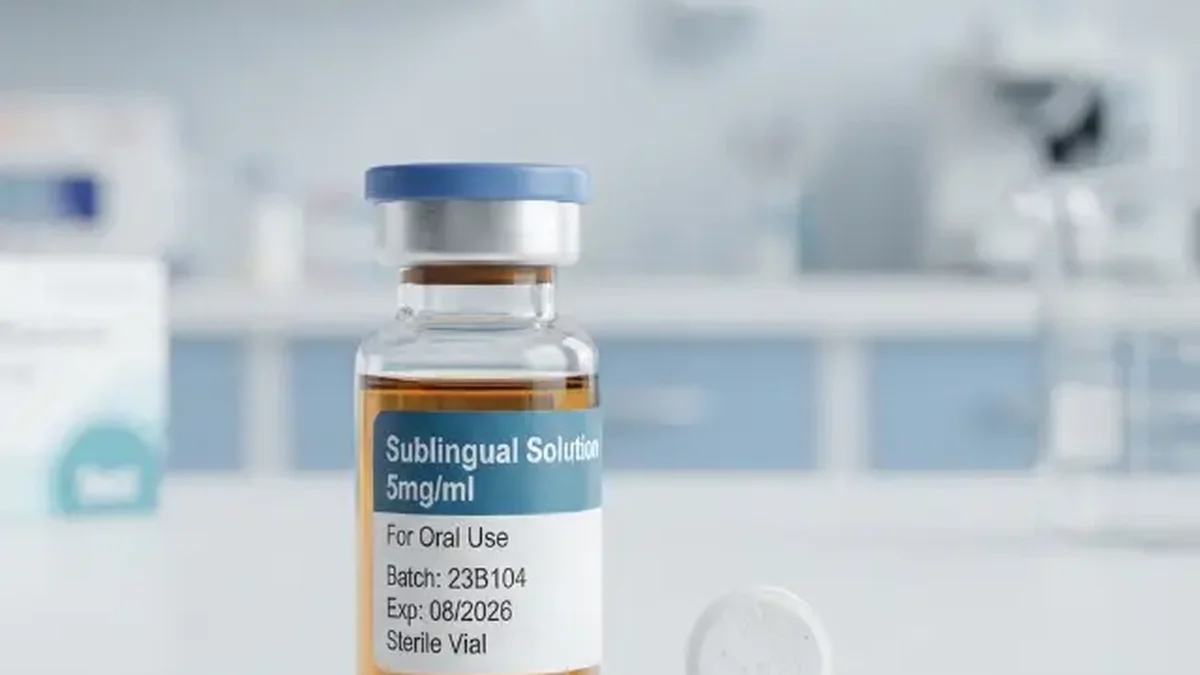
Illustrative image. Does not represent guaranteed results.
Key points
- There are now two needle-free ways to take semaglutide, and they are not the same thing. Knowing the difference is what lets you walk into an appointment calm.
- The Wegovy pill does not dissolve under your tongue. It was measured with a gamma camera in 26 people: the tablet breaks down in the stomach, not the mouth. That is why the label says swallow it whole — do not cut, chew or dissolve it.
- In the pill's trial — 71 weeks, 307 people — body weight fell 13.6% on average by week 64, against 2.2% on placebo.
- An indirect comparison found the 25 mg pill and the weekly 2.4 mg injection perform comparably, with differences below the threshold the FDA treats as clinically relevant.
- Sublingual delivery rests on real pharmacology: it bypasses the stomach. In rats it absorbed nearly six times more than the same oral dose, with less variability between animals.
- But today's sublingual evidence is in animals. The authors themselves write that human pharmacokinetic research is still needed. A review of 33 compounded products concluded that whether sublingual offers any advantage over the approved tablet has not been determined.
- Same molecule, two routes, two different categories. One is an FDA-approved finished medication with a label and set doses. The other is prepared by a licensed pharmacy at the dose a physician writes. A compounded preparation is not "the generic" of Wegovy.
- Which one fits is not this article's call — it is the call of the physician who reviews your case. Eligibility is determined by medical evaluation.
In this article
- The good news: there are two needle-free routes now
- Where each one is absorbed (and why it changes everything)
- Why the pill asks for an empty stomach and very little water
- What the pill's trial actually showed
- Sublingual: the logic, and the evidence as it stands
- Two categories, not two grades of quality
- How the decision gets made in practice
- What SCTS1 offers on both routes
- So your expectations are the right ones
- Who is this NOT for?
- How it works at SCTS1
The good news: there are two needle-free routes now
If the needle is what has been stopping you, this one is for you. For years, semaglutide for weight came one way only: a weekly injection. Not anymore.
In December 2025 the FDA approved the Wegovy pill, the first oral GLP-1 for chronic weight management. In parallel, many compounding pharmacies offer sublingual semaglutide: drops or tablets placed under the tongue.
Both are semaglutide. Both go in through the mouth. That is where the resemblance ends.
People come looking for "the pill version" and assume sublingual is the same thing, cheaper — or that the brand pill can be dissolved under the tongue to work faster. Neither is true, and the reason is rather elegant: each was engineered to be absorbed in a different place in your body.
Understanding that saves you two concrete mistakes — one of them wastes the dose — and leaves you asking better questions when you talk to a physician. That is the whole point of this article. We are not here to tell you which one is yours.
Where each one is absorbed (and why it changes everything)
Semaglutide is a peptide: a chain of amino acids. Your digestive tract is built, among other things, to destroy peptides. That is why for years it existed only as an injection.
Getting it into a tablet meant solving that problem. The solution was to co-formulate it with an absorption enhancer called SNAC, which shields the molecule and opens a window for it to cross into the blood.
And where does it cross? This was measured directly, and it is the single most useful fact in this article. In a study of 26 healthy men, the tablet was given with a tracer and followed by gamma scintigraphy — imaging that shows where it breaks apart.
That is the key to all of it. The Wegovy pill is designed to survive the mouth intact and release against the stomach wall, where SNAC does its work in a small area and over a short window.
Which is why the manufacturer's label says to swallow it whole: do not crush, cut, chew or dissolve. If you chew it or let it break down in your mouth, you are not speeding anything up — you are throwing away the dose. The entire mechanism depends on it arriving sealed.
Sublingual delivery aims at the opposite. Under the tongue sits a thin, richly vascular mucosa; what is absorbed there passes straight into the bloodstream and skips both the stomach and first-pass metabolism in the liver. It is the same logic as nitroglycerin placed under the tongue in a cardiac emergency: not a trick, a genuine route.
Two opposite designs, then, for the same molecule. One needs the stomach; the other avoids it. Every other difference follows from that.
Why the pill asks for an empty stomach and very little water
The instructions for the Wegovy pill look excessive until you know the above. The manufacturer says to take it in the morning, on waking, on an empty stomach, with up to 4 ounces of plain water — about 120 millilitres, less than you would guess — and to wait 30 minutes before eating, drinking anything else, or taking other oral medications.
It is not ritual. In that same scintigraphy study, taking it with 50 millilitres of water was compared against 240 millilitres. With less water, the tablet took longer to erode — 85 minutes versus 57 — and the amount of semaglutide reaching the blood was roughly 70% higher.
Read that again, because it runs against intuition: more water, less medication. Water pushes the tablet out of the stomach before it has finished delivering its contents. Less water lets it stay where it needs to be.
Food does the same thing. Eating tells your stomach to empty, and the tablet goes with it.
This has a practical consequence worth saying out loud: the pill works if you take it a specific way, every day. Not hard, but demanding about timing. It suits plenty of people fine; it is harder for someone who wakes and eats immediately, or takes other pills first thing. That is useful information about you, not a flaw in the medication.
Sublingual has none of that choreography, and that is its most honest argument: you hold it under your tongue for a while and you are done. It is easier to stick with. What has not yet been shown in people is that the ease translates into the same result.
What the pill's trial actually showed
The pill reached approval on a serious trial, and it is worth knowing what it said.
It ran 71 weeks, double-blind and placebo-controlled, across 22 sites in four countries. 307 adults without diabetes took part, with obesity or with overweight plus a related condition: 205 received the 25 mg pill once daily and 102 received placebo. Both groups made lifestyle changes.
Reaching 5%, 10%, 15% and 20% losses was also significantly more likely, and physical-function scores improved.
And the other side, which was published too: gastrointestinal side effects were considerably more common on the pill than on placebo — 74% versus 42%. Nausea, vomiting, diarrhea, constipation. They typically show up when the dose steps up and are managed by going slowly, which is exactly why the schedule starts at 1.5 mg and increases roughly every 30 days.
One question always comes up: does the pill match the injection? There is no head-to-head trial, but there is an indirect comparison between the pill's study and the weekly 2.4 mg injection study. Results were comparable across every outcome assessed, with a small numerical edge for the injection that landed well below the 5% the FDA uses as a threshold for clinical relevance.
Translated: for a lot of people, the pill is a real option, not a consolation prize.
Sublingual: the logic, and the evidence as it stands
This is where we want to be especially clear, because it is where the confusion lives — and where selling would be easiest.
Sublingual delivery has a sound idea behind it and data pointing in a good direction. In a study in rats, the same semaglutide dose was given sublingually and orally. Sublingual produced an area under the curve of 82.5 versus 15.1 — nearly six times the absorption — and showed less variability between animals than the oral route. Relative bioavailability was 0.34% sublingually against 0.06% orally at the same dose.
Sit with those numbers a moment: even the better of the two routes lets less than 1% of the dose through. That is peptide pharmacology by mouth, and it explains why oral doses are so much larger than injected ones.
There is more. In a study in minipigs — 40 animals, nine weeks — a thin sublingual film of semaglutide slowed weight gain by 24.9% compared with placebo, and did better than the group given the oral tablet.
Both results are genuinely promising. And now the part an honest article has to state just as plainly: both are in animals. Rats and pigs. The authors of the rat study write that their work is a proof of concept supporting further pharmacokinetic research in humans — which is to say, in humans it has not been done yet.
A 2026 review went looking at what is actually being sold. It found 33 distinct compounded products of semaglutide or tirzepatide; among those with a single active ingredient, 82% were sublingual. Its conclusion about the route is exactly the right one: there is a valid rationale for making a sublingual formulation, but whether it offers advantages over the innovator's tablet has not been determined.
That same review noted something useful to you as a consumer: many of those products did not publish a beyond-use date or storage conditions. If you go the compounded route, which pharmacy it comes from matters.
None of this says sublingual does not work. It says something more precise and more useful: we know how much weight people lose on the approved tablet, and we do not know that for sublingual. That is a difference in information, not a verdict.
Two categories, not two grades of quality
This is the part that settles people most once it is explained properly.
The Wegovy pill is an FDA-approved finished medication. That means a label, established doses, a published trial behind it, and an inspected facility making every batch like the last one.
Compounded sublingual semaglutide is a different thing, and the right word matters: it is prepared by a licensed pharmacy, at the dose and in the form a physician writes for a patient. That is a legal, regulated practice with a real purpose — tailoring something to a person when the factory product does not fit.
What a compounded preparation is not: it is not "the generic" of Wegovy, not "the cheap version" of the brand, and not an FDA-approved finished medication. No one reviewed a trial of that specific preparation, because none is required to exist.
And we want to be clear about which side of that line we are on: SCTS1 does not sell or dispense medication. We provide the medical evaluation, the prescription and the follow-up. The pharmacy provides the product. That is why we can tell you about both routes without having to push you toward one.
How the decision gets made in practice
The real question is not "which is better" but "which one fits my case" — and a physician answers that with your history in front of them. What we can tell you is what they look at, so you arrive with the good questions.
- Your morning. The pill needs an empty stomach, little water and a 30-minute wait. If you take levothyroxine or other pills first thing, that has to be sequenced.
- What evidence you want behind it. If a published human number is what reassures you, today the approved tablet is what has one.
- Your gut tolerance. Three in four people had some digestive effect in the trial. It is manageable, but it is discussed up front.
- Your medical history. Some histories change the answer entirely, and they are in the section below.
- The real, sustained cost. Not month one — month twelve, because this is long-term treatment.
Something that takes weight off a lot of shoulders: you do not have to arrive with the decision already made. Researching each option and then talking to a physician is exactly the right order. That the physician decides molecule, route and dose is not a limitation — it is the part that protects you.
What SCTS1 offers on both routes
We will give you both, with their names and their prices, because hiding one would be treating you like someone to be managed.
The brand route. A licensed physician writes the prescription and the manufacturer's pharmacy sells and ships the medication: NovoCare® Pharmacy for Wegovy® and Ozempic®, LillyDirect® for Zepbound®, Mounjaro® and Foundayo™. You pay the pharmacy directly. The Wegovy® pill starts from $149/month at the starting doses; injectable semaglutide from $199 and tirzepatide from $299. Membership is separate.
The compounded route. Semaglutide or tirzepatide from a licensed pharmacy, from $88.99/month, at the dose a physician writes. Remember the point above: it is not an FDA-approved finished medication.
Both are by telemedicine, in Spanish and English, and both include follow-up. Eligibility is determined by medical evaluation. Individual results vary and are not guaranteed.
If you want to see how the whole thing is put together, it is in our programs.
So your expectations are the right ones
Three things, said without drama:
One. The trial's 13.6% is an average across 205 selected people, supported for more than a year, with lifestyle changes included. Inside that average, some lost considerably more and some considerably less. It is not a forecast for you.
Two. The pill-versus-injection comparison is indirect: two similar studies were compared, not two groups within one trial. That is reasonable evidence, not the definitive kind.
Three. On sublingual, what exists is animal evidence and good reasoning. If someone offers it to you as a proven equivalent of the approved tablet, that has not been measured in people yet.
What you can reasonably expect: that a needle-free option exists which genuinely works and is approved, and that a physician can sort the options with you in one appointment instead of you settling it by reading forums.
Who is this NOT for?
This section is not negotiable, and we write it in full even though it does not sell.
- If you or a family member has had medullary thyroid cancer, or if you have multiple endocrine neoplasia syndrome type 2. GLP-1s are not used there.
- If you have had a serious allergic reaction to semaglutide or any GLP-1.
- If you are pregnant, trying to conceive, or breastfeeding. This is not for that stage, and it is worth discussing before, not after.
- If you have a history of pancreatitis, gallstones, diabetic retinopathy or gastroparesis. Not automatic bars, but they change the conversation and sometimes the answer.
- If you take insulin or other glucose-lowering medications. It can be done, but doses get adjusted, and that needs an attentive physician rather than an internet prescription.
- If what you want is the pill without the follow-up. Buying semaglutide from anyone who does not ask for a medical history is not a shortcut — it is the real risk in this category.
- If you are thinking of dissolving the brand tablet under your tongue to stretch it further. Do not: the label says swallow whole, and dissolving it wastes the dose.
- If your weight will not move and the underlying cause is something else — a thyroid, broken sleep, a medication you are already on. Starting a GLP-1 on top of that covers the problem up. We will tell you, even if it means you do not start with us.
How it works at SCTS1
Here is the real order, no fine print.
SCTS1 does not prescribe or dispense medication. We work with two companies: Scientists One Health (SOH) for brand medications, and Altro Health, an independent licensed clinical platform, for compounded preparations. Once you start your program, a licensed physician reviews your case — habits, stress, sleep and medical history — and orders labs only if they consider it necessary. Eligibility is determined by medical evaluation. The order is this: you start, the physician reviews, and only then is it decided what fits.
What you pay covers the medical evaluation, the prescription and the follow-up. The medication is paid to the pharmacy, at the prices above.
And one more thing, because it is the one that defines us: if your case points to the route you came looking for not being the one that fits, we will tell you — even if the one that fits is the cheaper of the two, or neither.
Frequently asked questions
Can I dissolve the Wegovy pill under my tongue?
No. The manufacturer's label says to swallow it whole: do not crush, cut, chew or dissolve. The tablet is designed to break down in the stomach, where the absorption enhancer does its work. Dissolving it in your mouth speeds nothing up; it wastes the dose.
Is sublingual the same as the pill, just cheaper?
No. They are two different absorption routes and two different regulatory categories. The pill is an FDA-approved finished medication with a published human trial. Compounded sublingual is made by a licensed pharmacy at the dose a physician writes, and its evidence today is in animals.
Why does the pill have to be taken with so little water?
Because it was measured. With 50 millilitres of water instead of 240, the tablet took longer to erode in the stomach and roughly 70% more medication reached the blood. More water pushes it out of the stomach before it finishes releasing.
Does the pill match the injection?
There is no head-to-head trial. An indirect comparison of the two studies found comparable results, with a small numerical edge for the injection that landed well below the 5% threshold the FDA treats as clinically relevant.
What if the pill upsets my stomach?
In the trial, 74% had some digestive effect versus 42% on placebo. It almost always appears when the dose steps up. That is why the schedule starts at 1.5 mg and rises roughly every 30 days, and why the adjusting is done by the physician following you, not by a fixed calendar.
How do I know the pharmacy compounding my sublingual is a serious one?
Ask for the product's beyond-use date and storage conditions. A review of 33 compounded products found most published neither. A pharmacy that tells you both without being pressed is a good sign.
Sources
- Wharton S, Lingvay I, Bogdanski P, et al. Oral semaglutide at a dose of 25 mg in adults with overweight or obesity. N Engl J Med. 2025;393(11):1077-1087. — DOI
- Baekdal TA, Donsmark M, Hartoft-Nielsen ML, Søndergaard FL, Connor A. Relationship between oral semaglutide tablet erosion and pharmacokinetics: a pharmacoscintigraphic study. Clin Pharmacol Drug Dev. 2021;10(5):453-462. — DOI
- Plotkin M, Ivkovic M, Smith I, et al. Semaglutide 25 mg oral versus semaglutide 2.4 mg injectable: an indirect treatment comparison of weight loss outcomes. Diabetes Obes Metab. 2026;28(8):7237-7246. — DOI
- Liu Y, Song G, Banov D, Denison J, Davis C, Ip K. Single-dose pharmacokinetics of sublingual semaglutide in rats. Eur J Pharm Sci. 2026;217:107406. — DOI
- Sagar G, Stránská V, Stránská D, et al. Electrospun nanofiber oral thin film platform for sublingual peptide delivery: a promising alternative to conventional semaglutide formulations. Diabetes Obes Metab. 2026;28(9):8034-8044. — DOI
- Belcourt J, Sapowadia A, White CM. Compounded semaglutide and tirzepatide products use unique formulations but efficacy and safety largely unknown. Ann Pharmacother. 2026;60(9):902-906. — DOI
Related articles
Your trust is worth more than a sale.
This article is informational and is not medical advice. SCTS1 does not prescribe or dispense medication. All medical care, prescriptions and treatment plans are provided by licensed physicians through our partner platforms. Treatment eligibility is determined by a licensed provider through medical evaluation. Wegovy®, Ozempic®, Mounjaro® and Zepbound® are registered trademarks of their respective owners, which are not affiliated with SCTS1 and do not sponsor this content. Medications prepared by compounding pharmacies are not FDA-approved finished medications. Figures cited are averages from defined populations and are not a prognosis for your case. Do not cut, chew or dissolve a tablet intended to be swallowed whole. Do not stop or change any medication without speaking to whoever prescribed it. Individual results vary and are not guaranteed.