Stress, cortisol and weight: what stress does to your body
Estrés, cortisol y peso: lo que el estrés le hace a tu cuerpo
There's a scene that repeats itself in thousands of homes: you get back from work with your head still running, you handle dinner, answer two more messages, and when you finally sit down, your body asks for something. It isn't hunger exactly. It's a mix of exhaustion, tension, and the urge to reward yourself for surviving the day.
And then there's the other part, the one almost no one connects to the first: the scale that won't move — or moves upward — even though you feel you don't eat that much. The clothes that pinch right at the waist. The sense that your body is working against you.
For years, the conversation about weight treated stress as a separate topic, something "emotional" that didn't belong at the same table as calories and exercise. The evidence says otherwise. It says stress is a measurable chemical signal, that the signal is called cortisol, that it predicts future weight gain in prospective studies, and that it forms a cycle with abdominal fat and cravings that can be understood — and can begin to be dismantled.
This article is about that mechanism. With real numbers, with the sources at the end, and with the honest part about what science still cannot promise you.
Key points
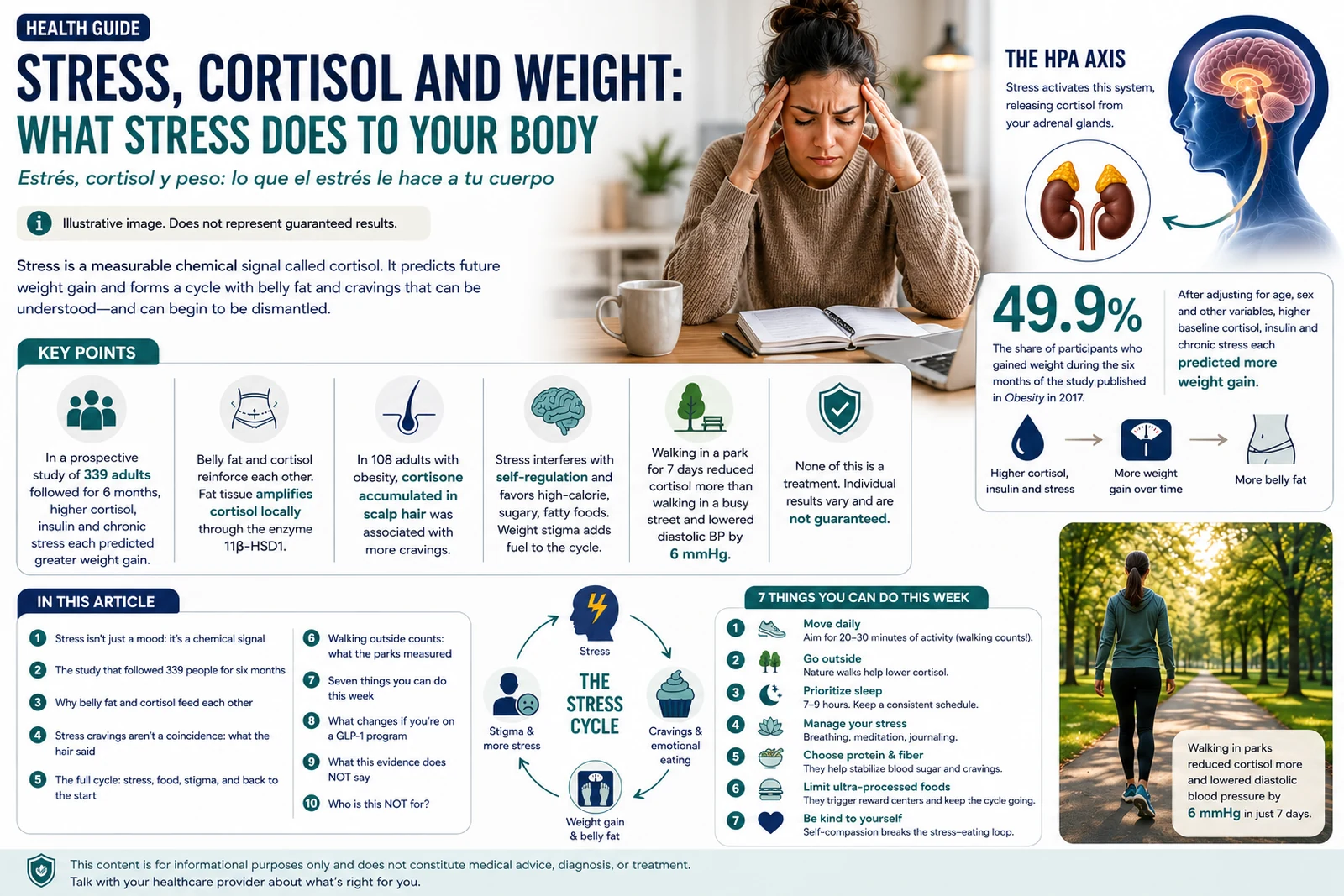
- In a prospective study of 339 adults followed for 6 months, higher baseline cortisol, insulin and chronic stress each predicted greater weight gain at the end of the period.
- Abdominal fat and cortisol reinforce each other: a systematic review documented greater stress-axis reactivity with more abdominal fat, and that fat tissue amplifies cortisol locally through the enzyme 11β-HSD1.
- In 108 adults with obesity, cortisone accumulated in scalp hair — months of biological stress, not one bad day — was associated with more cravings; the group with both high psychological and biological stress had the highest cravings and emotional eating.
- Stress also pushes through behavior: it interferes with self-regulation and tilts choices toward calorie-dense, sugary, fatty foods; weight stigma acts as an additional stressor that feeds the cycle.
- Walking helps, and place matters: in a 7-day trial, walking in a park reduced cortisol more than walking on a busy street, and lowered diastolic blood pressure by 6 mmHg by day seven.
- None of this is a treatment. Individual results vary and are not guaranteed.
In this article
- Stress isn't just a mood: it's a chemical signal
- The study that followed 339 people for six months
- Why belly fat and cortisol feed each other
- Stress cravings aren't a coincidence: what the hair said
- The full cycle: stress, food, stigma, and back to the start
- Walking outside counts: what the parks measured
- Seven things you can do this week
- What changes if you're on a GLP-1 program
- What this evidence does NOT say
- Who is this NOT for?
Stress isn't just a mood: it's a chemical signal
When your brain perceives a threat — a difficult boss, a debt, a diagnosis, traffic that won't move — it activates a chain of command physiologists call the hypothalamic-pituitary-adrenal axis, or HPA axis. At the end of that chain are your adrenal glands, two small structures above the kidneys, which release a hormone: cortisol.
Cortisol is not a villain. It's your body's emergency system: it raises available glucose, sharpens attention, and readies your muscles. For a short threat — run, argue, solve — it's exactly what you need. The system was designed to switch on, resolve, and switch off.
The modern problem is that threats no longer last minutes. They last months. Traffic is daily, debt is monthly, the extra shift is permanent. And a system designed for short emergencies, switched on chronically, starts producing side effects: on appetite, on where fat gets stored, and on the very capacity to self-regulate around food.
This matters because it changes the question. The question isn't "why don't you have willpower?" The question is "what is this chemical signal doing to your body, and what keeps it switched on?" The first question blames. The second one can be worked on.
The study that followed 339 people for six months
The best way to know whether stress predicts weight gain — rather than merely accompanying it — is to measure it first and wait. That's what a team from Yale and the University of Pennsylvania did: they recruited 339 adults from the community, measured baseline fasting blood cortisol, insulin, other appetite hormones, and cumulative chronic stress through a structured adversity interview, and re-evaluated them six months later.
Three details of this study are worth holding on to.
First: it was not a study of people with obesity. Average body mass index was 26.7 — mild overweight — and the average age 29. The effect of stress on weight doesn't wait for a big problem to exist; it starts earlier.
Second: ghrelin — the hormone that opens appetite — played its own role: participants with higher baseline ghrelin reported more cravings six months later. Hunger and craving, once again, traveling separate roads.
Third: the authors concluded that studies are needed on stress-reduction methods to normalize cortisol responses and prevent weight gain. In other words: the scientific community already treats stress as a weight variable, not a side topic.
Why belly fat and cortisol feed each other
If cortisol were only a signal running from the brain downward, the story would be simpler. But a systematic review published in Psychoneuroendocrinology — which examined the full literature on the HPA axis and obesity — documented something more uncomfortable: the relationship runs both ways.
On one side, the general pattern of studies shows that more abdominal fat is associated with greater stress-axis reactivity: the cortisol awakening response and the response to acute stress tend to be more pronounced in people with more central fat, though not all studies agree.
On the other side — and this is the remarkable part — abdominal fat tissue itself participates. Fat cells express an enzyme called 11β-HSD1, which reactivates cortisol locally inside the tissue. In the adipocytes of people with obesity that enzyme is clearly upregulated. In simple terms: abdominal fat is not a passive warehouse; it is a tissue that amplifies the cortisol signal in its own neighborhood.
The result is a loop: chronic stress favors central fat deposition, and central fat amplifies the hormonal environment that favors more deposition. The review's authors are honest: the literature has inconsistencies and methodological contradictions, and the exact patterns are not settled. But the general direction — that stress and abdominal fat form a self-reinforcing system — is today the most reasonable reading of the evidence.
Stress cravings aren't a coincidence: what the hair said
Measuring stress with a questionnaire has a problem: it depends on how you feel that day. Measuring blood cortisol has another: it captures a moment, not a season. That's why a group at the Erasmus MC obesity center in Rotterdam used a different measure: hair.
The team analyzed 108 adults with obesity (median BMI 38.4) and crossed their hair cortisone levels with validated eating-behavior questionnaires. The finding: the more cortisone accumulated in the hair, the more food cravings, even after adjusting for sex and age, and even after adjusting for perceived psychological stress.
And when they split participants into groups, the pattern sharpened: people with high psychological stress and high hair cortisone at the same time showed the highest cravings and emotional eating of all. The stress you feel and the stress your body accumulates appear to add their effects together.
One more nuance, from an earlier study of women with overweight and obesity: among the women with overweight, ghrelin was related to caloric intake, to giving in to cravings, and to a flatter daily cortisol rhythm; among the women with obesity, those relationships weakened — which the authors interpret as possible ghrelin resistance. Appetite biology is not the same in every body, and that also explains why the same advice doesn't work equally for everyone.
The full cycle: stress, food, stigma, and back to the start
A review published in the International Journal of Preventive Medicine gave the full phenomenon a name: a vicious cycle in which stress and weight produce each other through three pathways operating at once.
The cognitive pathway: stress consumes self-regulation. The same mental capacity you use to plan meals and say "not today" is the one stress exhausts first. It isn't weakness of character; it's a finite resource spent on another fight.
The behavioral pathway: under stress, preference tilts toward calorie-dense, sugary, fatty foods — the classic "stress eating" the literature documents consistently.
The physiological pathway: appetite hormones — leptin, ghrelin, neuropeptide Y — and cortisol shift with chronic stress, pushing appetite and central fat deposition.
And there is a fourth pathway that deserves saying out loud: stigma. The review documents that shaming and blame about weight act as an additional social stressor. That is: shaming someone about their weight doesn't motivate them; it stresses them, and stress feeds exactly the cycle the shame was supposed to break.
The same review points to the most-studied way out: the recent studies it cites found that improvements in mindfulness, chronic stress and the cortisol awakening response were associated with reductions in abdominal fat, and that mindfulness training improves eating patterns. It isn't magic; it's turning down the volume of the signal that keeps the cycle spinning.
Walking outside counts: what the parks measured
If stress is a chemical signal, the practical question is what lowers it. One of the most accessible answers has two ingredients: walking, and doing it outside.
A randomized trial in Lithuania assigned stable cardiac patients to walk for 7 consecutive days, some in a park and others on an urban street with traffic, same duration. On the first day, the cortisol reduction after the walk was greater in the park group. By day seven, the park group had lower diastolic blood pressure before walking, and one hour after the walk the difference reached −6 mmHg.
It's a small study in a specific population, so take it for what it is: a signal, not a law. But the signal matches an Austrian crossover trial with 81 healthy adults, where an hour of walking plus rest reduced salivary cortisol and systolic blood pressure and improved mood. Walking isn't just burning calories — for that you already have our article on walking — it is also a direct intervention on the stress signal.
Seven things you can do this week
None of this requires buying anything. Everything targets the mechanisms we just covered.
1. Name the stressor, not the craving
When the urge to eat without hunger arrives, ask first: what happened today? A stress craving is a symptom. Attacking the symptom without naming the cause is fighting blind.
2. Walk 20–30 minutes — in green space if you can
A park, a tree-lined block, the canal path. The evidence suggests the same steps in a green environment lower cortisol more than among traffic. If all you have is the street, the street works too: movement is the main ingredient.
3. Protect sleep like you protect an appointment
Short sleep is a direct physiological stressor and pushes the same appetite hormones. If sleep is your weak point, this article is your next read.
4. Don't skip meals on hard days
A stressful day on an empty stomach ends, far too often, at the pantry at nine at night. Protein at breakfast and a real midday meal take fuel away from the evening craving.
5. Try five minutes of breathing or mindfulness
The evidence cited above associates mindfulness training with better eating patterns and a better cortisol awakening response. Five minutes a day is an honest starting dose.
6. Reduce the background noise you do control
You can't fire your boss, but maybe you can mute the group chat that sets you off, move email checks to two fixed times, or say one small "no" this week. Cortisol doesn't distinguish between big stressors and many small ones.
7. If your body has been on alert for months, consider labs
Persistent fatigue, a waist growing without a clear change in habits, high blood pressure, broken sleep: that combination deserves a conversation with a provider, who will decide whether labs are needed. Not to look for an excuse — to look for data.
What changes if you're on a GLP-1 program
GLP-1 medications work mainly on physical appetite and satiety. What they don't do is fire your boss, pay your debts, or sleep for you. Chronic stress can keep pushing cravings and sleep even when hunger is under control — which is why the large trials of these medications always studied them as a complement to a lifestyle intervention, not a substitute.
In practice, this means a serious weight-management program asks about your stress and your sleep, not just your weight. Once you start your program, a licensed physician through our partner platform reviews your case — habits, schedules, stress, sleep and medical history — and orders labs only if they consider it necessary. Eligibility is determined by medical evaluation. Sometimes the answer is that a medication isn't what you need yet, and that answer is worth as much as a prescription.
GLP-1 programs with FDA-approved medications (Wegovy®, Foundayo™, Ozempic®) from $149/month. Care in English and Spanish, 100% by telemedicine.
What this evidence does NOT say
Let's be explicit, because exaggeration abounds on this topic.
It does not say stress causes obesity. It says chronic stress is one of the factors that predict weight gain, alongside insulin, genetics, sleep, environment and more. It is a variable, not the variable.
It does not say you have "high cortisol" in the clinical sense. Pathological cortisol excess — Cushing's syndrome — is rare and is diagnosed with specific tests. What these studies measure are variations within the normal range, associated with everyday life stress.
It does not say lowering stress will make you lose weight. Mindfulness interventions were associated with better eating patterns and, in some studies, less abdominal fat. Association is not a guarantee. Individual results vary and are not guaranteed.
It does not say "anti-cortisol" supplements work. None of the studies cited here evaluated supplements, and this article does not recommend them.
And it does not say these studies are definitive. The parks trial had 20 participants; the hair study was cross-sectional — it cannot prove causal direction — and the HPA-axis review openly reports inconsistencies in the literature. They show converging mechanisms, not settled truths.
Who is this NOT for?
This article is not for you if your stress has crossed into clinical territory: panic attacks, anxiety that won't ease, persistent low mood, or thoughts of harming yourself. That is not solved with walks or habit lists; it deserves an evaluation with a mental health professional, and asking for it is not a failure — it is the right step.
It's also not for you if you suspect a medical cause: rapid unexplained weight gain, marked muscle weakness, wide purple stretch marks, or recent-onset very high blood pressure. That combination needs a doctor soon, not an article.
It's not for you if you're looking for permission to blame everything on cortisol and change nothing. The evidence in this article points to a system with several levers — sleep, movement, food, mindfulness — and all of them require moving something.
It is for you if you recognized yourself in the opening scene: the day running hot, the evening reward, the growing waist, and no one had explained that this is not a character flaw but a cycle with known mechanics — and entry points to break it.
GLP-1 programs with FDA-approved medications (Wegovy®, Foundayo™, Ozempic®) from $149/month, by telemedicine, in Spanish and English.
Frequently asked questions
Can stress really make me gain weight?
The evidence points to yes, it can contribute. In a prospective study of 339 adults followed for six months, higher baseline cortisol, insulin and chronic stress each predicted greater weight gain at the end of the period. It isn't the only factor, but it is a measurable one.
What is cortisol and why is it linked to belly fat?
Cortisol is the body's main stress hormone. A systematic review in Psychoneuroendocrinology documented that abdominal fat is associated with greater reactivity of the stress axis, and that abdominal fat tissue itself amplifies cortisol locally through the enzyme 11β-HSD1. In other words: stress favors belly fat, and belly fat amplifies the stress signal.
Why do I want to eat when I'm stressed — and always the least healthy things?
In a study of 108 adults with obesity, higher levels of cortisone accumulated in scalp hair — a marker of months of biological stress, not one bad day — were associated with more food cravings. The group with both high psychological stress and high hair cortisone showed the highest cravings and emotional eating of all. Stress cravings have biology behind them, not just habit.
Does walking actually help with stress?
In a trial of controlled walks over 7 days, walking in a park reduced cortisol more on the first day than walking the same distance on a busy street, and by day seven diastolic blood pressure was 6 mmHg lower an hour after the walk in the park group. It's a small study, but it suggests where you walk counts too.
Will lowering my stress make me lose weight?
We can't promise you that. What the evidence shows is that chronic stress is one of the factors that predict weight gain, and that interventions like mindfulness have been associated with improvements in eating patterns and in the cortisol awakening response. Individual results vary and are not guaranteed.
Does this apply if I'm already in a weight-management treatment?
Serious weight-management programs treat medication as a complement to habits, not a substitute. Chronic stress can keep pushing cravings and sleep even when physical appetite is under control. Talk to your provider about your case; eligibility is determined by medical evaluation.
When should I get labs?
A clinician decides that, not a questionnaire. If you start a program, the physician reviews your case and orders labs only if they consider them necessary. Clinically high cortisol from a medical condition (such as Cushing's syndrome) is rare and is diagnosed with specific tests, not a questionnaire.
Do you offer care in Spanish?
Yes. All of our content and our care are available in English and Spanish.
Sources
- Chao AM, Jastreboff AM, White MA, Grilo CM, Sinha R. Stress, cortisol, and other appetite-related hormones: Prospective prediction of 6-month changes in food cravings and weight. Obesity (Silver Spring). 2017;25(4):713-720. — DOI · via PubMed
- Incollingo Rodriguez AC, Epel ES, White ML, Standen EC, Seckl JR, Tomiyama AJ. Hypothalamic-pituitary-adrenal axis dysregulation and cortisol activity in obesity: A systematic review. Psychoneuroendocrinology. 2015;62:301-318. — DOI · via PubMed
- Kuckuck S, van der Valk ES, Lengton R, et al. Long-term hair cortisone and perceived stress are associated with long-term hedonic eating tendencies in patients with obesity. Psychoneuroendocrinology. 2024;171:107224. — DOI · via PubMed
- Kumar R, Rizvi MR, Saraswat S. Obesity and Stress: A Contingent Paralysis. Int J Prev Med. 2022;13:95. — DOI · via PubMed
- Buss J, Havel PJ, Epel E, Lin J, Blackburn E, Daubenmier J. Associations of ghrelin with eating behaviors, stress, metabolic factors, and telomere length among overweight and obese women. Appetite. 2014;76:84-94. — DOI · via PubMed
- Grazuleviciene R, Vencloviene J, Kubilius R, et al. Tracking Restoration of Park and Urban Street Settings in Coronary Artery Disease Patients. Int J Environ Res Public Health. 2016;13(6):550. — DOI · via PubMed
- Matzer F, Nagele E, Lerch N, Vajda C, Fazekas C. Combining walking and relaxation for stress reduction—A randomized cross-over trial in healthy adults. Stress Health. 2018;34(2):266-277. — DOI · via PubMed
Related articles
Fatty liver: the organ that complains in silence → Insulin resistance: the signs that show up before diabetes → Testosterone in men over 40 →Your trust is worth more than a sale.
This article is informational and is not medical advice. SCTS1 does not prescribe medications. All medical care, prescriptions and treatment plans are provided by licensed physicians through our partner platform. Eligibility is determined by medical evaluation. Compounded medications contain the same class of active ingredient but are not FDA-approved finished pharmaceutical products. Individual results vary and are not guaranteed. If you experience persistent anxiety, low mood or thoughts of harming yourself, seek professional help; in the United States you can call or text 988.