Ozempic or Wegovy: one molecule, two different approvals
Ozempic o Wegovy: la misma molécula, dos permisos distintos
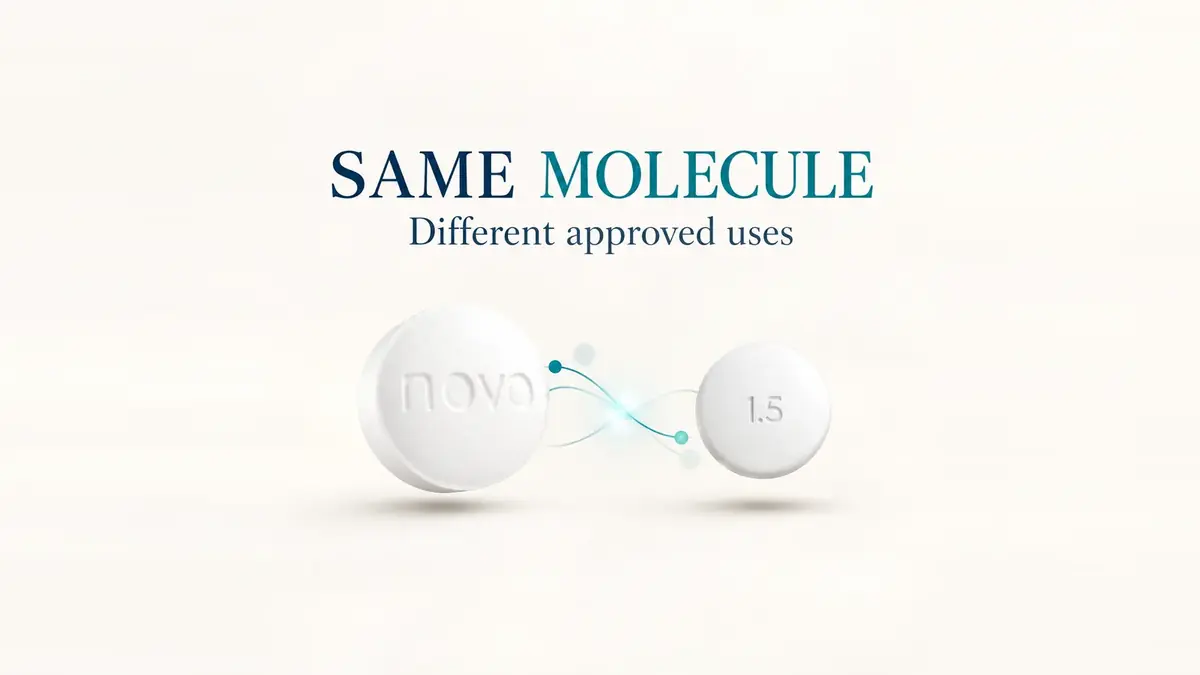
Illustrative image. Does not represent guaranteed results.
Key points
- Start with the part that takes the pressure off: you are not choosing between two drugs. Ozempic® and Wegovy® are the same molecule — semaglutide — from the same company.
- What differs is the approval the FDA granted each product. Ozempic® is approved for type 2 diabetes, for lowering cardiovascular risk in people who have diabetes plus heart disease, and for protecting the kidneys in people with diabetes and chronic kidney disease.
- Wegovy® is approved for long-term weight management, for lowering cardiovascular risk in people with overweight or obesity plus heart disease — with or without diabetes — and, since 2025, for fatty liver disease with inflammation and moderate-to-advanced fibrosis.
- The maximum dose differs too: Ozempic® tops out at 2 mg weekly. Wegovy® injection maintains at 2.4 mg, and its current label allows going up to 7.2 mg in selected cases.
- There is also a third form many people don't know exists: Wegovy® tablets, 25 mg daily, approved for weight and for cardiovascular risk.
- In the large trial of 1,961 adults without diabetes, semaglutide 2.4 mg reduced body weight by 14.9% over 68 weeks, versus 2.4% with placebo.
- In 17,604 people with heart disease and overweight or obesity, without diabetes, the same dose cut the risk of heart attack, stroke or cardiovascular death by 20%.
- Which box your physician chooses isn't paperwork — it is the clinical decision. Eligibility is determined by medical evaluation.
In this article
- The good news: it's one medication
- So what actually differs?
- The dose: 2 mg, 2.4 mg, and what came after
- What was measured at each dose
- The kidney finding almost nobody mentions
- The tablet changed the map
- "Ozempic for weight loss": what that means
- Why your insurance treats one molecule two ways
- What SCTS1 offers on both pathways
- So your expectations are the right ones
- Who is this NOT for?
- How it works at SCTS1
- Frequently asked questions
- Sources
The good news: it's one medication
If you came here to find out which of the two is better, here is an answer that simplifies your life considerably: the question doesn't apply.
Ozempic® and Wegovy® contain exactly the same molecule. It is called semaglutide. The same company makes both — Novo Nordisk. Neither is a copy of the other, neither is an improved version, neither is a generic. It is the same substance inside two boxes with different names.
That matters more than it sounds, because it changes the whole conversation. You are not comparing two drugs and trying to guess which one suits you. You are looking at one drug with two different permissions for use, and what decides which one fits you isn't the name on the box: it's what is being treated in your case.
There is something reassuring in that. It means the entire body of evidence built up around semaglutide — years of trials, tens of thousands of people — is about the molecule inside both boxes. You are not starting from zero with either one.
So what actually differs?
The approval differs. In the United States, the FDA does not approve a molecule in the abstract. It approves a product, for a specific indication, at specific doses. That is the label. And the label is different for each box.
What the Ozempic® label says
Three approved uses, all of them in people with type 2 diabetes:
- Improving glycemic control in adults with type 2 diabetes, alongside diet and exercise.
- Reducing the risk of major adverse cardiovascular events — cardiovascular death, non-fatal heart attack or non-fatal stroke — in adults with type 2 diabetes and established cardiovascular disease.
- Reducing the risk of sustained kidney function decline, end-stage kidney disease and cardiovascular death in adults with type 2 diabetes and chronic kidney disease.
Notice what is not on that list: weight management. It isn't there. Not because the molecule doesn't reduce weight — it does — but because that product was not approved for it.
What the Wegovy® label says
The injection has three approved uses, and none of them requires diabetes:
- Reducing the risk of major adverse cardiovascular events in adults with established cardiovascular disease and either obesity or overweight.
- Reducing excess body weight and maintaining that reduction long term in adults and in children aged 12 and older with obesity, or in adults with overweight plus at least one weight-related condition.
- Treating metabolic dysfunction-associated steatohepatitis — fatty liver with inflammation — without cirrhosis, with moderate to advanced fibrosis, in adults. This last one was granted under accelerated approval based on improvement in the liver and in fibrosis, and continued approval may depend on a confirmatory trial.
It is the same molecule doing different things in different populations, and each one had to be demonstrated separately, in its own trial. That is the real reason two boxes exist.
| Ozempic® | Wegovy® | |
|---|---|---|
| Molecule | Semaglutide | Semaglutide |
| Approved for type 2 diabetes | Yes | No |
| Approved for weight management | No | Yes |
| Cardiovascular risk | With type 2 diabetes | With overweight or obesity |
| Kidney | Yes, with diabetes and CKD | No |
| Fatty liver with fibrosis | No | Yes |
| Maximum weekly dose | 2 mg | 2.4 mg (up to 7.2 mg) |
| Available as a tablet | Not under this name | Yes, 25 mg daily |
The dose: 2 mg, 2.4 mg, and what came after
Both boxes start identically: 0.25 mg once a week for four weeks. That first dose is not meant to do the work. It is meant to let your stomach adjust. After that they climb, and the paths separate.
Ozempic® moves to 0.5 mg, and from there can go to 1 mg and then 2 mg, always with at least four weeks at each step. Two milligrams is the ceiling.
Wegovy® injection climbs through five steps: 0.25 → 0.5 → 1 → 1.7 → 2.4 mg, moving every four weeks. And here is the newer detail many people haven't caught up with: the current label allows going up to 7.2 mg weekly for weight reduction, only if the person tolerated 2.4 mg for at least four weeks and the physician judges that more is clinically warranted.
Written out, the gap between 2 and 2.4 mg looks small. In practice it is less trivial than it looks, because response to these medications is dose-dependent. But it is also not the difference between working and not working, and that is worth saying plainly.
What was measured at each dose
This is where "which is better" finally becomes answerable, because there are numbers.
The 2.4 mg dose, in people without diabetes
The landmark trial enrolled 1,961 adults with obesity, or with overweight plus a related condition, without diabetes. They received semaglutide 2.4 mg or placebo for 68 weeks, with lifestyle support in both groups.
Weight fell 14.9% on average with semaglutide, versus 2.4% with placebo. In kilograms: 15.3 against 2.6. And the distribution tells you more than the average: 86.4% lost at least 5% of their body weight, 69.1% lost at least 10%, and half — 50.5% — lost at least 15%. With placebo those figures were 31.5%, 12% and 4.9%.
The same dose, in people with diabetes
A separate trial of 1,210 adults with overweight or obesity and type 2 diabetes compared three groups over 68 weeks: semaglutide 2.4 mg, semaglutide 1 mg — a dose in the range approved for diabetes — and placebo.
At 2.4 mg, weight fell 9.6%. With placebo, 3.4%. Of those on 2.4 mg, 68.8% lost at least 5% of their weight, versus 28.5% on placebo.
Two things worth noting. First: in people with diabetes, the same molecule at the same dose produces less weight loss than in people without — 9.6% against 14.9%. That is a known pattern and does not mean something is going wrong. Second: that trial included a 1 mg arm precisely because "how much does the dose matter?" was a real question, and the answer favored 2.4 mg.
The heart, with no diabetes involved
This is the result that changed the category. 17,604 people aged 45 or older, with established cardiovascular disease and a body mass index of 27 or more, without diabetes. Half received semaglutide 2.4 mg, half placebo, and they were followed for nearly 40 months on average.
Cardiovascular death, non-fatal heart attack or non-fatal stroke occurred in 6.5% of the semaglutide group and 8.0% of the placebo group — a 20% reduction in relative risk.
That result is why Wegovy® now carries a cardiovascular indication that does not depend on having diabetes. Put another way: the benefit was not cosmetic. It was measured in hard events.
The heart, with diabetes
Before all of the above came the trial that opened the door: 3,297 people with type 2 diabetes, semaglutide 0.5 or 1 mg versus placebo over 104 weeks. The composite outcome occurred in 6.6% on semaglutide versus 8.9% on placebo. That study underpins Ozempic®'s cardiovascular indication.
The kidney finding almost nobody mentions
When people compare Ozempic® and Wegovy®, they usually talk only about weight. As it happens, the strongest argument for Ozempic® has nothing to do with weight at all.
One trial followed 3,533 people with type 2 diabetes and chronic kidney disease, assigned to semaglutide 1 mg weekly or placebo. It was stopped early at a planned interim analysis because the benefit was already clear. Median follow-up: 3.4 years.
- 24% lower risk of the trial's major kidney events: reaching kidney failure, losing half of kidney function, or dying from kidney-related or cardiovascular causes.
- 18% fewer major cardiovascular events.
- 20% lower death from any cause.
- Kidney function declined more slowly.
- And serious adverse events were less common on semaglutide than on placebo: 49.6% versus 53.8%.
If you have type 2 diabetes and your kidneys are affected, that is an entirely different conversation from weight loss — and one of the reasons the right box for you may not be the one you saw in an ad.
The tablet changed the map
There is a third option that breaks the two-column comparison: Wegovy® tablets.
It is oral semaglutide, once a day. The schedule starts at 1.5 mg for 30 days, rises to 4 mg, then 9 mg, reaching 25 mg daily from day 91. It is approved for long-term weight reduction and for lowering cardiovascular risk in people with heart disease and obesity or overweight.
For a lot of people the needle is the real obstacle, not the medication. A needle-free route that is approved and has its own published trial is concrete good news. We cover it separately in sublingual vs the Wegovy pill and in the Wegovy pill vs Zepbound.
One warning that sits in the label itself and is worth repeating: combining the tablet with the injection is not recommended, and neither is combining either one with any other semaglutide-containing product or any other GLP-1. One route at a time.
"Ozempic for weight loss": what that means
It is the most repeated phrase in this whole category, and it deserves an honest explanation rather than a scolding.
When a physician prescribes Ozempic® to someone whose main goal is weight loss, that is prescribing off-label. Meaning: the molecule is the right one and does what it does, but that specific use is not what the FDA approved for that product. Off-label prescribing is legal, and it is normal, long-standing medical practice — not a shady workaround. A physician decides it case by case and carries the clinical responsibility.
What does change, practically, is two things. First, coverage: an insurer that covers Ozempic® for diabetes may not cover it when the reason is weight, because coverage is decided against the approved indication. Second, dose: Ozempic®'s ceiling is 2 mg, and the weight trials were run at 2.4 mg.
So when the goal is weight and there is no diabetes, the product designed, studied and approved for that is the other one. This isn't marketing. It's that each box carries the dose its trial was run at.
Why your insurance treats one molecule two ways
This is the part that frustrates people most, and understanding it helps you walk in prepared.
Insurers do not evaluate molecules. They evaluate a product for an indication. Which is why something that looks absurd can happen: the same semaglutide, covered in one box and not the other, for the same person. That is not a glitch — it is exactly how the system is built.
The useful part of knowing this is that it changes the question you bring to your physician. Instead of "can you prescribe me Ozempic?", the question that actually helps is: "what are we treating, and which presentation is approved for that?" That is the question that opens the door to coverage, where coverage exists.
What SCTS1 offers on both pathways
We'll tell you about both, with their names and their prices, because hiding one would be treating you like someone to be managed.
Brand pathway. A licensed physician writes the prescription and the manufacturer's pharmacy sells and ships the medication: NovoCare® Pharmacy for Wegovy® and Ozempic®, LillyDirect® for Zepbound®, Mounjaro® and Foundayo™. You pay the pharmacy directly. Pills start from $149/month at starting doses; injectable semaglutide from $199 and tirzepatide from $299. Membership is separate.
Compounded pathway. Semaglutide or tirzepatide from a licensed pharmacy, from $88.99/month, at the dose a physician writes. A compounded preparation is not an FDA-approved finished drug, and it is not "the generic" of Wegovy® or "the cheap version" of Ozempic®. It is a different category.
Both run through telemedicine, in Spanish and English, and both include follow-up. Eligibility is determined by medical evaluation. Individual results vary and are not guaranteed.
If you want to see how it's all put together, it's in our programs.
So your expectations are the right ones
Three things, said without drama:
One. The 14.9% is an average across 1,961 selected people, supported for 68 weeks, with lifestyle changes built into both arms. Inside that average were people who lost a great deal more and people who lost considerably less. Half the group reached 15% or more; the other half did not. It is not a forecast for your case.
Two. The difference between 2 and 2.4 mg is real, but there is no head-to-head trial of the two boxes as they are sold. What exists is a trial that compared 2.4 mg against 1 mg within one study, in people with diabetes. That's good evidence — it just isn't the exact question.
Three. Digestive side effects are common, especially while the dose is climbing. In the diabetes trial they were reported by 63.5% on 2.4 mg and 57.5% on 1 mg, versus 34.3% on placebo — mostly mild to moderate. That is why the schedule climbs slowly, and why the adjusting is done by a physician who follows you, not by a fixed calendar.
What you can expect with reasonable confidence: that this molecule sits on one of the largest evidence bases in recent metabolic medicine, that the measured benefit goes beyond the number on the scale, and that a physician can sort the options out with you in one visit instead of you resolving it by reading comment threads.
Who is this NOT for?
This section is not negotiable, and we write it out in full even though it doesn't sell.
- If you or a family member has had medullary thyroid cancer, or if you have multiple endocrine neoplasia syndrome type 2. GLP-1s are not used there.
- If you've had a serious allergic reaction to semaglutide or to any GLP-1.
- If you are pregnant, trying to conceive, or breastfeeding. This is not for that stage, and it's better discussed beforehand than after.
- If you have a history of pancreatitis, gallstones, diabetic retinopathy or gastroparesis. These aren't automatic disqualifications, but they change the conversation and sometimes the answer.
- If you take insulin or pills that lower blood sugar. It can be done, but doses get adjusted and that needs an attentive physician, not an online prescription.
- If you are already using another GLP-1 or any other semaglutide-containing product. The label says combining them is not recommended. One route at a time.
- If what you want is the injection without the follow-up. Buying semaglutide from someone who never asks for your medical history is not a shortcut — it is the real risk in this category.
- If your weight won't move and the underlying cause is something else — your thyroid, broken sleep, a medication you're taking. Starting a GLP-1 on top of that covers the problem up. We'll tell you, even if it means you don't start with us.
How it works at SCTS1
Here is the real order, no fine print.
SCTS1 does not prescribe or dispense medication. We work with two companies: Scientists One Health (SOH) for brand medications, and Altro Health, an independent licensed clinical platform, for compounded ones. Once you start your program, a licensed physician reviews your case — habits, stress, sleep and medical history — and orders labs only if they consider it necessary. Eligibility is determined by medical evaluation. The order is exactly that: you start, the physician reviews, and only then is it decided what fits.
What you pay covers the medical evaluation, the prescription and the follow-up. The medication is paid to the pharmacy, at the prices above.
And one more thing, because it's the part that defines us: if your case points to the box you came looking for not being the one that fits you, we will tell you — even if the one that fits is the cheaper one, or none at all.
Frequently asked questions
Are Ozempic and Wegovy the same thing?
They contain the same molecule, semaglutide, and the same company makes them. They are not the same product: different FDA approvals, different maximum doses — 2 mg versus 2.4 mg, with the option of reaching 7.2 mg for Wegovy injection — and they're prescribed for different things. Same substance, two products.
Which one produces more weight loss?
No trial compares the two boxes as they are sold. What was measured, inside a single study in people with diabetes, was 2.4 mg against 1 mg, and the higher dose produced more weight loss. The large weight trials were run at 2.4 mg, which is the Wegovy dose.
Can I ask for Ozempic if I don't have diabetes?
A physician can prescribe it off-label, which is legal and routine. But if the goal is weight and there's no diabetes, the product approved for that is the other one, carrying the dose its trials used. That decision belongs to the physician reviewing your case, not to an article.
Why does my insurance cover one and not the other?
Because coverage is decided against the product's approved indication, not against the molecule. The same semaglutide can be covered in one box and not the other, for the same person. Walking in knowing what is being treated is what helps most in that conversation.
Does the tablet replace the injection?
It's a different route, approved, with its own dose schedule: 1.5 mg daily climbing to 25 mg. Using it alongside the injection or any other GLP-1 is not recommended. Which one fits depends on the case, and the physician decides.
What if my issue is my kidneys or my liver?
Then the conversation changes quite a bit. For type 2 diabetes with chronic kidney disease there is a specific approved indication, based on a trial of 3,533 people. For fatty liver with inflammation and moderate-to-advanced fibrosis, the approved indication belongs to the other box. Different clinical reasons leading to different products.
What happens if I stop?
Fair question, and the answer is just as plain: weight tends to return after stopping, because the medication works while it is present. That is why the indication speaks of reducing weight and maintaining that reduction long term, and why the plan matters as much as the prescription. We cover it in preventing weight regain.
Sources
- Wilding JPH, Batterham RL, Calanna S, et al. Once-weekly semaglutide in adults with overweight or obesity. N Engl J Med. 2021;384(11):989-1002. — DOI
- Davies M, Færch L, Jeppesen OK, et al. Semaglutide 2·4 mg once a week in adults with overweight or obesity, and type 2 diabetes (STEP 2): a randomised, double-blind, double-dummy, placebo-controlled, phase 3 trial. Lancet. 2021;397(10278):971-984. — DOI
- Lincoff AM, Brown-Frandsen K, Colhoun HM, et al. Semaglutide and cardiovascular outcomes in obesity without diabetes. N Engl J Med. 2023;389(24):2221-2232. — DOI
- Marso SP, Bain SC, Consoli A, et al. Semaglutide and cardiovascular outcomes in patients with type 2 diabetes. N Engl J Med. 2016;375(19):1834-1844. — DOI
- Perkovic V, Tuttle KR, Rossing P, et al. Effects of semaglutide on chronic kidney disease in patients with type 2 diabetes. N Engl J Med. 2024;391(2):109-121. — DOI
- U.S. Food and Drug Administration. OZEMPIC (semaglutide) injection — Prescribing Information, NDA 209637. — FDA label
- U.S. Food and Drug Administration. WEGOVY (semaglutide) injection / tablets — Prescribing Information, NDA 215256. — FDA label
Related articles
Your trust is worth more than a sale.
This article is informational and is not medical advice. SCTS1 does not prescribe or dispense medication. All medical care, prescriptions and treatment plans are provided by licensed physicians through our partner platforms. Treatment eligibility is determined by a licensed provider through medical evaluation. Ozempic®, Wegovy®, Mounjaro®, Zepbound® and Foundayo™ are registered trademarks of their respective owners, which are not affiliated with SCTS1 and do not sponsor this content. Compounded medications are not FDA-approved finished drugs and are not approved equivalents of any brand medication. The figures cited are averages from specific populations and are not a forecast for your case. Off-label use is decided by a licensed physician, case by case. Do not stop or change a medication without speaking to whoever prescribed it. Individual results vary and are not guaranteed.