Loose skin after weight loss: what the evidence shows
En español: Piel flácida al bajar de peso — qué la causa, qué ayuda realmente desde adentro, y qué todavía no está probado.
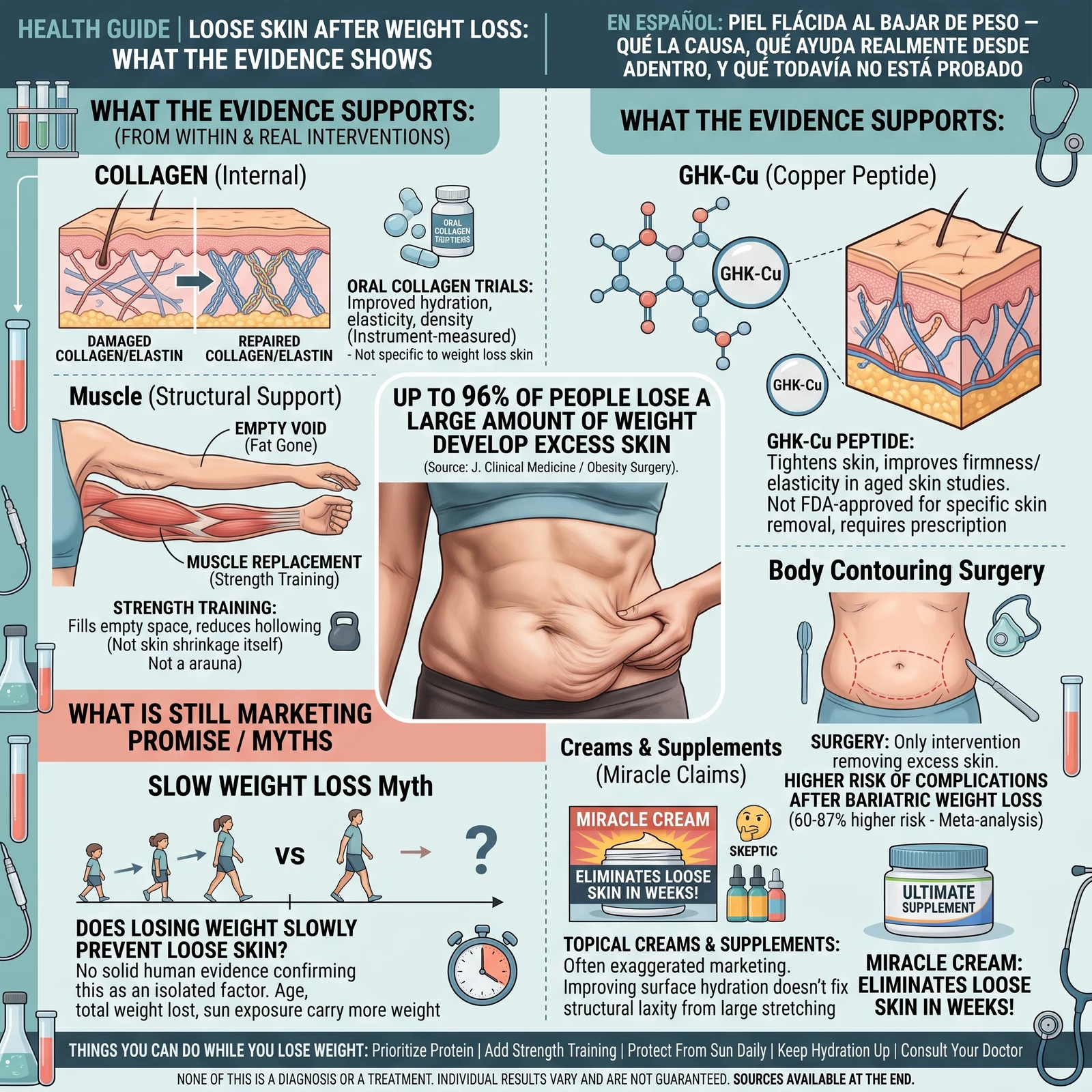
You hit the number you were working toward, and the mirror shows something nobody warned you about: skin doesn't always shrink at the same pace as the rest of the body. It stays a little loose around the abdomen, the back of the arms, the inner thighs — right where there used to be more volume.
It's not in your head, and it's not rare. A study of people who lost a large amount of weight after bariatric surgery found 96% developed excess skin somewhere on the body, according to a review published in Journal of Clinical Medicine. With more people now losing weight steadily on GLP-1 programs, it's a question that comes up more and more in consults — and increasingly in ads promising solutions that aren't actually proven.
This article separates the two: what the evidence supports — collagen, GHK-Cu, muscle, surgery — and what's still marketing promise. Sources at the end.
Key points
- Up to 96% of people who lose a large amount of weight develop excess skin somewhere on the body, per data gathered in Journal of Clinical Medicine and confirmed by an independent study in gastric bypass patients.
- In that same study, 75% of women and 68% of men wanted body contouring surgery — even though 90% and 88% respectively rated their overall appearance as satisfactory or better.
- Body contouring surgery after massive weight loss carries 60% to 87% higher risk of complications than the same surgery in people who did not lose weight via a bariatric route, per a meta-analysis of 7 studies.
- In placebo-controlled trials, oral collagen improved instrument-measured skin hydration, elasticity and density over 8 weeks — but none of those trials were run in people with excess skin from large weight loss.
- GHK-Cu, the copper peptide, showed in controlled studies on aged skin that it tightens skin and improves firmness and elasticity — it is not FDA-approved and no research has directly compared it against excess skin from large weight loss.
- There is no solid human evidence that losing weight more slowly, by itself, prevents loose skin. Total amount of weight lost, age, and years of sun exposure carry more documented weight in what has been studied.
- None of this is a diagnosis or a treatment. Individual results vary and are not guaranteed.
In this article
- What loose skin is and why it happens
- How common it is — with real numbers
- Body contouring surgery: what it does and its real risk
- Collagen from the inside: what the trials show
- GHK-Cu: the copper peptide and skin
- Muscle: why filling the space matters
- Does losing weight more slowly prevent loose skin?
- Things you can do while you lose weight
- What changes if you're on a GLP-1 program
- What this evidence does NOT say
- Who is this NOT for?
What loose skin is and why it happens
Skin has two support layers that give it the ability to stretch and spring back: collagen, which gives it structure and firmness, and elastin, which gives it stretch. When you gain weight over months or years, those fibers stretch gradually to accommodate the new volume — similar to what happens to abdominal skin during pregnancy.
The problem is that stretching is easier than shrinking back. Collagen and elastin don't contract as easily as they stretched, especially if the stretch was large or lasted a long time. Once the fat that was supporting that skin is gone — through diet, exercise, or a GLP-1 program — the skin that stretched to cover it is left with more surface area than the new body needs.
Three factors determine how much this happens: age (younger skin has more capacity to retract), the total amount of weight lost, and skin quality before starting — including years of sun exposure, smoking, and genetics. None of these factors can be fully controlled, which is part of what makes this topic so frustrating for people.
How common it is — with real numbers
It's far more common than most people expect going into a large weight loss process. A review published in Journal of Clinical Medicine in 2022 describes excess skin as affecting up to 96% of people who lose a large amount of weight through bariatric surgery, and notes that 46,577 body contouring procedures were performed after massive weight loss in the United States in 2020 alone, per figures from the American Society of Plastic Surgeons cited in the same article.
That same study, led by Kitzinger's team in Vienna, found something worth underlining: despite the excess skin, 90% of women and 88% of men rated their overall appearance after weight loss as satisfactory, good, or very good. At the same time, 75% of women and 68% of men wanted body contouring surgery, mainly for improved appearance, confidence and quality of life — not an urgent medical problem in most cases, though excess skin can also cause irritation, fungal infections, and difficulty exercising or finding clothes that fit.
The honest read: excess skin is an expectable consequence of large weight loss, not a sign that something went wrong. And its presence doesn't mean overall appearance has to feel worse — both things can be true at once.
Body contouring surgery: what it does and its real risk
The only intervention that directly removes excess skin is surgery — abdominoplasty, brachioplasty (arms), or thigh lift, depending on the area. It's not a minor cosmetic procedure: it involves anesthesia, recovery time, and permanent scars, which is why the decision is made with a plastic surgeon, case by case.
What almost nobody mentions is the differentiated risk. A meta-analysis published in the Journal of Plastic, Reconstructive & Aesthetic Surgery, pooling seven studies, found that body contouring surgery in patients who lost weight via bariatric surgery carries a 60% higher complication risk than the same surgery in people who lost weight through diet or exercise. In the subgroup of patients who had only a single procedure, that risk rises to 87% higher.
This doesn't mean surgery is a bad idea — for many people it's the only option that actually removes the excess — but it does mean the conversation with the surgeon needs to include that risk honestly, not just the final cosmetic outcome.
Collagen from the inside: what the trials show
Before reaching surgery, the most common question is whether anything taken orally can help. The evidence here is real but limited in scope.
A randomized, double-blind, placebo-controlled trial published in Journal of Cosmetic Dermatology in 2024 gave oral tuna collagen peptides to 36 women over 8 weeks. The group that received collagen showed significant increases in instrument-measured skin hydration, elasticity and density compared with placebo — and the effect held even 2 weeks after stopping.
A second randomized, placebo-controlled trial, in 66 people aged 30 to 60, tested a proteoglycan derived from salmon nasal cartilage over 56 days and found significant improvements in elasticity, hydration, roughness and wrinkles versus placebo.
The honest part: neither trial was conducted in people with excess skin from large weight loss. Both were done in general populations evaluating signs of skin aging, not skin stretched by lost weight. That collagen improves hydration and elasticity in those contexts is a real finding; that it resolves already-formed excess skin is an extrapolation science hasn't directly tested yet.
GHK-Cu: the copper peptide and skin
If you've read about recovery peptides and skin, you've likely come across GHK-Cu — a small peptide that already circulates naturally in your body and whose levels decline with age. It's one of the more studied peptides in humans within this category. We cover it in detail, in Spanish, in our dedicated GHK-Cu article.
In controlled studies on aged skin, reviewed by researcher Loren Pickart and his team, creams containing GHK-Cu tightened skin and improved elasticity, density and firmness, while also reducing fine lines, wrinkles, photodamage and hyperpigmentation over periods of several weeks. The proposed mechanism: GHK-Cu stimulates production of collagen, elastin and other proteins in the skin's matrix.
What doesn't exist is a study comparing GHK-Cu specifically against the excess skin left by large weight loss — the available research is on skin aged by time and sun exposure, a related but not identical mechanism. And as with any compounded peptide: GHK-Cu is not FDA-approved for any use, is prepared at a licensed compounding pharmacy per prescription, and is not intended to diagnose, treat, cure, or prevent any disease or skin condition.
Muscle: why filling the space matters
There's a piece almost nobody mentions in conversations about loose skin: what's underneath the skin. When you lose fat without building or keeping muscle, the space fat used to occupy is left empty, and the skin that stretched to cover that volume looks looser. When you keep or build muscle mass while losing weight, part of that space fills back in — not because the skin itself shrinks more, but because there's less hollow space to cover.
This is why strength training keeps showing up in recommendations from physicians and plastic surgeons for patients losing weight, even though no trial yet directly measures its effect on skin elasticity. If you want to go deeper on protecting muscle while you lose weight, our article on preventing weight regain covers habits that protect lean mass.
Does losing weight more slowly prevent loose skin?
This is one of the most commonly repeated claims, and the honest answer is: there is no solid human evidence confirming it as an isolated factor. We did not find a controlled trial that directly compares the speed of weight loss — fast versus gradual, in the same people or comparable groups — and measures the outcome in skin elasticity.
What the bariatric surgery and body contouring literature consistently shows is that the factors with the most documented weight are others: total amount of weight lost, age, and accumulated years of sun exposure and smoking before starting. That doesn't mean pace matters not at all — it's biologically plausible that giving skin more time to adapt helps — it means it isn't proven with the same rigor as the other factors, and repeating it as a guarantee would go beyond what today's evidence says.
Things you can do while you lose weight
None of these guarantee avoiding excess skin, but all of them target mechanisms that do have support.
1. Prioritize protein at every meal
It's the raw material for both maintaining muscle and synthesizing collagen. Aim for a portion of protein at breakfast, lunch and dinner, not just at one meal.
2. Add strength training, not just cardio
Two or three times a week. It's the intervention with the best biological logic for filling the space left by lost fat.
3. Protect your skin from the sun consistently
Accumulated sun damage is one of the most repeated factors in the skin-quality literature. Daily sunscreen, not just at the beach.
4. Keep hydration up
Well-hydrated skin behaves differently than dry skin, though external hydration doesn't replace the structural changes of collagen and elastin.
5. Talk to your doctor before buying big promises
Creams and supplements that promise to "eliminate" excess skin in weeks don't have that level of support. Ask what evidence exists before spending on something.
6. If it worries you from the start, ask for a realistic plan
A clinician can help you set honest expectations based on your age, the amount of weight to lose, and your skin history — before it's a surprise at the end of the process.
What changes if you're on a GLP-1 program
GLP-1 medications help you lose weight steadily, but they don't do anything different for your skin's elasticity — that mechanism depends on your age, genetics, and how you support the process with protein, strength training, and skin care. A serious program should talk to you about this from the start, not leave it as a surprise at the end.
Once you start your program, a licensed physician through our partner platform reviews your case — habits, stress, sleep and medical history — and orders labs only if they consider it necessary. Eligibility is determined by medical evaluation. Sometimes the answer includes an honest conversation about skin expectations, and that conversation is worth as much as a prescription.
GLP-1 programs with FDA-approved medications (Wegovy®, Foundayo™, Ozempic®) from $149 a month, by telemedicine, in Spanish and English.
What this evidence does NOT say
Let's be explicit, because this is a topic full of overblown promises.
It does not say there's a cream, peptide, or supplement that eliminates excess skin. What the cited studies show is instrument-measured improvement in hydration, elasticity, or firmness — not the disappearance of already-formed excess skin.
It does not say losing weight more slowly guarantees avoiding it. It's a reasonable hypothesis, not a proven finding in the studies we reviewed.
It does not say excess skin is avoidable in every case. Age and genetics are factors no habit changes.
And it does not say you need surgery to look or feel good. The same study that found 96% had excess skin also found 9 out of 10 women rated their overall appearance as satisfactory or better.
Who is this NOT for?
This article is not for you if you already have excess skin causing irritation, recurring fungal infections, or back pain — those are reasons to talk with a plastic surgeon soon, not to wait for a peptide or supplement to solve the problem.
It's also not for you if you're looking for a "no surgery, no effort" promise in weeks. No topical or oral product cited here has that level of evidence, and anyone promising that is selling more than the science supports.
It is for you if you're starting or in the middle of a large weight loss process and want an honest answer about what to expect from your skin and which tools have real support — so you arrive prepared, not surprised.
Frequently asked questions
Does loose skin always happen after weight loss?
Not always, but it is common after a large weight loss. A study in bariatric surgery patients found 96% developed excess skin somewhere on the body. Risk rises with the total amount of weight lost, age, and years of accumulated sun exposure, not any single isolated factor.
Does GHK-Cu get rid of loose skin?
There is no evidence of that. In controlled studies on aged skin, topical GHK-Cu showed measurable improvements in firmness and elasticity, but no research has compared it specifically against the excess skin left by large weight loss. It is not FDA-approved for any use and does not replace a plastic surgery evaluation when that is the real need.
How much weight do you have to lose for it to appear?
There is no fixed published number. What bariatric surgery literature shows is that the more body weight is lost, the more likely excess skin is noticed, especially in the abdomen, arms and thighs. Age and skin quality before starting also play a role.
Is surgery the only real solution?
It is the only option that surgically removes excess skin, but it is not the only option and it is not for everyone. It carries a documented 60% to 87% higher complication risk than the same contouring surgery in people who did not lose weight through bariatric surgery. It is a decision made with a plastic surgeon, case by case.
Does taking collagen actually help?
There is preliminary evidence from placebo-controlled trials that oral collagen improves instrument-measured skin hydration, elasticity and density over 8 weeks. None of those trials were done specifically in people with excess skin from large weight loss, so the direct translation is not proven.
Does strength training help with loose skin?
It helps with what sits underneath the skin: more muscle fills part of the space left by lost fat, which can improve overall appearance even if it does not change the skin's own elasticity. It is the best-supported intervention overall for protecting body composition while you lose weight.
Which labs are ordered for this?
A clinician decides that. Once you start your program, a licensed physician reviews your case — habits, medical history, goals — and orders labs only if they consider it necessary. Eligibility is determined by medical evaluation.
Do you offer care in Spanish?
Yes. All our content and care are available in Spanish and English.
Sources
- Kitzinger HB, Abayev S, Pittermann A, et al. After massive weight loss: patients' expectations of body contouring surgery. Obes Surg. 2012;22(4):544-548. — DOI · via PubMed
- Sadeghi P, Duarte-Bateman D, Ma W, et al. Post-Bariatric Plastic Surgery: Abdominoplasty, the State of the Art in Body Contouring. J Clin Med. 2022;11(15):4315. — DOI · via PubMed
- Hasanbegovic E, Sørensen JA. Complications following body contouring surgery after massive weight loss: a meta-analysis. J Plast Reconstr Aesthet Surg. 2014;67(3):295-301. — DOI · via PubMed
- Morakul B, Teeranachaideekul V, Wongrakpanich A, Leanpolchareanchai J. The evidence from in vitro primary fibroblasts and a randomized, double-blind, placebo-controlled clinical trial of tuna collagen peptides intake on skin health. J Cosmet Dermatol. 2024;23(12):4255-4267. — DOI · via PubMed
- Bai XD, Liu YC, Ge SY, Fei WC. Clinical Trial of Salmon Nasal Cartilage-Derived Proteoglycans on Human Facial Antiaging: A Randomized, Double-Blind, Placebo-Controlled Study. J Cosmet Dermatol. 2025;24(7):e70218. — DOI · via PubMed
- Pickart L. The human tri-peptide GHK and tissue remodeling. J Biomater Sci Polym Ed. 2008;19(8):969-988. — DOI · via PubMed
- Pickart L, Vasquez-Soltero JM, Margolina A. GHK Peptide as a Natural Modulator of Multiple Cellular Pathways in Skin Regeneration. Biomed Res Int. 2015;2015:648108. — DOI · via PubMed
Related articles
Preventing weight regain → Weight loss plateau: why it happens → Your first month on a GLP-1 →Your trust is worth more than a sale.
This article is informational and is not medical advice. SCTS1 does not prescribe medication. All medical care, prescriptions, and treatment plans are provided by licensed healthcare providers through our partner platform. Treatment eligibility is determined by a licensed provider. Compounded medications contain the same active ingredient class but are not FDA-approved finished pharmaceuticals. Individual results vary and are not guaranteed.