Lipo-B and MIC injections: do they actually burn fat?
En español: qué lleva adentro una inyección Lipo-B o MIC, qué encontramos al buscar ensayos clínicos, y cuál es la única inyección para grasa aprobada por la FDA.
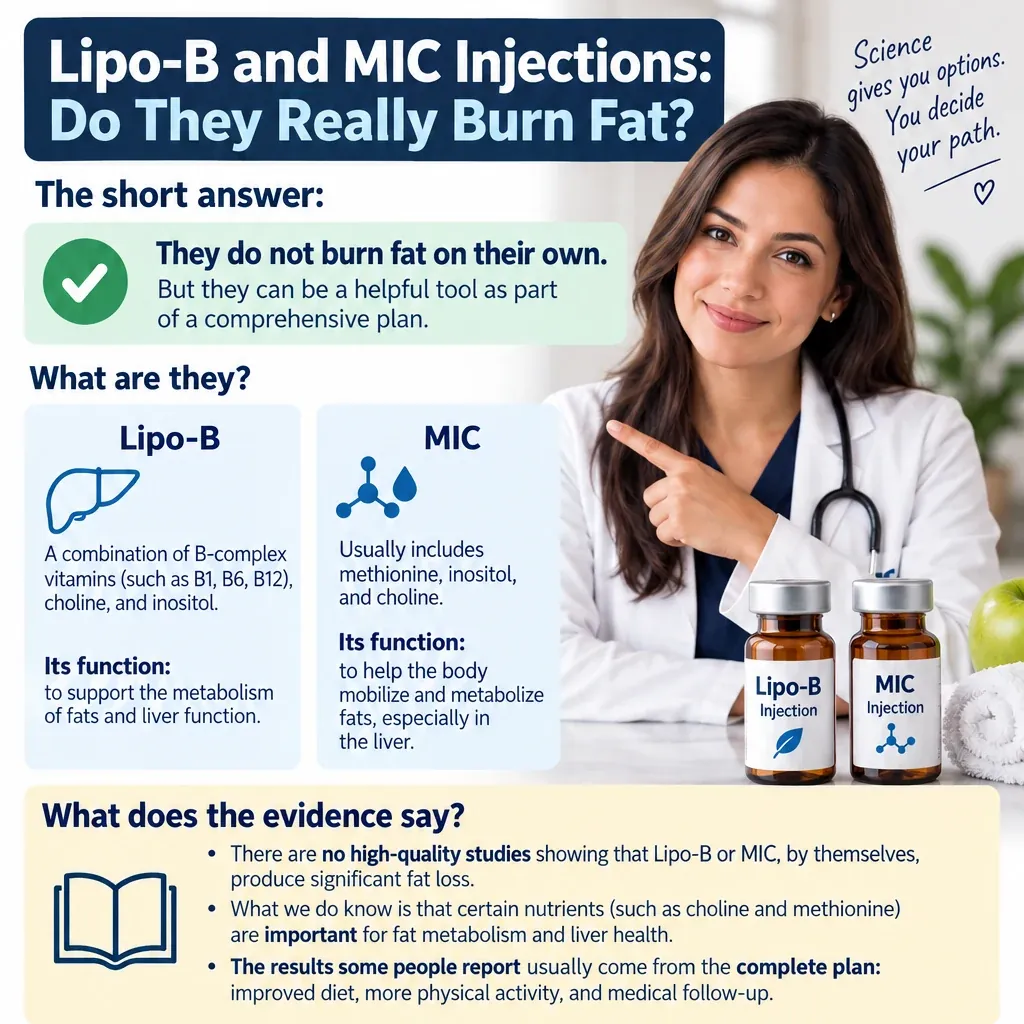
If you have ever walked into a weight-loss clinic, you have probably been offered one. They call it the fat-burner shot, the lipotropic, Lipo-B, or MIC. It runs $25 to $50, goes into the arm or the hip, and the pitch is usually one or two a week.
It is one of the questions we get most. And it deserves a full answer rather than a flat "it doesn't work" or an enthusiastic "yes it does."
This article covers three things: what is actually in that syringe, what we found when we went looking for the studies, and what the FDA has actually approved when it comes to injections for fat. That last part is the most useful, because it gives you something real to compare against.
Key points
- MIC stands for methionine, inositol and choline. The B in Lipo-B is vitamin B12. These are real nutrients, not inventions.
- We searched PubMed for clinical trials of these injections for weight loss. The result was zero. It is a search you can run yourself.
- The FDA states that Kybella (deoxycholic acid) is the only injectable approved to reduce fat — and only under the chin.
- In Kybella's phase 3 trial, 70.0% improved by at least one grade versus 18.6% on placebo. That is what a fat injection that went through the full process looks like.
- The FDA has received reports of permanent scars, serious infections, cysts and painful knots from unapproved fat-dissolving injections.
- Choline genuinely matters for the liver — but that is solved at the table, and protecting the liver from storing fat is not the same as burning fat off your waist.
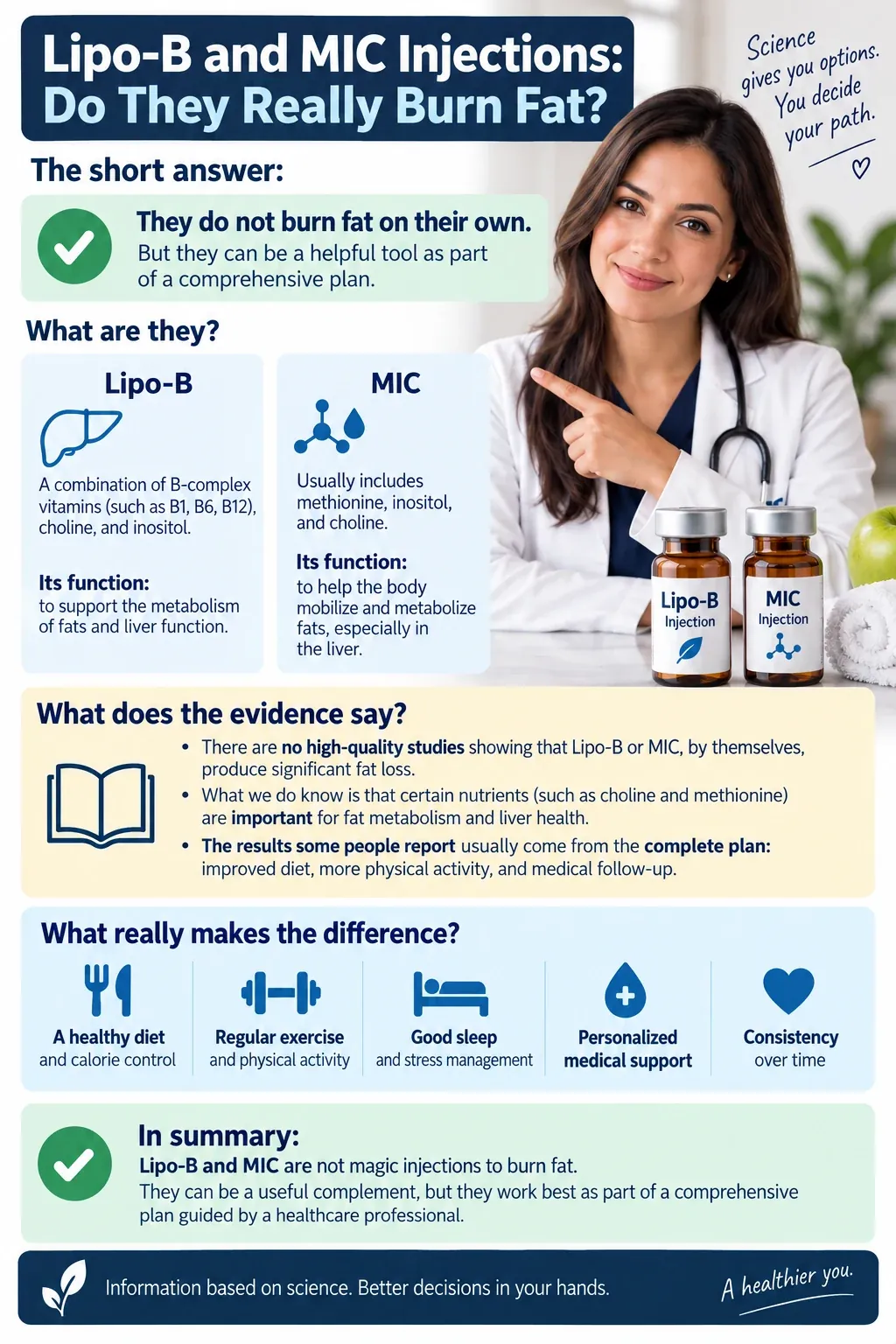
Lipo-B and MIC: what they contain, what the evidence shows, and what actually drives weight loss.
In this article
- What is actually in the syringe
- Where the word "lipotropic" comes from
- The search you can repeat
- Choline: the ingredient with the best science
- Methionine and inositol
- B12 and the energy myth
- The one fat injection the FDA did approve
- What the FDA has reported about the unapproved ones
- Why some people do lose weight
- Six questions before you accept one
- Weight and metabolism: where your program fits
- What this evidence does NOT say
- Who is this NOT for?
- Frequently asked questions
- Sources
What is actually in the syringe
Start with the basics, because almost nobody explains them.
MIC is an acronym. It is the first letter of three compounds:
- M for methionine, an essential amino acid. Your body cannot make it; it comes from food.
- I for inositol, a sugar-like molecule involved in how cells receive signals, including the insulin signal.
- C for choline, an essential nutrient the body uses to build cell membranes and to move fat out of the liver.
The B in Lipo-B is vitamin B12, usually as cyanocobalamin or methylcobalamin. It is what gives the mixture that bright pink color you would recognize.
Some formulas add more: B6, B5, thiamine, L-carnitine. And here is the first thing worth knowing.
There is no single Lipo-B formula. It is a compounded preparation, made by a compounding pharmacy to the prescriber's or clinic's recipe. Doses and ingredients vary from place to place. Two people who both say "I get lipotropic shots" may be receiving noticeably different things.
That does not make it shady or illegal. Compounding pharmacies are a legitimate, regulated part of the system. But it does mean something concrete: a compounded formula does not go through FDA approval. Nobody had to prove to the agency that this mixture does what it is being sold to do.
Where the word "lipotropic" comes from
The word sounds modern. It is nearly a hundred years old.
"Lipotropic" literally means "moving toward fat." It comes from 1930s laboratory research in animals. Scientists noticed that when choline was removed from the diet, the animals' livers filled with fat — and that giving the choline back resolved it.
That finding was real and still holds. The methionine- and choline-deficient diet remains one of the classic laboratory models used to deliberately produce fatty liver in order to study it.
But look carefully at what the experiment proves, and what it does not.
It proves that lacking choline makes the liver store fat. It does not follow that an excess of choline makes the body burn the fat you already carry. Those are two different claims, and only one of them has been demonstrated.
It is the same logic as any nutrient. If you are low in iron you feel exhausted, and correcting it gives you your energy back. If your iron is already normal, more iron does not turn you into an athlete. The jump from "correcting a deficiency" to "improving someone who isn't deficient" is exactly where an enormous number of health promises break.
There is a second distinction that gets lost: liver fat and belly fat are not the same depot. They are related, but not interchangeable. We cover fatty liver separately, because it affects one in four adults and almost never causes symptoms.
The search you can repeat
Here is the part that was hardest to write, and the most important.
PubMed is the U.S. National Library of Medicine's database of medical literature. It is free, public, and it is where essentially every published clinical trial in the world is indexed. When we cite a study on this site, that is where it comes from.
We went looking for clinical trials of lipotropic injections — methionine, inositol, choline and B12 — for weight loss.
It is worth saying exactly what that means, without overstating it in either direction.
It does not mean they have been proven not to work. Nobody has shown that either. Proving something does not work also takes a study.
It does mean that if someone tells you it is "proven" that these shots burn fat, that claim has nothing to stand on. There is no published trial behind it. The absence is complete.
And you can verify it. Go to pubmed.ncbi.nlm.nih.gov, type "lipotropic injections weight loss," and see how many results come back. You do not have to take our word for it.
This is what we mean when we write that your trust is worth more than a sale. It would be far easier to write an article about how good people feel on their lipotropic shots. This number sells less and helps more.
Choline: the ingredient with the best science
Of the four components, choline has the strongest human science. It deserves to be told properly, because it is real.
Choline is an essential nutrient. The body makes some on its own, but not enough; the rest has to come from food. It is in eggs, liver, meat, fish, poultry, soy, and cruciferous vegetables like broccoli and cauliflower.
The recommended adequate intake for adults is 550 mg a day for men and 425 mg a day for women. One whole egg supplies roughly 150 mg — almost all of it in the yolk.
A team at the University of North Carolina ran the study that actually answers the question. They put healthy adults on a choline-sufficient diet, then on a very low choline diet under controlled conditions, and watched what happened.
Some of them developed signs of liver or muscle damage. But not all of them — and that is the interesting part, because who got sick depended on two things.
The first was genetics. There is a common variant in a gene called PEMT, which is what lets the body make its own choline. Among premenopausal women, 80% of those carrying two copies of that variant developed problems on the low-choline diet. With one copy, 43%. With no copies, only 13%.
The second was estrogen, because estrogen switches that gene on. Among postmenopausal women, 73% of those given placebo ran into trouble on the low-choline diet. Among those given estrogen, only 18%.
| Group (low-choline diet) | Developed damage |
|---|---|
| 2 copies of the PEMT variant | 80% |
| 1 copy | 43% |
| No copies | 13% |
| Postmenopausal, placebo | 73% |
| Postmenopausal, estrogen | 18% |
It is a beautiful study, and it says something that applies well beyond choline: the same diet does not do the same thing to everyone.
Now read again what it measured. It measured what happens when choline is missing. It did not measure fat loss, or weight, or waist size. And the problem was corrected with food, not with a needle.
That is the honest conclusion on choline: it is a nutrient that genuinely matters, especially for the liver, and most people fall short of the recommended amount. It is worth attending to. You attend to it on the plate.
Methionine and inositol
Methionine
An essential amino acid that acts in the body as a methyl donor — a kind of courier delivering chemical parts that other reactions need. Among other things, it takes part in moving fat out of the liver.
If you eat protein regularly, you already get methionine in quantity. It is in meat, fish, eggs, dairy and soy. Methionine deficiency in someone eating normally is rare in the United States.
And the other side is worth knowing. Methionine converts to homocysteine in the body, and elevated homocysteine is a marker watched for its association with cardiovascular risk. The body has a way to recycle it — using folate, B12 and B6 — but it is one more reason not to assume that more is always better with this particular amino acid.
Inositol
Inositol has studies of its own, and they are more interesting than people assume — but for something else.
Most human inositol research is in polycystic ovary syndrome. In a network meta-analysis comparing several oral supplements in women with PCOS, inositol performed best for improving markers of insulin resistance and the lipid profile, and those improvements correlated with changes in body mass index.
Two caveats matter. That study is oral inositol, not injected. And it is a specific population with a specific hormonal condition. It is a reasonable signal that inositol does something for glucose handling — it is not evidence that a lipotropic shot burns fat in the general population.
B12 and the energy myth
Of all the components, B12 is the one people most often say they feel. It is also where two different things get conflated.
Vitamin B12 is essential for red blood cells, for the nervous system and for DNA. Real deficiency exists and is not rare: it is more common after 50, in people on long-term metformin or acid-reducing medication, in strict vegetarians, and after bariatric surgery.
In those people, a B12 injection is not a luxury. It is treatment. The fatigue of B12 deficiency runs deep, and correcting it is something you feel.
But if your levels are already normal, more B12 does not create extra energy. B12 is not fuel. It is a part that a machine needs in order to run; having spare parts on the shelf does not make the machine run faster. It is water soluble, so the surplus is excreted.
The cleanest way to know which group you are in is to measure it. It is a common, inexpensive lab. If it is low, treating it makes sense and it does not need to arrive mixed with anything else. If it is normal, you already have your answer.
If you want to see how measurement changes the picture elsewhere in metabolism, our article on insulin resistance makes the same point with different numbers.
The one fat injection the FDA did approve
To judge lipotropics fairly you need a reference point: what a fat injection that went through the entire process actually looks like.
There is exactly one. The FDA says so plainly on its own consumer page: Kybella, the brand name for deoxycholic acid, is the only fat-dissolving injectable drug approved to reduce the amount of fat under the chin — the "double chin" — in adults. And it adds a line worth underlining: the FDA has only evaluated this drug for use under the chin, and it is not approved for use in any other area of the body.
Deoxycholic acid is a bile salt the body already produces. Injected into fat beneath the skin, it breaks down the membrane of fat cells. This is called adipocytolysis: the cells are not emptied, they are destroyed.
Look at the kind of evidence it took to get there. The phase 3 trial, REFINE-1, enrolled 256 people on the drug and 250 on placebo, double blind. Neither patient nor physician knew who was getting what.
| REFINE-1 (phase 3) | Drug vs placebo |
|---|---|
| ≥1-grade improvement | 70.0% vs 18.6% |
| ≥2-grade improvement | 13.4% vs 0% |
| MRI-measured response | 46.3% vs 5.3% |
Notice two details. First: 18.6% of the placebo group improved too. That is what shows up when a person receives attention, follow-up and expectation — and it is precisely why a placebo group is indispensable. Without one, anybody would have sworn that 18.6% was the treatment working.
Second: there was an objective measurement, by MRI, alongside the patient's and the clinician's judgment.
And the approved drug has real adverse effects. In that trial, 4.3% of treated patients had temporary weakness of the nerve that moves the lower lip, producing an uneven smile while it lasted. It was mostly mild and it resolved — but it is documented, counted and published, which is exactly what you want from a serious treatment.
That is the practical difference. With Kybella you know the percentage that improves, the percentage that improves on placebo, and the percentage that has something go wrong. With lipotropics we have none of those three numbers.
To be clear so there is no misunderstanding: Kybella is a prescription drug, it is discussed here for informational purposes only, and SCTS1 does not offer or prescribe it.
What the FDA has reported about the unapproved ones
The FDA maintains a consumer notice about fat-dissolving injections that are not FDA approved. It is worth reading precisely, because there is a distinction the alarmist articles skip.
That notice is mainly about products sold under names like Aqualyx, Lipodissolve, Lipo Lab and Kabelline, whose usual ingredients are phosphatidylcholine and sodium deoxycholate. That mixture is not the MIC formula this article is about. They are different products with a different mechanism.
That said, the FDA reports what it has received: permanent scars, serious infections, skin deformities, cysts, and deep, painful knots after unapproved fat-dissolving injections. There is a published dermatopathology case of a woman who developed mycobacterial infected nodules on both upper arms a week after her injections.
The agency flags two factors that make the risk worse: people who bought the product online and injected themselves, and personnel who administered the injections without being properly licensed. Its recommendation is explicit: do not buy these products from websites and do not attempt to inject them yourself.
And back in 2010 the FDA had already sent warning letters to half a dozen med spas over lipodissolve claims, noting it was not aware of clinical evidence supporting them.
The underlying principle applies to both families of product equally: when a preparation has not been evaluated, nobody verified either its safety or its effectiveness. The person carrying that risk is you.
Why some people do lose weight
Be fair here, because people who say they lost weight on lipotropic shots are not lying.
What happens is that these shots are almost never given on their own. They come inside a package, and the package usually includes:
- A low-calorie diet, sometimes a very low one.
- A weekly visit to the clinic, with a weigh-in.
- Someone expecting you and writing down your number.
- Money already paid up front.
- Sometimes another prescription medication in the same package.
Each of those, on its own, moves weight. And they are well studied. Frequent weighing and regular contact with a care team are among the best-evidenced factors in all of weight management.
So the honest question is not "did this person lose weight?" It is "which part of the package did the work?" Without a comparison group, nobody can answer that — not you, not the clinic, not us.
There is one more thing, and it is not a joke at anyone's expense: feeling that you are actively doing something for your health changes behavior over the days that follow. A needle on Monday makes it harder to break the plan on Tuesday. That effect is real. It just does not come from the contents of the syringe.
Six questions before you accept one
If you are considering them anyway, these six questions work in any consultation. And they are useful well beyond lipotropics.
- What exactly is in it, and at what dose? You should be able to see it written down. "It's our formula" is not an answer.
- Is it FDA approved for this? For lipotropics the answer is no, and whoever is injecting you should be able to say so without discomfort.
- What human study supports what you are offering me? Ask for the reference, not an explanation.
- Who administers it, and under what license? The FDA names unlicensed personnel as a concrete risk factor.
- Which pharmacy compounds it? It should be an identifiable compounding pharmacy.
- What do we measure before, and what will we measure after? If nobody measures your B12 before injecting you with B12, nothing is being treated — something is being sold.
A serious clinic answers all six without getting defensive. That reaction alone tells you a great deal.
Weight and metabolism: where your program fits
If you came here wondering what to do about fat that will not move, the useful conclusion from all of the above is this: there is a large difference between a mixture with no trials and a medically supervised approach with evidence behind it.
GLP-1 medications have what lipotropics lack: large trials, with placebo groups, with published numbers — adverse effects included — and with medical follow-up. None of that makes them right for everyone. It makes them verifiable.
That is why the order at SCTS1 is this. Once you start your program, a licensed physician reviews your case — habits, stress, sleep and medical history — and orders labs only if they consider it necessary. That physician is the one who decides what approach makes sense for you. Eligibility is determined by medical evaluation.
GLP-1 programs with FDA-approved medications (Wegovy®, Foundayo™, Ozempic®) from $149 a month, by telemedicine, in Spanish and English. Individual results vary.
What this evidence does NOT say
It does not say lipotropic injections are proven useless. It says there are no published trials evaluating them. That is absence of evidence, not evidence of absence. The difference matters.
It does not say methionine, inositol, choline or B12 are bad. They are essential nutrients or compounds with real functions. What is unproven is that injecting them burns fat.
It does not say choline is useless. It is useful, and meaningfully so — for the liver, through food, particularly if you fall short of the recommended amount.
It does not say the choline study measured weight loss. It measured liver and muscle damage on a deficient diet. It did not measure body fat.
It does not say the FDA's fat-dissolving warnings are about the MIC formula. They are mainly about phosphatidylcholine and deoxycholate products. What the two share is never having been evaluated.
It does not say Kybella works on the abdomen. The FDA evaluated it only for under the chin and is explicit that it is not approved elsewhere.
Who is this NOT for?
- Anyone expecting a weekly shot to replace an evidence-based approach: no trials support that.
- Anyone planning to buy the product online and inject it at home. The FDA advises directly against it, and there are reports of infections and permanent scarring.
- Anyone considering having them administered by unlicensed personnel.
- Anyone with liver or kidney disease, or who is pregnant or breastfeeding, without discussing it with their physician.
- Anyone on medications that interact with B12 or folate metabolism, without checking their levels first.
- Anyone with unexplained fatigue. Fatigue has many causes — thyroid, anemia, sleep, iron, mood — and deserves a diagnosis, not a mixture.
Frequently asked questions
What is a Lipo-B or MIC injection?
It is a pharmacy-compounded mixture of compounds your body already uses: methionine, inositol and choline (the MIC), almost always with vitamin B12 added, which is the B in Lipo-B. Some formulas add other B vitamins or L-carnitine. It is not an FDA-approved drug: it is a compounded preparation, and the exact recipe differs from clinic to clinic.
Are there clinical trials of Lipo-B injections for weight loss?
We searched PubMed, the U.S. National Library of Medicine's database of medical literature, combining lipotropic injections with methionine, inositol, choline, B12 and weight loss. The result was zero. It is a search anyone can repeat. That does not mean they cannot work; it means that as of today nobody has shown it in a published trial.
Is any fat injection FDA approved?
Yes, exactly one: Kybella, the brand name for deoxycholic acid. The FDA states plainly that it is the only fat-dissolving injectable drug approved to reduce fat under the chin, and that the agency has only evaluated it for use under the chin: it is not approved for use in any other area of the body.
Has the FDA warned about fat-dissolving injections?
Yes. The FDA maintains a consumer notice about fat-dissolving injections that are not FDA approved, sold under names such as Aqualyx, Lipodissolve, Lipo Lab and Kabelline. It reports permanent scars, serious infections, skin deformities, cysts, and deep, painful knots. Those products contain phosphatidylcholine and sodium deoxycholate rather than the MIC formula, but they share the same underlying problem: they were never evaluated.
So is choline useful at all?
Very much so, but through food rather than a needle. Choline is an essential nutrient. When healthy adults were placed on a very low choline diet under controlled conditions, some developed liver or muscle damage, and who did depended on their genetics and their estrogen level. Choline protects the liver from storing fat. That is not the same thing as burning fat off your waist.
Does vitamin B12 give you energy?
If you are deficient in B12, correcting it can change your life: the fatigue of a real deficiency runs deep. If your levels are already normal, more B12 does not create extra energy or speed up your metabolism. It is water soluble, so the surplus is simply excreted.
Why do some people lose weight with these injections?
They are almost never given on their own. They usually come inside a package with a low-calorie diet, a weekly weigh-in, regular follow-up and sometimes another medication. All of that does move weight and is well studied. The honest question is not whether the person lost weight, but which part of the package did the work.
What evaluation is needed before considering something like this?
That is decided by a licensed physician reviewing your full case, not by an article. Once you start your program, a physician reviews your history and orders labs only if they consider it necessary. Eligibility is determined by medical evaluation.
Do you offer care in Spanish?
Yes. All of our content and our care are available in Spanish and English.
Sources
- U.S. Food and Drug Administration. Using Fat-Dissolving Injections That Are Not FDA Approved Can Be Harmful. Content current as of 12/20/2023. FDA
- Jones DH, Carruthers J, Joseph JH, et al. REFINE-1, a multicenter, randomized, double-blind, placebo-controlled, phase 3 trial with ATX-101, an injectable drug for submental fat reduction. Dermatol Surg. 2016;42(1):38-49. DOI · via PubMed
- Walker P, Fellmann J, Lizzul PF. A phase I safety and pharmacokinetic study of ATX-101: injectable, synthetic deoxycholic acid for submental contouring. J Drugs Dermatol. 2015;14(3):279-87. PubMed
- Fischer LM, da Costa KA, Kwock L, Galanko J, Zeisel SH. Dietary choline requirements of women: effects of estrogen and genetic variation. Am J Clin Nutr. 2010;92(5):1113-9. DOI · via PubMed
- Zhang J, Xing C, Zhao H, He B. The effectiveness of coenzyme Q10, vitamin E, inositols, and vitamin D in improving the endocrine and metabolic profiles in women with polycystic ovary syndrome: a network meta-analysis. Gynecol Endocrinol. 2021;37(12):1063-1071. DOI · via PubMed
- Kaur H, Reyes-Barron C, Sipprell WH, et al. Painful purulent nodules caused by Mycobacterium at site of lipodissolve injections. Am J Dermatopathol. 2022;44(4):257-259. PubMed
- Institute of Medicine. Dietary Reference Intakes for Thiamin, Riboflavin, Niacin, Vitamin B6, Folate, Vitamin B12, Pantothenic Acid, Biotin, and Choline. Choline chapter (adequate intake: 550 mg/day men, 425 mg/day women). NCBI Bookshelf
- PubMed search (U.S. National Library of Medicine) for clinical trials of lipotropic injections with methionine, inositol, choline and B12 for weight loss: 0 results. Accessed September 12, 2026. PubMed
Related articles
Fatty liver → Insulin resistance → All our programs, in plain language → Why diets don't work →Your trust is worth more than a sale.
This article is informational and is not medical advice. SCTS1 does not prescribe medication. All medical care, prescriptions and treatment plans are provided by licensed physicians through our partner platform. Eligibility is determined by a licensed provider. MIC and Lipo-B lipotropic injections are compounded preparations that are not FDA approved for weight loss; they are discussed here for informational purposes only and SCTS1 does not offer or prescribe them. Kybella (deoxycholic acid) is a prescription drug approved by the FDA only for the reduction of submental fat in adults; it is referenced here for informational purposes only and SCTS1 does not offer or prescribe it. Individual results vary and are not guaranteed.