Vaginal dryness in menopause: your tissue still responds
Sequedad vaginal en la menopausia: tu tejido todavía responde
The important part in 30 seconds
- Start with the good news: that tissue did not wear out and it is not damaged. It lost the hormone signal that kept it thick, elastic and moist. And when the signal comes back, the tissue responds.
- Of everything available for the genital and urinary symptoms of menopause, low-dose vaginal estrogen has the most robust evidence base. That is not our claim: it is the wording of the 2025 joint clinical guideline from the US urology and urogynecology societies.
- There is a half of this that almost nobody connects to menopause: sudden urges to go, getting up at night, leaks, and urinary infections that keep coming back. In a review of 17 studies covering 2,111 women, local treatment improved every one of those symptoms.
- For repeat infections the number is concrete: in pooled placebo-controlled trials, vaginal estrogen cut recurrent urinary tract infections by about 58%. Oral estrogen, in the same analyses, did not.
- It is called local because it stays local. With a 4-microgram insert, blood estradiol measured 3.6 to 3.9 pg/mL — inside the range of a postmenopausal woman taking nothing at all.
- And there is regulatory news: on November 10, 2025 the FDA began removing the boxed warning from menopausal hormone therapies, including the local vaginal formulations. The label caught up with the evidence.
- The part we owe you just as plainly: most of these studies run 12 weeks or less, and for several outcomes the certainty of evidence was rated low. It works on symptoms; about the long term we know less.
In this guide
- The tissue did not wear out — it lost a signal
- The symptoms almost nobody connects to menopause
- What happened when it was actually measured
- The urinary half, with numbers
- Why it is called local (and why that matters)
- November 2025: the FDA changed the label
- If you would rather start without hormones
- The biggest gap here is not biological
- So your expectations are the right ones
- Who is this NOT for?
- GLP-1 programs with FDA-approved medications (Wegovy®, Foundayo™, Ozempic®) from $149/month, by telemedicine, in Spanish and English
- Frequently asked questions
- Sources
The tissue did not wear out — it lost a signal
There is an idea in wide circulation that is worth taking apart in the first line: that after menopause this part of the body is simply worn out, and nothing can be done about it.
That is not what happened. What changed was a signal.
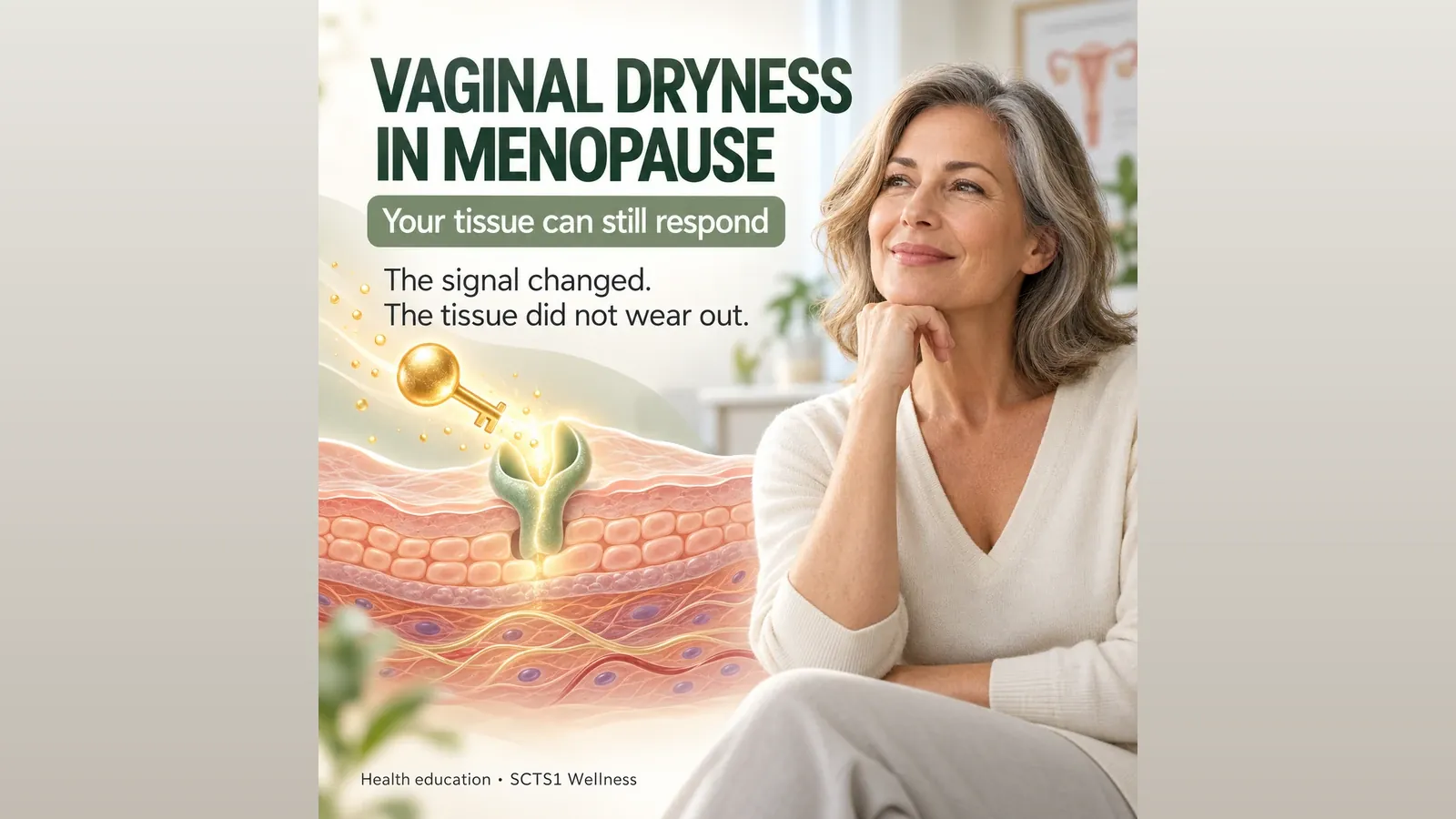
The walls of the vagina, the urethra and the bladder neck are full of estrogen receptors. A receptor is a lock waiting for its key. For as long as the ovary made estrogen, that key arrived every day, and with it the tissue kept its thickness, its elasticity, its blood supply and its own moisture. It also kept an acidic pH — the environment where the protective bacteria live.
When the ovary winds down, the key stops arriving. The lock is still there, intact. The tissue thins, loses elasticity, dries out, and the pH rises. Nothing broke: it is waiting.
And here is the hopeful part, and the reason for this article: when the key starts arriving again — in a small amount, placed directly where it is needed — the tissue responds. It thickens again. The pH comes back down. The natural moisture returns. This has been measured many times, in many studies, across four decades.
The clinical name for this is genitourinary syndrome of menopause. It is a long name for something very concrete: dryness, burning, discomfort during sex, and a whole list of urinary complaints we will get to in a moment.
One important difference from hot flashes: hot flashes usually fade on their own over the years; this does not. Left alone, it tends to persist. That is the bad news, and at the same time the best argument for not letting it slide.
The symptoms almost nobody connects to menopause
Dryness and painful sex are the ones everyone associates with menopause. But there is a second half of the list that almost nobody connects to it, and it is the half that quietly takes the most quality of life:
- Sudden urges to urinate, with no warning.
- Going many times during the day.
- Getting up at night once, or twice, or three times.
- Leaking when you cough, laugh or lift something.
- Burning when you urinate with no infection present.
- Urinary infections that keep coming back, one after another, each with its course of antibiotics.
Plenty of women spend years treating that second list as a separate bladder problem, or as "just getting older." The reality is that the urethra and the bladder neck come from the same tissue, carry the same receptors, and lost the same signal.
That changes the conversation. If the origin is shared, local treatment reaches there too.
What happened when it was actually measured
This is one of the best-studied topics in all of menopause medicine, and that is worth using.
In 2024 a systematic review commissioned by the US federal health research agency was published. The team screened nearly 12,000 citations and kept 46 randomized trials of at least eight weeks. Their conclusion on vaginal estrogen: it improves dryness, painful sex, each woman's most bothersome symptom, and satisfaction with treatment.
A year later, in 2025, the American urology, female pelvic medicine and urogynecology societies published a joint clinical guideline on the subject. Their sentence about local estrogen is the one that titles this section: of all the hormonal and non-hormonal options that exist, low-dose vaginal estrogen has the most robust evidence base.
That same guideline says something else we find honest, and we repeat it here: there is not enough information to recommend one hormonal option over another, and the decision is made with your physician, with your goals and preferences on the table. It is not a staircase you climb in order.
An earlier review, from 2014, had already pulled together 44 studies and found something that still holds: every commercially available vaginal estrogen relieves these complaints, and among them efficacy and safety look similar. Choosing between them is usually about comfort and preference, not potency.
The urinary half, with numbers
This is where the data get especially concrete, and where most people are surprised.
In 2025 a review with meta-analysis of 17 studies and 2,111 women was published, focused only on urinary symptoms. It compared how women were before and after local treatment. Every symptom analyzed improved:
| Symptom | Result |
|---|---|
| Recurrent urinary infections | OR 0.14 |
| Urinary urgency | OR 0.11 |
| Leaking when coughing or laughing | OR 0.12 |
| Urge incontinence | OR 0.22 |
| Going many times a day | OR 0.22 |
| Getting up at night | OR 0.24 |
Those numbers are odds ratios: the lower they are, the less likely the symptom is after treatment. All of them landed far below 1. Vaginal pH came down too, which is the objective sign that the environment of the tissue genuinely changed.
On repeat infections there is a further figure that comes from placebo-controlled trials, the design that carries the most weight. In a 2020 meta-analysis, five trials with 1,936 women found that vaginal estrogen reduced recurrent urinary tract infections compared with placebo, at a relative risk of 0.42. In plain terms: roughly 58% fewer.
The same paper left a comparison that is worth its weight for decision-making: in three trials with 2,766 women, oral estrogen did not reduce infections. The route matters. What solves this particular problem is treatment delivered where the problem is.
That fits a 2023 review which reached the same place by a different road: systemic hormone therapy may even worsen urinary leaking, while vaginal estrogen improves it. They are not interchangeable, even though the word "estrogen" appears in both.
Why it is called local (and why that matters)
The question that comes up most, and rightly so, is: will this spread through my whole body?
It is a question with a measured answer, not an opinion. In 2020 a review was published that gathered the studies measuring blood estradiol during use of low-dose vaginal formulations, separating results by laboratory method and by dose.
To place the figures, you first need something to compare them with. That same review estimated that a postmenopausal woman using nothing has blood estradiol ranging from undetectable to about 10.7 pg/mL.
Against that reference point, the results were:
- 4-microgram insert: 3.6 to 3.9 pg/mL. Inside the range of someone using nothing.
- 10-microgram insert: 4.6 to 7.4 pg/mL as a softgel capsule, somewhat higher as a tablet.
- 25-microgram insert: 7.1 to 9.1 pg/mL as a softgel capsule.
Put plainly: absorption rises with the dose, and at low doses it stays inside or very close to what you already had without treatment. That is why the word "local" is not marketing.
The 2014 review added the finding that reassures most women: with vaginal formulations, endometrial thickening and endometrial cancer were extremely rare. The exception that review flagged was high-dose conjugated equine estrogen cream, which did push blood estradiol above the postmenopausal range. Low dose and high dose are not the same conversation.
November 2025: the FDA changed the label
For more than twenty years these boxes carried a boxed warning — the most serious notice a drug label can carry — inherited from the systemic hormone therapy studies of the early 2000s. The local vaginal formulations carried it too, even though they were never studied in those trials.
On November 10, 2025, the FDA announced it was beginning to remove that warning from menopausal hormone therapies and asked for updated labeling. For local vaginal formulations, the agency recommended condensing the safety information and prioritizing what actually applies to a local formulation.
It is worth saying what did not change, because honesty here is worth more than the headline: for systemic estrogen-only products, the endometrial cancer warning stays. This is not a blanket absolution of hormones. It is the label being matched to what the evidence says about each way of using them.
If a warning on a box once sent your prescription into a drawer, or if your pharmacist read it out loud and it frightened you, this is a good moment to revisit it with your physician. The document changed, not your body.
If you would rather start without hormones
Some women would rather not start with a hormone, and that is a perfectly reasonable position. There are also cases where it is not the first option. The good news is that the 2024 review looked there too, and found useful things:
- Vaginal moisturizers — used every few days, not only in the moment — may improve dryness. In women with few or minor complaints, the 2014 review found relief comparable to estrogen.
- Lubricants are a different thing: they relieve in the moment, they do not change the tissue. You can use both, and you do not have to choose.
- Vaginal DHEA may improve dryness, painful sex, and the distress and bother these symptoms cause.
- Oral ospemifene, which is not a hormone but a receptor modulator, may improve dryness and painful sex.
The same review was equally clear about what did not show benefit or stayed uncertain: vaginal testosterone, systemic DHEA, vaginal oxytocin, and oral raloxifene or bazedoxifene. We would rather tell you than have you find out by spending.
If your symptoms are mild, starting with a moisturizer is a sensible, inexpensive first step. If this has been going on for months, if it hurts, or if the urinary half is already reshaping your days, that conversation deserves a physician.
The biggest gap here is not biological
A review of 27 studies found that between 13% and 87% of women after menopause have these symptoms, depending on the population studied and how the question is asked.
It found something else too: among those who have them, only 4.8% to 35% use low-dose vaginal estrogen. By a wide margin, the most-used option is over-the-counter products.
We think that is the most important finding in this whole article. This is not a problem without a solution: it is a well-studied solution that is not reaching people. And what is missing is not biology. It is information, and a conversation almost nobody starts.
If you have read this far, that conversation has already started.
So your expectations are the right ones
If this turns out to fit your case, here is what is worth knowing from day one:
- It is measured in weeks, not days. The trials in the review ran at least eight weeks, and most of them twelve. Tissue rebuilds slowly.
- The certainty of evidence is not the same everywhere. The 2024 review rated the certainty as "low" for several of the improvements it found. Low does not mean false: it means the studies were short and measured in different ways.
- We know less about the long term. Almost all these studies run twelve weeks or less. On efficacy and safety over years, data are sparse. That is a reason to stay in contact with your physician, not a reason not to start.
- If you stop, symptoms tend to return. This does not correct the cause: it replaces the missing signal. While the signal is there, the tissue responds.
- It does not treat hot flashes. A local formulation does its work where it is applied. For the general symptoms of menopause, that is a different conversation.
- Local irritation can happen. Studies describe irritation, burning or itching. In the urinary-infection meta-analysis there was no significant increase versus placebo, but it exists and you should know it.
- The doses in the studies are not your prescription. They are what was researched. Yours is decided by your physician.
Who is this NOT for?
This part is not negotiable, and we leave it complete:
- Anyone with unexplained vaginal bleeding. The bleeding gets investigated first. Always, without exception.
- Anyone with a current or past hormone-dependent cancer of the breast or endometrium. There is reassuring recent literature — a 2024 meta-analysis in breast cancer survivors found no increase in recurrence with vaginal estrogen — but those were observational studies, not trials, and this is a decision your oncologist makes with you, never an article.
- Anyone pregnant or who might be.
- Anyone with a history of blood clots or serious liver disease who has not discussed it with their physician.
- Anyone with a known allergy to estradiol or to any component of the preparation.
- Anyone expecting this to fix hot flashes, sleep or weight. That is not its job, and saying so clearly is part of ours.
- Anyone who does not want follow-up. This is done with monitoring and an open door to report anything new — new bleeding above all. Without that, it is not done.
And a reminder that applies to everything you read here: do not start, change or stop any medication on your own, not even based on a well-cited article. What decides is your case, seen by your physician.
GLP-1 programs with FDA-approved medications (Wegovy®, Foundayo™, Ozempic®) from $149/month, by telemedicine, in Spanish and English
If menopause is what brought you here, weight is probably part of the conversation too. It is one of the changes women notice most in these years, and it is not a matter of willpower: it is a body running on different hormonal rules.
That part we can walk with you, with real clinical oversight, in English and in Spanish, with continuous follow-up. Cancel whenever you want, in one click.
The path is the same for everything we do: once you start your program, a licensed physician reviews your case — habits, stress, sleep and medical history — and orders labs only if they consider it necessary.
Eligibility is determined by medical evaluation. Individual results vary and are not guaranteed.
See the programsFrequently asked questions
Why does this happen after menopause?
Because the tissue of the vagina, urethra and bladder neck is full of estrogen receptors, and estrogen is what kept it thick, elastic, well supplied with blood and acidic in pH. When the ovary winds down, that signal stops arriving. The tissue is not damaged: it is waiting.
Does it resolve on its own with time, like hot flashes?
No. Hot flashes usually fade over the years; these symptoms tend to persist if untreated. That is why it is worth not letting it slide.
Does vaginal estrogen actually work?
It is the treatment with the most robust evidence base for this condition, according to the 2025 joint clinical guideline from the American urology and urogynecology societies. A review of 46 trials found improvement in dryness, painful sex and satisfaction with treatment.
Does it help with urgency and getting up at night?
In the studies, yes. A review of 17 papers covering 2,111 women found improvement in urgency, frequency, leaking, nighttime trips and recurrent infections. This is the half almost nobody connects to menopause.
What about urinary infections that keep coming back?
That is where the number is most concrete: across five placebo-controlled trials with 1,936 women, the relative risk was 0.42 — about 58% fewer. In the same analyses, oral estrogen did not achieve this.
Is it absorbed into my whole body?
At low doses, very little. With a 4-microgram insert, blood estradiol measured 3.6 to 3.9 pg/mL, inside the range of a postmenopausal woman using nothing, which runs from undetectable to about 10.7 pg/mL. Absorption rises with the dose.
Wasn't this dangerous? I saw a warning on the box.
That boxed warning came from the systemic hormone therapy studies, not from the local vaginal formulations. On November 10, 2025 the FDA began removing it from menopausal hormone therapies and asked for updated labeling. The endometrial cancer warning remains on systemic estrogen-only products.
How long until I notice something?
Weeks, not days. The trials ran at least eight weeks and most of them twelve. And if you stop, symptoms tend to return.
Are there non-hormonal options?
Yes. Vaginal moisturizers may improve dryness, and for mild complaints they gave relief comparable to estrogen. Vaginal DHEA and oral ospemifene also showed benefit. Vaginal testosterone, systemic DHEA and vaginal oxytocin did not.
Can I use this if I have had breast cancer?
That is your oncologist's decision, not a web page's. There is a 2024 meta-analysis, covering more than 24,000 patients, that found no increase in recurrence with vaginal estrogen — but those were observational studies, not trials.
Do I need labs before starting?
Once you start your program, a licensed physician reviews your case — habits, stress, sleep and medical history — and orders labs only if they consider it necessary. It is not automatic or required for everyone.
Do you serve Spanish speakers?
Yes. All our content and our care are available in Spanish.
Sources
- Kaufman MR, Ackerman AL, Amin KA, et al. The AUA/SUFU/AUGS Guideline on Genitourinary Syndrome of Menopause. J Urol. 2025;214(3):242-250. — DOI · via PubMed
- Danan ER, Sowerby C, Ullman KE, et al. Hormonal Treatments and Vaginal Moisturizers for Genitourinary Syndrome of Menopause: A Systematic Review. Ann Intern Med. 2024;177(10):1400-1414. — DOI · via PubMed
- Porcari I, Uccella S, Casprini C, et al. Vulvovaginal estrogen therapy for urinary symptoms in postmenopausal women: a review and meta-analysis. Climacteric. 2026;29(1):13-22. — DOI · via PubMed
- Chen YY, Su TH, Lau HH. Estrogen for the prevention of recurrent urinary tract infections in postmenopausal women: a meta-analysis of randomized controlled trials. Int Urogynecol J. 2021;32(1):17-25. — DOI · via PubMed
- Santen RJ, Mirkin S, Bernick B, Constantine GD. Systemic estradiol levels with low-dose vaginal estrogens. Menopause. 2020;27(3):361-370. — DOI · via PubMed
- Rahn DD, Carberry C, Sanses TV, et al. Vaginal estrogen for genitourinary syndrome of menopause: a systematic review. Obstet Gynecol. 2014;124(6):1147-1156. — DOI · via PubMed
- Mili N, Paschou SA, Armeni A, et al. Genitourinary syndrome of menopause: a systematic review on prevalence and treatment. Menopause. 2021;28(6):706-716. — DOI · via PubMed
- Christmas MM, Iyer S, Daisy C, et al. Menopause hormone therapy and urinary symptoms: a systematic review. Menopause. 2023;30(6):672-685. — DOI · via PubMed
- Beste ME, Kaunitz AM, McKinney JA, Sanchez-Ramos L. Vaginal estrogen use in breast cancer survivors: a systematic review and meta-analysis of recurrence and mortality risks. Am J Obstet Gynecol. 2025;232(3):262-270.e1. — DOI · via PubMed
- U.S. Food and Drug Administration. November 10, 2025 announcement on removing the boxed warning from menopausal hormone therapies and updating labeling. — fda.gov
Related articles
Your trust is worth more than a sale.
This article is informational and is not medical advice. SCTS1 does not prescribe medications. All medical care, prescriptions and treatment plans are provided by licensed physicians through our partner platform, and preparations are dispensed by licensed pharmacies. Eligibility is determined by a licensed provider through medical evaluation. Vaginal estradiol is a prescription medication; the doses and figures mentioned are those studied in the cited literature and do not replace your physician's direction. Any vaginal bleeding after menopause must be evaluated by a professional before starting any hormonal treatment. Do not start, change or stop any medication on your own. Individual results vary and are not guaranteed.