What tesamorelin is
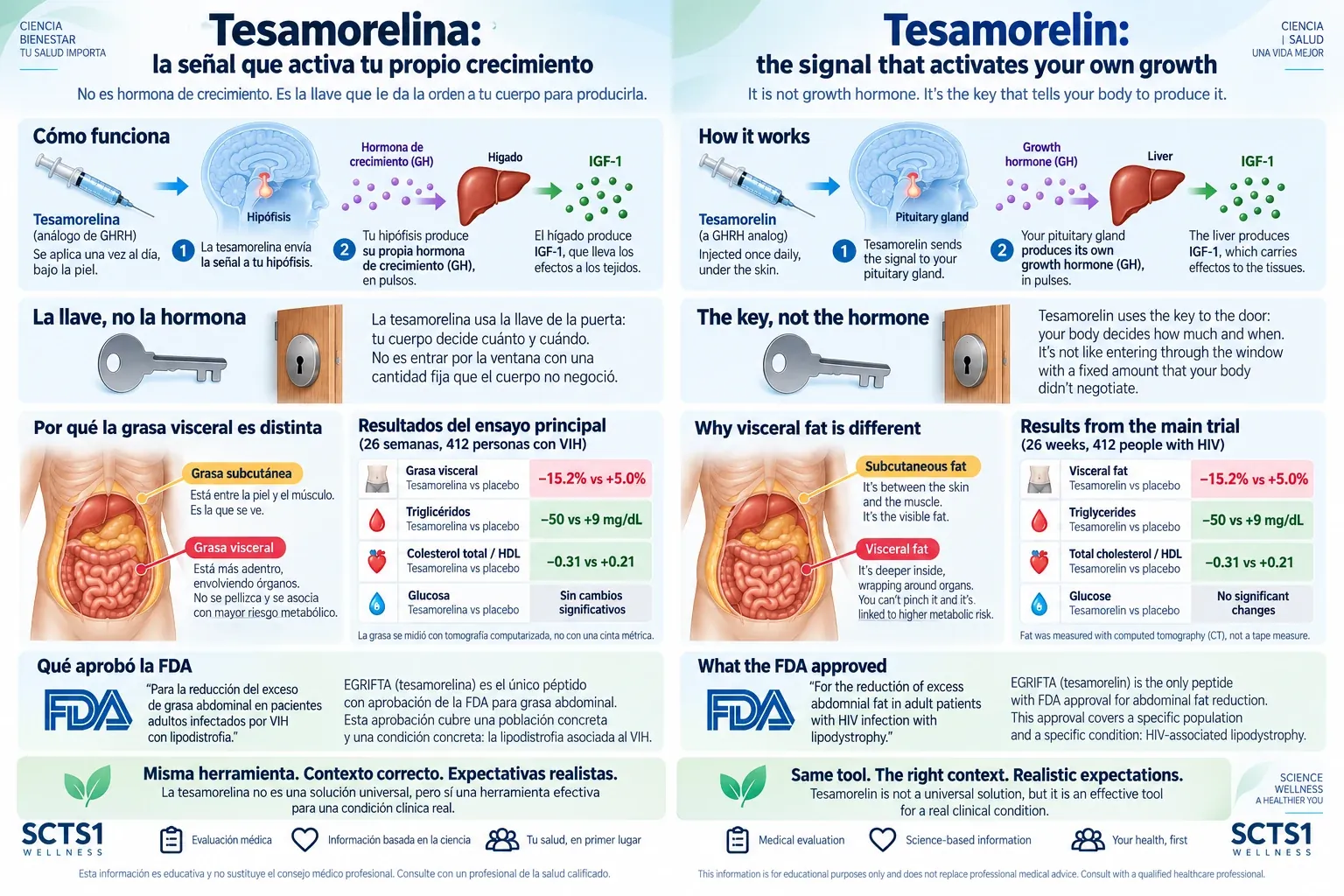
Tesamorelin is a synthetic analog of GHRH — growth hormone-releasing hormone. It is sold under the brand name EGRIFTA and is given as an injection under the skin once a day.
That detail in the name matters more than it may seem. It is not growth hormone. It is the hormone that gives the signal for growth hormone to be released.
The difference is substantial in practice. When someone injects growth hormone directly, the body receives a fixed amount it did not regulate. When a GHRH analog is used, what arrives is a signal: the pituitary receives the message and produces its own growth hormone, in pulses, following the rhythm the body already has programmed.
That rhythm has a technical name — pulsatile secretion — and a practical consequence: the body’s natural control systems keep working. If the level rises too much, the internal brakes respond. With directly injected growth hormone, those brakes do not control the dose that was already administered.
How it works: the key, not the hormone
Think of it as a lock and key. Injected growth hormone is like entering through the window: you get inside, but you skipped the whole system. Tesamorelin is like using the key to the door: the house decides how much to open and when.
Once growth hormone rises, the liver responds by producing IGF-1, the messenger that carries much of its effect to tissues. In the large trial, IGF-1 rose 81% with tesamorelin and fell 5% with placebo. That confirms the mechanism does what it is supposed to do: it activates the hormonal axis.
And growth hormone has had a known effect on fat for decades: it promotes lipolysis, the process by which fat cells release what they store. What is distinctive is where that effect is strongest.
Why visceral fat is different
Not all abdominal fat is the same. There are two types, and they behave very differently.
Subcutaneous fat is the fat you can pinch: it sits between the skin and the muscle. It is the fat you can see.
Visceral fat is deeper, behind the abdominal wall, surrounding the liver, pancreas, and intestines. You cannot pinch it. It also carries more metabolic risk: it is associated with insulin resistance, fatty liver, high triglycerides, and low-grade inflammation.
That is why two people with the same weight and height can have very different risk profiles. What matters is not only how much fat there is, but where it is stored.
Tesamorelin showed a useful characteristic: it acts much more strongly on visceral fat than on subcutaneous fat. In the trials, subcutaneous abdominal fat and fat in the arms and legs changed very little.
What the FDA approved exactly
This is where it is worth being literal, because this is where many of the exaggerations you see online enter the conversation.
The official prescribing information, revised in March 2025, says EGRIFTA is indicated “for the reduction of excess abdominal fat in adult patients infected with HIV who have lipodystrophy.”
That is the full indication. There is not a second one.
HIV-associated lipodystrophy is a specific condition: in some people, certain antiretroviral treatments cause a redistribution of body fat, with marked accumulation deep in the abdomen. It is a real clinical problem with serious metabolic consequences, and before tesamorelin there was no treatment specifically directed at it.
So yes: tesamorelin is the only peptide with FDA approval for abdominal fat reduction. At the same time, that approval applies to a specific population and a specific condition. Both statements are true at the same time.
The numbers from the large trial
The study that opened the door was published in the New England Journal of Medicine in 2007. It included 412 people with HIV and abdominal fat accumulation. Participants were randomly assigned, without knowing which one they received, to 2 mg of tesamorelin per day or placebo for 26 weeks. Visceral fat was measured with computed tomography, not with a tape measure.
−15.2%
visceral fat with tesamorelin at 26 weeks, compared with +5.0% in the placebo group (P<0.001). The placebo group did not simply stay the same: it accumulated more.
Changes in the lipid profile moved in the same direction. Triglycerides fell by 50 mg/dL with tesamorelin and rose by 9 mg/dL with placebo. The ratio of total cholesterol to HDL cholesterol — an indicator of cardiovascular risk — fell by 0.31 with tesamorelin and rose by 0.21 with placebo.
And one result is worth reading carefully: there were no significant changes in glucose measures in that 26-week study. That matters because the story becomes more nuanced later.
| Measure at 26 weeks — Tesamorelin vs placebo | |
|---|---|
| Visceral fat | −15.2% vs +5.0% |
| Triglycerides | −50 vs +9 mg/dL |
| Total cholesterol / HDL | −0.31 vs +0.21 |
| IGF-1 | +81% vs −5% |
Twelve months — and what happens after stopping
The second trial, with 404 people, did something more informative: it lasted a year and intentionally changed treatment halfway through.
During the first six months, visceral fat fell 10.9% with tesamorelin and 0.6% with placebo. Trunk fat, waist circumference, and waist-to-hip ratio also improved. Fat in the arms and legs and subcutaneous abdominal fat did not change — once again, the effect was selective.
People who continued tesamorelin for the full 12 months reached a reduction close to 18%.
But the most candid finding from the study is the other one. People who had been improving on tesamorelin for six months were switched to placebo. The authors wrote clearly that the initial improvements were rapidly lost in those who switched from tesamorelin to placebo.
This is not a defect of the medication. It is information. Tesamorelin does not permanently repair the mechanism: it keeps a signal turned on. When the signal is turned off, the body moves back toward where it was before.
That is the same logic seen in much of metabolic medicine. Blood pressure rises again when treatment is stopped. Cholesterol rises again. Visceral fat can accumulate again. Knowing that from the beginning is part of making a good decision.
The liver finding
In 2014, a team at Massachusetts General Hospital published a smaller trial in JAMA — 50 people over 6 months — with a different question: if tesamorelin reduces the fat surrounding the organs, does it also reduce the fat inside the liver?
The answer was yes. Liver fat fell by a median of 2.0% with tesamorelin and rose by 0.9% with placebo, for a net effect of −2.9 percentage points. Visceral fat fell by 42 cm² more than with placebo.
Fatty liver is a separate topic because it affects roughly one in four adults and often causes no symptoms. It makes biological sense that a treatment directed at visceral fat might also affect liver fat because those two fat depots often increase together.
That said, the scale of the evidence matters. Fifty people is a small study. The authors themselves wrote that more research is needed to determine the clinical importance and long-term consequences. This also remains outside the approved indication.
That same study adds the missing nuance about glucose. At two weeks, fasting glucose rose by 7 mg/dL more than with placebo. By six months, the difference was no longer significant. It was an early, temporary change — but still a change.
Not only how much fat, but what kind
A 2021 analysis combined data from the two large trials and measured something almost nobody measures: fat density on CT.
That sounds abstract, but it means something concrete. Denser fat corresponds to smaller fat cells with better metabolic quality. Less-dense fat corresponds to larger, overloaded cells that function less well.
At 26 weeks, the density of visceral fat increased by 6.2 units with tesamorelin and 0.3 with placebo. Subcutaneous fat density increased by 4.0 versus 0.3. The effect remained even after adjusting for how much fat had been lost.
In other words, the fat that remained was not only less abundant; it was metabolically different. It is a subtle finding, but it helps explain why metabolic markers can improve more than the simple change in fat volume might suggest.
Does it still work in the modern era?
The large trials were conducted between 2007 and 2010. HIV treatment has changed substantially since then. Today, integrase inhibitors are a standard part of treatment — a medication class that was not standard when tesamorelin was originally studied and that is also associated with weight gain and changes in fat tissue.
That created a legitimate open question: does tesamorelin still work in this newer context?
An analysis published in 2024 addressed that question. In people using integrase-inhibitor-based regimens, after 12 months visceral fat fell by a median of 25 cm² with tesamorelin and rose by 14 cm² with placebo. Liver fat fell by 4.2% versus 0.5%. There was no worsening of glucose control.
It was a small group — 31 people completed the study — but the direction of the result was consistent with the earlier evidence.
The line that changes everything
And now the part that defines this article.
Every FDA-approved prescribing label has a section called “Limitations of Use.” It is where the agency is required to state what the medication does not do. The EGRIFTA label has three lines. The second one is this:
- “EGRIFTA is not indicated for weight loss management, as it has a weight neutral effect.”
Read that again, because it is the center of the entire discussion.
Tesamorelin redistributes fat. It removes fat from the visceral compartment, the compartment that matters most metabolically. But total body weight does not move in the same way. If you measure the outcome only with a scale, tesamorelin may appear to do very little.
That has two very practical consequences. First: anyone selling tesamorelin as an alternative to a weight-loss treatment is making a claim that the official prescribing information directly contradicts.
The second is more uncomfortable. If your goal is to lose weight, this is not the medication for that goal — even though it is the only peptide approved for abdominal fat reduction. Those are two different goals, and the evidence separates them clearly.
The other two limitations matter as well. The first says long-term cardiovascular safety has not been established. The third says there are no data supporting improved adherence to antiretroviral therapy.