Sublingual vs. injectable GLP-1: what is actually known
GLP-1 sublingual vs. inyectable: lo que sí se sabe
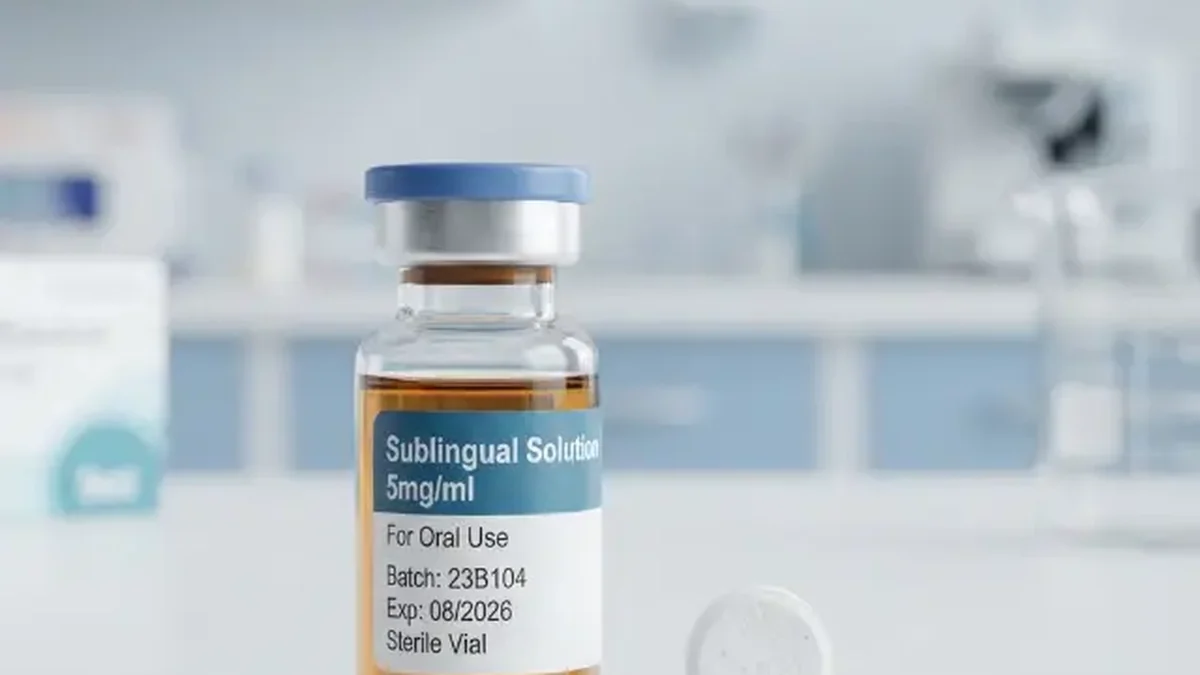
Illustrative image. Does not represent guaranteed results.
Let us start with the uncomfortable part, because it is the important part: the trials that produced the numbers everyone cites — STEP 1, SURMOUNT-1 — used weekly subcutaneous injection. Not drops, not sublingual tablets.
We offer both presentations through our partner platform. And we still think you are entitled to know exactly what has been measured and what has not.
Key points
- STEP 1 and SURMOUNT-1 were conducted with semaglutide and tirzepatide by weekly subcutaneous injection.
- The only FDA-approved oral semaglutide is a tablet swallowed whole, not a sublingual presentation.
- That tablet requires an absorption enhancer and a strict protocol: empty stomach, minimal water, and a wait before eating.
- No published trials on the scale of STEP 1 or SURMOUNT-1 exist for compounded sublingual formulations.
- Compounded medications contain the same active ingredient class but are not FDA-approved finished pharmaceuticals.
In this article
Why the route of administration is not a detail
Semaglutide and tirzepatide are peptides: chains of amino acids. The digestive system is designed precisely to break down chains of amino acids — that is what digesting protein is. That is why these medications began as injectables: injection bypasses the stomach entirely.
Every alternative route has to solve that problem somehow. And how it solves it determines how much drug actually reaches the bloodstream.
The only approved oral version is not sublingual
This surprises people. FDA-approved oral semaglutide comes as a tablet swallowed whole. It is absorbed in the stomach, with help from an absorption enhancer built into the formulation. It does not dissolve under the tongue.
That tablet protocol, per its prescribing information
Taken on an empty stomach on waking, with no more than about 4 ounces of plain water, and you must wait at least 30 minutes before eating, drinking, or taking other oral medications.
That protocol is strict for a reason: oral absorption is fragile and highly condition-dependent. If it were easy, the instructions would not be that detailed.
So what is known about sublingual?
Let us be exact. Sublingual means the medication dissolves under the tongue and is absorbed through the mucosa. It is a real route and it works for several drugs.
What does not exist today are published trials on the scale of STEP 1 or SURMOUNT-1 — thousands of participants, randomized, placebo-controlled, followed more than a year — for compounded sublingual semaglutide or tirzepatide.
That does not mean they do not work. It means it has not been measured at that level of evidence, and transferring the injection-trial percentages to a sublingual presentation is an extrapolation, not a finding.
What a compounded medication is
A compounded medication is prepared in a compounding pharmacy for a specific patient. It contains the same active ingredient class, but it is not an FDA-approved finished pharmaceutical, and it does not go through the same review process as a branded product.
Legitimate reasons to prefer each one
For sublingual
For some people the needle is a real obstacle — phobia, not preference — and a presentation that avoids injection is the difference between starting and not starting. There are also differences in cost and handling, since it does not require refrigeration in the same way.
For injectable
It is the route that generated all the evidence we cite on this site. It is the weekly dosing studied in the trials. And its absorption does not depend on whether you have eaten breakfast.
The honest conclusion: if the needle is not an obstacle for you, injectable is the option with more evidence behind it. If the needle is what stops you from starting at all, that is also a valid clinical consideration, and it should be discussed with the clinician with the data on the table.
Who is this NOT for?
If you choose sublingual expecting exactly the STEP 1 or SURMOUNT-1 percentages, that is the point of this article: those numbers come from a different route. Individual results vary and are not guaranteed.
If someone offers you a sublingual version promising results equivalent to the trials, that claim goes beyond what is published. You can ask directly: "in which study, with how many participants?"
And an important safety point: the FDA has publicly warned about counterfeit products containing semaglutide found in the drug supply chain. Buying outside a legitimate pharmacy is not a saving, it is a risk.
Frequently asked questions
Does sublingual work or not?
We cannot tell you yes or no from the available evidence, and anyone giving you a categorical answer is going beyond what is published. What is established is that the large trials used subcutaneous injection.
Is Rybelsus not sublingual?
No. It is a tablet swallowed whole and absorbed in the stomach with help from an absorption enhancer. It is oral, but not sublingual — those are different routes.
Why is the oral tablet protocol so strict?
Because digestive absorption of a peptide is fragile. Empty stomach, minimal water and waiting before eating are necessary conditions for absorption to be consistent.
What should I ask if offered a sublingual version?
Ask which study the claim is based on, with how many participants and over how long. If there is no concrete answer, you know where you stand.
Is compounded the same as generic?
No. A generic is an FDA-approved product that demonstrated equivalence to the original. A compounded medication is prepared in a pharmacy for a specific patient and is not an FDA-approved finished pharmaceutical.
What is the catch?
That convenience and evidence do not always point the same direction. We would rather you know and decide, with your clinician.
Do you offer support in Spanish?
Yes. All of our content and support is available in Spanish.
Sources
- RYBELSUS (semaglutide) tablets — full prescribing information, Novo Nordisk. — DailyMed · U.S. National Library of Medicine
- Wilding JPH, et al. Once-Weekly Semaglutide in Adults with Overweight or Obesity (STEP 1). N Engl J Med. 2021;384(11):989-1002. — DOI
- Jastreboff AM, et al. Tirzepatide Once Weekly for the Treatment of Obesity (SURMOUNT-1). N Engl J Med. 2022;387(3):205-216. — DOI
- FDA. Compounding and the FDA: Questions and Answers. — U.S. Food and Drug Administration
- FDA. FDA warns consumers not to use counterfeit Ozempic (semaglutide). — U.S. Food and Drug Administration
Related articles
Your first month on a GLP-1 → Managing GLP-1 side effects → Semaglutide vs. tirzepatide: what’s the difference? →Your trust is worth more than a sale.
This article is informational and is not medical advice. SCTS1 does not prescribe medication. All medical care, prescriptions, and treatment plans are provided by licensed healthcare providers through our partner platform. Treatment eligibility is determined by a licensed provider. Compounded medications contain the same active ingredient class but are not FDA-approved finished pharmaceuticals. Individual results vary and are not guaranteed.