Strength Training on GLP-1: How to Protect Your Muscle While You Lose Weight
En español: Entrenamiento de fuerza en GLP-1 — cuánto músculo se pierde realmente, por qué importa, y qué dice la evidencia sobre protegerlo.
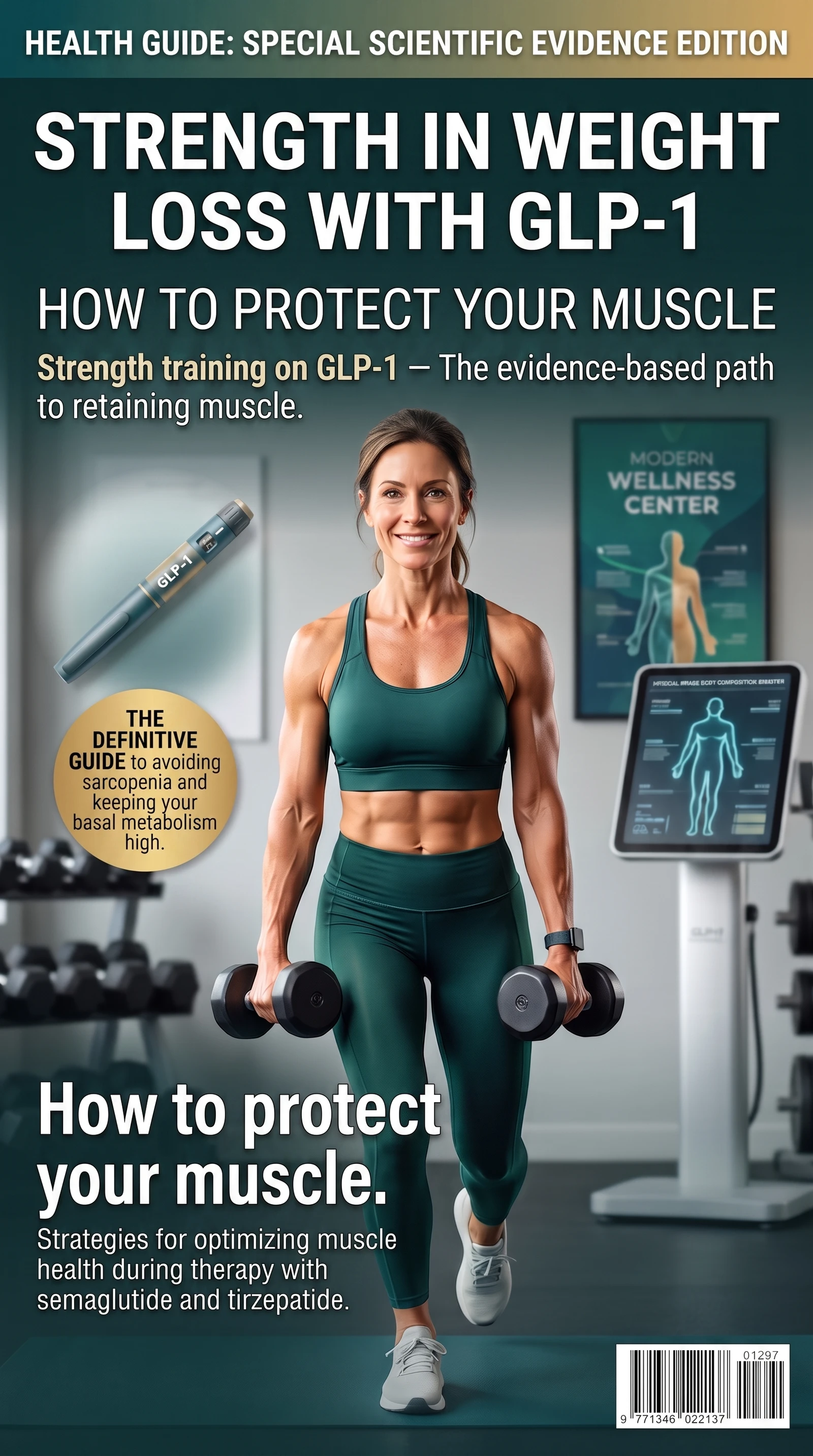
You lost 10, 20, 30 pounds on your GLP-1 program, and the mirror shows something you didn't expect: you're thinner, yes, but also a bit "deflated." Your arms look less firm. Your clothes fit loose in a different way than you imagined. It's not in your head, and it doesn't mean you did anything wrong — a real part of what you lost wasn't fat.
According to PubMed, several medical reviews agree that a significant portion of the weight lost with semaglutide or tirzepatide is lean mass — muscle. It's not a rare or hidden side effect: it's a pattern documented across dozens of clinical trials, and the reason more and more physicians talk about resistance training as part of the plan, not an optional extra.
This article brings together what the evidence shows: how much muscle is actually lost, why it matters more than it looks at first glance, and how much resistance training it takes to protect what you most want to keep — with sources at the end so you can check them yourself.
Key points
- With semaglutide, about 45% of weight lost can be lean mass; with tirzepatide, about 25%, per a 2025 review in Reviews in Endocrine and Metabolic Disorders.
- A systematic review of 35 trials published in 2026 in Annals of Internal Medicine found a median muscle loss of 28.3% of total weight lost, exceeding the expected benchmark in two out of three studies.
- It isn't exclusive to medications: groups that lost weight through diet or placebo alone also lost muscle above the benchmark in 38% of cases in that same review.
- Supervised resistance training programs longer than 10 weeks produced average gains of ~3 kg of lean mass and 25% strength, per Locatelli and colleagues in Diabetes Care.
- Losing muscle accelerates the path toward sarcopenia — age-related loss of muscle mass and function linked to frailty — a risk that already rises with age on its own, with no medication involved.
- Preserving muscle during weight loss may help maintain lost weight after treatment ends, per the same review by Locatelli and colleagues.
- None of this is a diagnosis or a treatment. Individual results vary and are not guaranteed.
In this article
- What happens to your muscle when you lose weight fast
- The numbers: how much muscle is actually lost
- Is it only the medication's fault?
- Why muscle matters more than you think
- What the evidence shows about resistance training
- Protein + strength: why they work better together
- How to start with no prior experience
- What changes if you're on a GLP-1 program
- What this evidence does NOT say
- Who is this NOT for?
- Frequently asked questions
- Sources
What happens to your muscle when you lose weight fast
When your body enters a calorie deficit — you eat less energy than you burn, which is how GLP-1 medications work by reducing appetite — it doesn't perfectly distinguish between fat and muscle when looking for fuel. Ideally, almost all the weight lost would come from fat. In practice, some always comes from lean tissue: muscle, and to a lesser extent bone.
That proportion isn't fixed. It depends on how much and how fast you lose weight, how much protein you eat, your age, and — the factor you can control most — whether you give your body a reason to hold on to the muscle it has. That reason is the mechanical stimulus of resistance training: when a muscle works against resistance, the body reads that tissue as still needed and prioritizes keeping it, even in a calorie deficit.
Without that stimulus, the body has no signal telling it not to use muscle as an energy source alongside fat. It's simple survival logic: tissue that isn't actively being used is the first to go when energy is scarce.
The numbers: how much muscle is actually lost
For years, the reference figure in general weight-loss literature was that around 25% of weight lost was fat-free mass (muscle, water, and some bone). With GLP-1 medications, several reviews show that proportion can run higher.
A more recent systematic review, published in 2026 in Annals of Internal Medicine, pooled 35 controlled trials with a median duration of 26 weeks and measured the problem more precisely using methods like dual-energy X-ray absorptiometry (DXA) and CT scans. It found the median loss attributable to muscle was 28.3% of total weight lost, with a typical range of 15.9% to 39.9% across studies.
A third analysis, published in 2024 in Metabolism by Harvard researchers, describes that more than 25% of total weight lost with these drugs — comparable to what's lost with bariatric surgery — comes from fat-free mass, including skeletal muscle and, to a lesser extent, bone.
Is it only the medication's fault?
Not entirely, and this part matters so the treatment isn't unfairly demonized. That same systematic review in Annals of Internal Medicine found that comparison groups — people who lost weight through lifestyle changes or placebo alone — also lost muscle above the expected benchmark in 38% of cases, though with much smaller total weight loss (median -2.5%, versus much larger losses in the medication groups).
The honest read: losing some muscle is a normal part of almost any significant weight loss, with or without medication, if nothing is actively done to prevent it. What changes with GLP-1s is the total magnitude of weight loss, which amplifies the absolute amount of muscle lost even if the percentage were similar. Losing 30 pounds fast, with or without medication, moves more tissue than losing 10.
Why muscle matters more than you think
It's easy to think of muscle purely as aesthetic — firm arms, a defined waist — but its function goes well beyond how it looks in the mirror.
- Sarcopenia and frailty: age-related loss of muscle mass and strength, known as sarcopenia, already rises after age 60 on its own. Losing muscle rapidly on a medication may accelerate that process, warns Ryan's review in Reviews in Endocrine and Metabolic Disorders.
- Resting metabolism: muscle tissue burns more energy at rest than fat tissue. Less muscle generally means a lower resting metabolic rate, which can make it harder to keep lost weight off long term.
- Real physical function: climbing stairs, carrying groceries, standing up from a chair without pushing off — all of it depends on muscle strength, not just weighing less.
- Bone and blood-forming health: the review by Stefanakis and colleagues in Metabolism describes that weight loss can also affect bone density and bone marrow health, systems that share biological signals with muscle tissue through the myostatin-activin-follistatin pathway.
- Regaining lost weight: per the same review by Locatelli and colleagues, preserving lean mass during treatment could help blunt fat regain if the medication is stopped in the future — though this point needs more direct research to confirm with certainty.
What the evidence shows about resistance training
The good news is this isn't a problem without a known solution. Resistance training — also called strength training — is the intervention with the most direct support for counteracting muscle loss during weight loss, with or without medication.
That same article describes something worth highlighting: when aerobic exercise was combined with liraglutide after a low-calorie diet, maintenance of lost weight improved compared with using either the medication or exercise alone. The combination outperformed each intervention on its own.
The 2025 precision-obesity-medicine review in Journal of Endocrinological Investigation by Tuccinardi and colleagues goes a step further: in older adults with sarcopenia, combining liraglutide or orlistat with resistance training and adequate protein intake preserved lean mass better than medication alone. It's the combination — not any single piece — that shows the best documented result.
It's important to be honest about the limits of this evidence: the systematic review in Annals of Internal Medicine notes that no included study measured objective physical function outcomes (like walking speed or grip strength), and that body composition measurement methods varied widely across trials. That means that while the direction of the finding is consistent, more research with standardized methods is still needed.
Protein + strength: why they work better together
Resistance training gives the body the signal that muscle is needed. Protein gives it the building material to respond to that signal. Separately, each helps partially; together, they target the same goal from two different angles.
If you eat enough protein but don't train for strength, your body has the material but not the biological reason to use it to maintain muscle instead of losing it. If you train for strength but don't eat enough protein, your body has the signal but not the full resources to respond to it. Our protein and muscle guides go deeper into how much protein per meal makes sense for your weight and how the two relate — currently published in Spanish at Proteína en tu plato and Proteína y músculo.
How to start with no prior experience
You don't need a gym, a personal trainer, or prior experience to start giving your body the stimulus it needs. What the evidence shows is that consistency matters more than intensity at the start.
1. Start with your own bodyweight
Chair-assisted squats, wall push-ups, glute bridges lying on your back. These are safe exercises to begin with no equipment and no experience, and they still provide the mechanical stimulus muscle needs.
2. Two to three times a week, not every day
Muscle needs time to recover between sessions. The programs that showed benefit in the studies cited weren't daily — they were 2 to 3 sessions per week, sustained for more than 10 weeks in a row.
3. Add resistance gradually
Light resistance bands or 2-to-5-pound dumbbells are an accessible next step once bodyweight starts to feel easier. Gradual progression — a little more difficulty every week or two — is what keeps the stimulus working.
4. Prioritize large muscle groups
Legs, back and hips hold the largest share of the body's muscle mass. Working them pays off more in terms of muscle preserved than focusing only on arms or abs.
5. Ask for guidance if you have form or health concerns
If you have a joint condition, a recent surgery, or simply don't know where to start safely, a physical therapist or certified trainer can build a safe progression for your specific situation. This is general information, not an individualized exercise plan.
What changes if you're on a GLP-1 program
GLP-1 medications don't do anything specific for your muscle mass — that work depends on how you pair the treatment with resistance training and protein. A serious program should talk about this from the start, not leave it as a surprise once you've already lost the weight.
Once you start your program, a licensed physician reviews your case — habits, stress, sleep and medical history — and orders labs only if they consider it necessary. Eligibility is determined by medical evaluation. Asking about body composition and a strength plan is a valid conversation to have with your provider from the first visit.
GLP-1 programs with FDA-approved medications (Wegovy®, Foundayo™, Ozempic®) from $149 a month, by telemedicine, in Spanish and English.
What this evidence does NOT say
Let's be explicit, because bigger promises than the science supports also circulate on this topic.
It does not say resistance training eliminates muscle loss entirely. Studies show it reduces loss and improves lean mass gain, not that loss drops to zero.
It does not say one type of exercise alone is enough without attention to protein. The strongest evidence is about the combination, not exercise in isolation.
It does not say every GLP-1 medication affects muscle the same way. The gap between semaglutide and tirzepatide in the cited data suggests the specific mechanism matters too — something research is still working out precisely.
And it does not say you should avoid the medication for this reason. The documented benefits for blood pressure, glucose, cholesterol and cardiovascular risk remain real; the evidence points to pairing treatment with resistance training and protein, not avoiding it.
Who is this NOT for?
This article isn't for you if you already have noticeable loss of strength or physical function — trouble standing up from a chair, recent falls, marked weakness — that calls for direct medical evaluation, not just starting an exercise program on your own.
It's also not for you if you're looking for an intense, unsupervised workout routine without talking to a health professional first, especially if you have any prior joint, cardiovascular or orthopedic condition.
It is for you if you're starting or in the middle of a GLP-1 program and want to understand, with real data, why resistance training keeps showing up in medical recommendations — and how to start simply and safely.
Frequently asked questions
How much muscle do you actually lose with semaglutide or tirzepatide?
It varies by person and by drug. A 2025 review in Reviews in Endocrine and Metabolic Disorders estimates that with semaglutide about 45% of weight lost is lean mass, and with tirzepatide about 25%. A systematic review of 35 trials published in 2026 in Annals of Internal Medicine found a median of 28.3% of weight loss coming from muscle-related indices, with two-thirds of studies exceeding the expected benchmark.
Is this only a problem with GLP-1 medications?
Not exclusively. The same systematic review found that diet or placebo groups also lost muscle above the benchmark in 38% of cases. Weight loss in general — not just with drugs — tends to include some muscle if nothing is done to protect it. What's different with GLP-1s is the speed and size of total weight loss, which can amplify the absolute amount of muscle lost.
How much resistance training does it take to see a difference?
The studies showing benefit used supervised programs longer than 10 weeks, with average gains of about 3 kg of lean mass and 25% strength, per the review by Locatelli and colleagues in Diabetes Care. That's not an occasional session — it's consistency over several weeks in a row, usually 2 to 3 times per week.
Do I need a gym or weights to start?
No. Resistance training includes resistance bands, your own bodyweight (squats, wall push-ups, glute bridges), and light dumbbells at home. What matters is consistency and gradually increasing difficulty, not specific equipment.
Is protein alone enough without resistance training?
Evidence suggests they work better together. Protein provides the building material; resistance training is the signal that tells the body to use that material to maintain muscle instead of just losing it. A study cited in the 2025 review by Tuccinardi and colleagues found that combining medication, resistance training and adequate protein preserved lean mass better than medication alone.
Does this mean I shouldn't take a GLP-1?
No. The same medications that reduce lean mass also produce documented benefits in blood pressure, cholesterol, glucose and cardiovascular risk, per the review by Tuccinardi and colleagues in Journal of Endocrinological Investigation. The evidence doesn't point to avoiding the medication — it points to pairing it with resistance training and protein to better protect body composition while getting those benefits.
What labs are ordered for this?
That's decided by a clinician. Once you start your program, a licensed physician reviews your case — habits, medical history, goals — and orders labs only if they consider it necessary. Eligibility is determined by medical evaluation.
Do you see patients in Spanish?
Yes. All of our content and care are available in both Spanish and English.
Sources
- Locatelli JC, Costa JG, Haynes A, et al. Incretin-Based Weight Loss Pharmacotherapy: Can Resistance Exercise Optimize Changes in Body Composition? Diabetes Care. 2024;47(10):1718-1730. — DOI · via PubMed
- Ryan DH. New drugs for the treatment of obesity: do we need approaches to preserve muscle mass? Rev Endocr Metab Disord. 2025;26(5):805-813. — DOI · via PubMed
- Batsis JA, Gavras A, Gross DC, et al. Effect of Incretin-Based and Nonpharmacologic Weight Loss on Body Composition: A Systematic Review. Ann Intern Med. 2026;179(7):996-1013. — DOI · via PubMed
- Stefanakis K, Kokkorakis M, Mantzoros CS. The impact of weight loss on fat-free mass, muscle, bone and hematopoiesis health. Metabolism. 2024;161:156057. — DOI · via PubMed
- Tuccinardi D, Masi D, Watanabe M, et al. Precision obesity medicine: A phenotype-guided framework for pharmacologic therapy across the lifespan. J Endocrinol Invest. 2025;48(12):2761-2798. — DOI · via PubMed
Related articles
Loose skin after weight loss: what the evidence says → Browse all Health Guide articles →Your trust is worth more than a sale.
This article is informational and is not medical advice. SCTS1 does not prescribe medications. All medical care, prescriptions and treatment plans are provided by licensed physicians through our partner platform. Eligibility is determined by a licensed provider. Compounded medications contain the same class of active ingredient but are not FDA-approved finished pharmaceutical products. Individual results vary and are not guaranteed.