Low-dose naltrexone: the medicine that changes jobs at a tenth of the dose
Naltrexona en dosis baja: el medicamento que cambia de oficio cuando le bajas la dosis
Watch the related video
What matters in 30 seconds
- It is an old, inexpensive medicine and one of the best tolerated in use. At 50 mg it treats alcohol and opioid dependence. At 4.5 mg it does something else entirely: it talks to the immune cells of your nervous system.
- The mechanism is well described in the lab. In cultured microglia, low-dose naltrexone shifted the cells from an inflamed state to a quiet one, and switched their metabolism from glycolysis to mitochondrial respiration.
- The strongest clinical point in its favor: in painful diabetic neuropathy it matched amitriptyline, with 8 adverse events versus 52.
- In fibromyalgia, the 2025 meta-analysis did find a real improvement over placebo (d = −0.34, p = 0.0186). Small, but statistically significant.
- And the other side, which you deserve to know too: across chronic pain as a whole it did not beat placebo, and the longest trial that exists in fibromyalgia — 12 months, 98 women — found no benefit.
- There is no FDA-approved low-dose naltrexone product in the United States. It is compounded by licensed pharmacies, off-label, always under medical supervision.
In this guide
- Same medicine, different job
- Your guard cells and the switch
- What the evidence does show
- 8 versus 52: the number that carries the most weight
- So your expectations land in the right place
- The real problem: the dose and the pharmacy
- How it is done well
- Who is this NOT for?
- How it works at SCTS1
- Frequently asked questions
Same medicine, different job
Here is something rarely said about medicines: dose does not only change how much they do. Sometimes it changes what they do.
Naltrexone is the cleanest example of that. At 50 mg a day it is an opioid receptor blocker. It was approved decades ago, and today the FDA recognizes it for treating alcohol dependence and for blocking the effects of opioids. It occupies the receptors, keeps them occupied all day, and that is the job.
At 4.5 mg — one tenth of that — something else happens. The blockade is brief. A fraction of the receptors is occupied for a few hours, and then the drug is gone. But while it is there, it touches a second door that the main effect covers up at the higher dose: an immune receptor called TLR4, which lives mostly on the defense cells of your brain and spinal cord.
That is the whole idea. It is not a painkiller in the classic sense. It does not switch off the pain signal at the nerve. It works one level up, on the cells that decide how much to amplify that signal.
Your guard cells and the switch
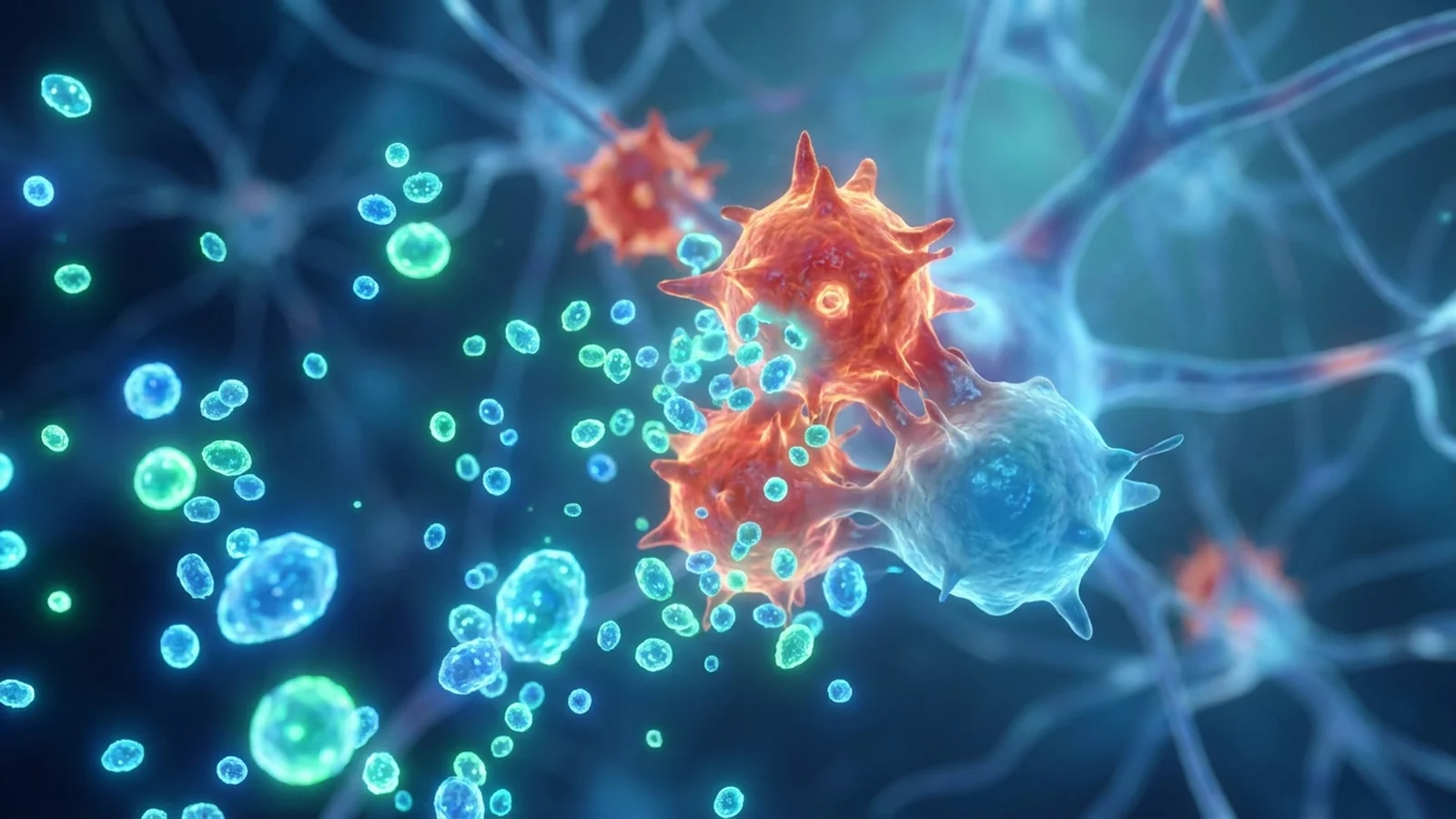
Your brain has its own guard corps. They are called microglia, and they are the immune system of nervous tissue. When there is a threat — an infection, an injury, an inflammation that never quite clears — they activate, they inflame, and they start producing signals that put the whole system on alert. More alert also means more sensitive to pain.
The problem is not that they switch on. The problem is when they never switch off. That permanent state of alert is one of the leading explanations for pain that is still there long after the original cause is gone.
In 2021, a group at the University of Rijeka put low-dose naltrexone on cultured microglia and measured what happened. They found two things at once. The cells moved from an inflamed, aggressive profile to a quiet, repairing one. And their metabolism changed at the root: they stopped burning glucose in a hurry and started making energy in the mitochondria, with higher oxygen consumption and less lactate.
This is a cell study, not a study in people. That has to be said plainly. But it explains why this medicine is investigated in conditions as unlike one another as fibromyalgia, Crohn's disease, multiple sclerosis and regional pain syndromes. The common thread is not the organ. It is inflammation of the nervous system.
What the evidence does show
This is where precision matters, because a great deal is claimed about this medicine and not all of it is supported.
Painful diabetic neuropathy. A randomized, double-blind, crossover trial in 67 people compared low-dose naltrexone against amitriptyline, one of the reference treatments for that pain. Pain reduction was equivalent between the two: the difference did not reach statistical significance in either analysis. In other words, it worked just as well. Below you will see the detail that makes that tie worth a great deal.
Fibromyalgia. The 2025 meta-analysis that pooled seven randomized trials found that, specifically in fibromyalgia, low-dose naltrexone did beat placebo (d = −0.34, 95% CI −0.62 to −0.06; p = 0.0186). It is a small effect by statistical convention, but it is real, and it is against placebo, which is the demanding comparison.
The pain circuitry. In a secondary analysis of the FINAL trial, in 99 women with fibromyalgia, out of five laboratory measures of how pain processing works only one showed a between-group difference: conditioned pain modulation, the body's own ability to dampen one painful signal with another. It improved more with naltrexone. That is a mechanistic signal, not a clinical outcome, but it points the same way the lab work does.
| What was measured | Result |
|---|---|
| Fibromyalgia vs. placebo (7 trials) | Better than placebo |
| Diabetic neuropathy vs. amitriptyline | Equivalent |
| Chronic pain overall vs. control | No difference |
| Adverse events vs. amitriptyline | 8 versus 52 |
8 versus 52: the number that carries the most weight
Go back to the diabetic neuropathy trial. Both arms relieved pain equally. But the naltrexone group recorded 8 adverse events and the amitriptyline group 52, a very clear statistical difference (p < 0.001). The most common effect with naltrexone was mild diarrhea. With amitriptyline, drowsiness.
That is the most useful finding in the whole literature, and it is worth understanding why. When two treatments relieve the same amount, what decides between them is not potency: it is the price you pay day to day. A medicine that leaves you functioning — working, driving, awake in the afternoon — is worth something different from one that relieves the same and switches you off.
The 12-month fibromyalgia trial confirms it from another angle. Adverse effects occurred in 68.8% of the naltrexone group and 72% of the placebo group. Essentially the same. None serious and treatment-related, across a full year of daily use. Very few medicines can show that.
The most recent review, published in 2026 after going through 105 studies, sums it up in three words: safe, inexpensive, well tolerated.
So your expectations land in the right place
That same 2026 review says something more, and leaving it out would be dishonest: of those 105 studies, only 15 are randomized trials, and the positive results that showed up in uncontrolled studies were rarely reproduced when compared against placebo. Its conclusion is that current evidence does not support routine use, and that the reasonable place for this medicine today is in cases where standard treatments have already failed, always with its experimental status clearly explained.
The longest trial that exists points the same way. In the INNOVA study, 98 women with fibromyalgia took 4.5 mg or placebo for 12 months. At three months, pain fell 0.33 points with naltrexone and 0.64 with placebo. There was no clinically meaningful benefit.
And the meta-analysis, when it looks at chronic pain as a whole rather than fibromyalgia alone, finds no difference against controls either (d = −0.11; p = 0.31).
So, so your expectations land in the right place: this is not a strong painkiller, it does not replace a treatment that already works for you, and there is no way to know in advance whether you will be one of the people who responds. What can be said calmly is that the trial of it, when a physician considers it reasonable, is an inexpensive and low-risk trial. That is not nothing. But it is exactly that, and no more.
The real problem: the dose and the pharmacy
In the United States naltrexone is manufactured as 50 mg tablets. There is no FDA-approved 4.5 mg product. All the low-dose naltrexone in use in the country today is either compounded by a licensed pharmacy from the active ingredient or a split tablet, and in both cases it is off-label use.
That has two practical consequences worth being clear about. The first is that quality depends on the pharmacy: a properly compounded 4.5 mg capsule and a kitchen-table split of a 50 mg tablet are not the same thing. The second is that there is no official label for this dose, so the judgment of the physician following you weighs more than usual.
None of that is a reason to rule it out. It is a reason not to buy it online with nobody behind it.
How it is done well
Start low and go up slowly
The usual approach is to start below the target dose — 1.5 mg, for example — and build up over a few weeks. That reduces the two most common early effects: vivid dreams and mild digestive upset. They almost always settle on their own within a week or two.
Put a review date on it
A trial with no cut-off date turns into a permanent expense for no reason. The sensible move is to set on day one when it will be evaluated — six to eight weeks is common — and what it will be measured against: pain, sleep, your ability to do your things. If nothing has changed by that date, you stop.
Say it everywhere
This is the most important item in this section. Any physician, dentist or emergency department treating you needs to know you are taking naltrexone, even at a low dose. It blocks opioids. If you need an emergency opioid painkiller, it will work worse or not at all.
Keep doing what already works
None of this replaces what has firmer evidence for chronic pain and inflammation: graded movement, enough sleep, weight management where it is needed, and specific treatment of the underlying condition. Low-dose naltrexone goes alongside those, never instead of them.
Who is this NOT for?
- If you take opioids — of any kind, including tramadol, codeine and some cough syrups. The combination can precipitate withdrawal and strip away the relief you had. This one is absolute.
- If you have surgery or a painful procedure scheduled — that gets discussed with your medical team beforehand, not afterward.
- If you have active liver disease or acute hepatitis — naltrexone is metabolized in the liver, and that calls for evaluation first.
- If you are pregnant, trying to conceive or breastfeeding — there is not enough safety data at this dose.
- If you have untreated opioid use disorder — that needs a specific, supervised approach, not a low dose on your own.
- If you expect it to replace a treatment that is already working for you — the evidence does not support that, and we are not going to tell you it does.
How it works at SCTS1
Here is the real order, no fine print.
Once you start your program, a licensed physician reviews your case — habits, stress, sleep and medical history — and orders labs only if they consider it necessary. Eligibility is determined by medical evaluation. The conclusion may be that low-dose naltrexone is not for you, and that is a valid outcome of the process too.
We carry low-dose naltrexone in the catalogue, compounded by licensed pharmacies, with follow-up in English and Spanish. Cancel whenever you want, in one click.
And one more thing, because it is the thing that defines us: this is a medicine with mixed evidence, and we tell you that before, not after. If your case points to a different problem, we will say so. Your trust is worth more than a sale.
GLP-1 programs with FDA-approved medications (Wegovy®, Foundayo™, Ozempic®) from $149/month, by telemedicine, in Spanish and English
Real clinical oversight, in English and Spanish, with continuous follow-up. Cancel whenever you want, in one click.
Eligibility is determined by medical evaluation. Individual results vary and are not guaranteed.
See the programsFrequently asked questions
Why does the same medicine do different things at different doses?
Because at the high dose the opioid receptor blockade is continuous and dominates everything. At the low dose that blockade is brief, which leaves room for a second action: antagonism of the TLR4 receptor on the immune cells of the nervous system, which at 50 mg is buried under the main effect.
Does it help fibromyalgia?
The 2025 meta-analysis found that in fibromyalgia it does improve pain compared with placebo, with a small but statistically significant effect. However, the longest trial that exists, 12 months in 98 women, found no clinically meaningful benefit. The honest answer is that it helps some people and not others, and that today there is no way to predict who.
What are the side effects?
The most common are vivid dreams, mild headache and digestive upset when starting, which usually pass within a week or two. In the 12-month trial, adverse effects were essentially the same as placebo: 68.8% versus 72%, none serious and treatment-related.
Can I take it if I use opioid painkillers?
No. Naltrexone blocks opioid receptors. Combining it with opioids can precipitate withdrawal and cancel the relief those medicines give you. That includes tramadol, codeine and some cough syrups. Always tell any physician, dentist or emergency department treating you.
How long before you know whether it works?
The usual approach is to set an evaluation at six to eight weeks, against one concrete measure chosen at the start: pain, sleep, or your ability to do your activities. If nothing has changed by then, the right move is to stop rather than keep paying.
Is low-dose naltrexone FDA-approved?
No. The FDA recognizes naltrexone at 50 mg for alcohol dependence and for blocking the effects of opioids. The low dose is off-label use and is obtained through licensed compounding pharmacies, always under the supervision of a licensed physician.
Do I need labs before starting?
Once you start your program, a licensed physician reviews your case — habits, stress, sleep and medical history — and orders labs only if they consider it necessary. It is not automatic and not required for everyone.
Sources
- Hegde NC, Mishra A, Divya V, Maiti R, Hota D, Srinivasan A. Low Dose Naltrexone In The Management Of Chronic Pain Syndrome: A Meta-Analysis Of Randomized Controlled Clinical Trials. Curr Pain Headache Rep. 2025;29(1):96. — DOI · via PubMed
- Srinivasan A, Dutta P, Bansal D, Chakrabarti A, Bhansali AK, Hota D. Efficacy and safety of low-dose naltrexone in painful diabetic neuropathy: A randomized, double-blind, active-control, crossover clinical trial. J Diabetes. 2021;13(10):770-778. — DOI · via PubMed
- Gouda AHK, Aitcheson NEC, Steadman KJ. Low-Dose Naltrexone: What is the Evidence? A Narrative Review. Adv Ther. 2026;43(7):2852-2870. — DOI · via PubMed
- Efficacy of Low-Dose Naltrexone in Women With Fibromyalgia Syndrome: A 12-Month Randomised, Double-Blind, Placebo-Controlled Single-Centre Clinical Trial (INNOVA Study). Eur J Pain. 2026. — DOI · via PubMed
- Effect of Naltrexone on Spinal and Supraspinal Pain Mechanisms and Functional Capacity in Women with Fibromyalgia: Exploratory Outcomes from the Randomized Placebo-Controlled FINAL Trial. CNS Drugs. 2025. — DOI · via PubMed
- Kučić N, Rački V, Šverko R, Vidović T, Grahovac I, Mršić-Pelčić J. Immunometabolic Modulatory Role of Naltrexone in BV-2 Microglia Cells. Int J Mol Sci. 2021;22(16):8429. — DOI · via PubMed
- McKenzie A, Bittar T, Dombrower R, et al. Low-Dose Naltrexone in Chronic Pain Management: Mechanisms, Evidence, and Clinical Implications. J Pers Med. 2026;16(3):151. — DOI · via PubMed
Related articles
Your trust is worth more than a sale.
This article is informational and is not medical advice. SCTS1 does not prescribe medications. All medical care, prescriptions and treatment plans are provided by licensed physicians through our partner platform, and preparations are dispensed by licensed pharmacies. Eligibility is determined by a licensed provider. There is no FDA-approved low-dose naltrexone product in the United States; use at 4.5 mg is off-label or via compounded preparation, and must be done under medical supervision. Naltrexone blocks opioids: always tell any physician, dentist or emergency department that you are taking it. Individual results vary and are not guaranteed.