Glycine and longevity: the amino acid your body makes every day
Glicina y longevidad: el aminoácido que tu cuerpo fabrica a diario
The important part in 30 seconds
- Start with the good news: you are not short on glycine through neglect. Your body makes it every single day — about 3 grams — and food brings in another 1.5 to 3 grams.
- It is the smallest of the twenty amino acids, and the most repeated piece of collagen. It is also one of the three parts you assemble glutathione from, your own internal antioxidant.
- Here is the interesting part: when researchers added up everything your body spends glycine on, the arithmetic came out short by roughly 10 grams a day in a 70 kg adult. That is why some call it semi-essential.
- In mice, glycine extended lifespan by 4 to 6% across three independent laboratories, in both males and females. That is a solid result, and it is in mice: it has not been shown in people.
- In people there are two trials and they do not agree. A small one, over 16 weeks, improved strength, walking speed and several metabolic measures. A larger one, with 114 people, did not meet its primary endpoint in two weeks.
- Both trials agree on something that matters: it was safe and well tolerated. And the larger one found that the people who did respond were those who started with more oxidative stress and less glutathione.
- And the part we owe you plainly: the glycine you see on some injectable preparations is not there as an active ingredient. It serves a formulation purpose. We explain that in detail below.
In this guide
- The glycine you already make
- The arithmetic that does not add up
- Why longevity research got interested
- What happened when it was tested in people
- Two trials that disagree
- Why does it appear in some preparations?
- So your expectations land in the right place
- Who is this NOT for?
- GLP-1 programs
- Frequently asked questions
- Sources
The glycine you already make
Of the twenty amino acids your body builds proteins from, glycine is the smallest. One carbon atom, one amino group, nothing else. And precisely because it is so small, it does things no other building block can do.
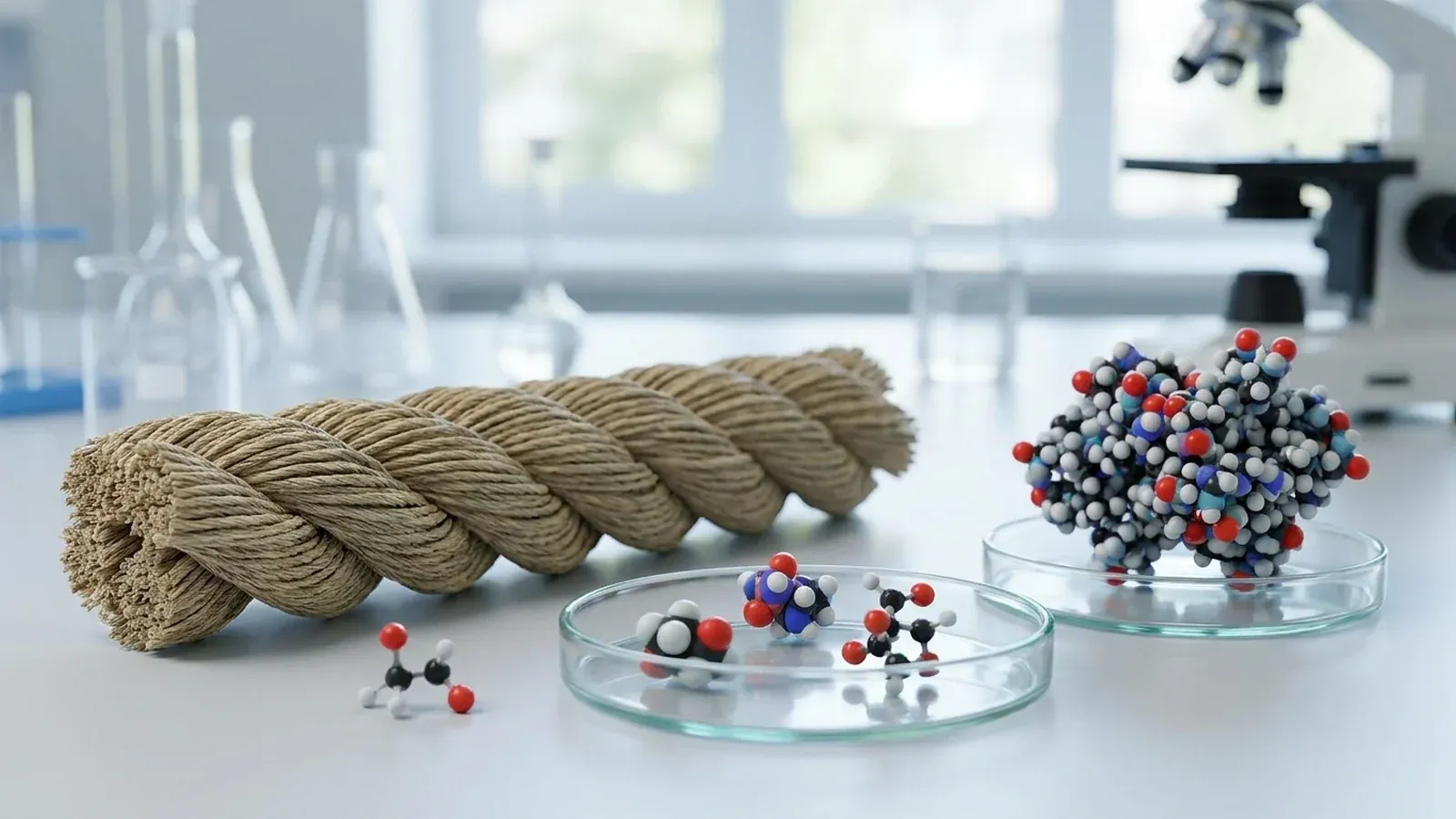
The most visible of those is in your skin, your tendons and your joints. Collagen is a rope of three strands braided together, and for those strands to wind that tightly you need an amino acid that takes up almost no room. Glycine is that amino acid. It is the most repeated piece in the whole molecule: it shows up once every three positions, like the pitch of a screw thread.
The second thing it does is less visible and more relevant to this guide. Your body makes its own antioxidant called glutathione, and it assembles it from three parts: cysteine, glutamic acid and glycine. Glutathione neutralizes the reactive debris left behind by the ordinary work of your cells. It does not come from a bottle — you produce it yourself, inside every cell, continuously.
There is a third function, the quietest one: glycine takes part in one-carbon metabolism, the system your body uses to move small chemical pieces around to build DNA and repair what wears out. It is also part of the heme group, which gives your blood its color and its job.
So: this is not a trend supplement somebody invented. It is a structural piece your body uses around the clock and knows how to make.
The arithmetic that does not add up
And here is the part that makes glycine a conversation rather than just a textbook entry.
In 2009, a group of researchers set out to do something that sounds simple and almost nobody had done: add it up. Add up, on one side, all the glycine an adult can obtain in a day. And on the other, all the glycine that person spends in a day.
On the supply side they found two sources. Your body makes it, mostly from another amino acid called serine, and that accounts for more than 85% of the total: about 3 grams a day. Food contributes a similar amount, between 1.5 and 3 grams, depending on what you eat.
On the spending side sat collagen, glutathione, the heme group, one-carbon metabolism and protein building. And when they subtracted, the arithmetic did not close: around 10 grams a day were missing in a 70 kg adult.
The authors called it a weak link in metabolism, and proposed that glycine be treated as semi-essential: something your body knows how to make, but perhaps not in the full amount it would like to use.
It is worth being just as clear about what kind of work this is. It is not a clinical trial. It is a calculation built from published measurements of glycine coming in and going out. It is a very well constructed argument, and it is an argument, not a direct measurement in living people. That distinction matters, and we come back to it below.
Why longevity research got interested
If glycine feeds glutathione, and glutathione declines with age, the question asks itself: what if giving glycine helped people age better?
The first serious answer came from mice, and it came well made. The Interventions Testing Program of the US National Institute on Aging exists for exactly this purpose: to test the same substance in three independent laboratories, in genetically varied mice, so that a pretty result at one site is not mistaken for a real finding.
Glycine passed that test. On a diet enriched to 8%, the mice lived 4 to 6% longer. The effect showed up in males and in females, with statistical significance in both, and it repeated at all three centers. And it was not only average lifespan that rose: maximum lifespan rose too, which is the hardest number to move.
Two further details are worth knowing. The glycine mice were less likely to die of one particular kind of lung tumor. And of the forty incidental conditions the pathologists looked for at the end of the study, none increased with glycine. In other words: the benefit did not arrive with a hidden cost attached.
It is an honest and encouraging result. And they are mice. A mouse living 5% longer promises you nothing. What a study like that does is justify someone going to the trouble of testing it in people.
What happened when it was tested in people
Someone went to that trouble. Twice. And both trials used the same idea: do not give glycine alone, but alongside a cysteine precursor, the other scarce part of glutathione. They called that combination GlyNAC: glycine plus N-acetylcysteine.
The small trial, over 16 weeks
At a university center in Houston, researchers studied 24 older adults and 12 young adults. The older group was randomized: half received GlyNAC for 16 weeks, half received an alanine placebo designed to deliver the same nitrogen, so the comparison would be clean.
Before starting, the older adults had — compared with the young group — less glutathione, more oxidative stress, worse mitochondrial function, more inflammation, worse endothelial function, more insulin resistance, a larger waist, higher systolic blood pressure and worse physical performance. A fairly recognizable portrait of what we call aging.
After the 16 weeks, the GlyNAC group improved on those measures and the placebo group did not. Glutathione inside the cells improved. Oxidative stress fell. The way mitochondria burned fat improved. And so did things you notice walking down the street: gait speed, muscle strength and the distance covered in the six-minute walk test.
It was safe and well tolerated. And it was twelve people per group. That number has to stay in view the whole time.
The large trial, over two weeks
The second trial was almost the opposite: more people, less time. It enrolled 114 healthy volunteers, average age 65, and tested three different doses of GlyNAC — 2.4, 4.8 and 7.2 grams a day — for two weeks, against placebo.
Its primary goal was to raise glutathione. And it did not. Neither total glutathione nor the ratio between its active and oxidized forms improved significantly. When a trial misses its primary endpoint, the right thing to do is say so without softening it.
That said, the same trial left two findings worth looking at. The first confirmed the starting premise: even in healthy 65-year-olds, oxidative stress markers were clearly above those of a young reference group, and the proportion of active glutathione below. The wear is real and it is measurable.
The second was an analysis done after seeing the data. When they separated out the subgroup that started with more oxidative stress and less glutathione, and had received the medium or high dose, an increase in glutathione production did appear. An after-the-fact analysis is not proof: it is a clue about who the next trial should study.
Two trials that disagree
When two studies on the same subject point in different directions, the worst thing you can do is pick the one you prefer. It is more useful to look at how they differ.
| 16-week trial | 2-week trial | |
|---|---|---|
| People | 24 older adults | 114 adults |
| Duration | 16 weeks | 2 weeks |
| Participants | Older adults | Healthy, age 65 |
| Primary endpoint | Met | Not met |
| Safety | Well tolerated | Well tolerated |
One thing jumps out: two weeks against sixteen. Refilling a reserve that drained over decades in fourteen days is an optimistic expectation, and it is possible the larger trial simply looked too early.
The second difference is who took part. The long trial studied older adults carrying the full picture of metabolic wear. The short one recruited healthy volunteers. And its own after-the-fact analysis points the same way: the people who responded were the ones with something to correct.
That leaves a reasonable provisional conclusion, and it is the one the literature holds today: glycine and its combinations appear to be safe, there is a real and repeated signal in animals, there is a promising but small signal in people, and the large, long trial that would confirm it is still missing. The author of the 16-week study writes exactly that in his own review: a larger randomized trial would be needed to confirm it.
Why does it appear in some preparations?
If you have seen glycine on the label of an injectable preparation, this is probably the part that brought you here. And it is the part where we would rather be boring and exact.
In pharmacy, glycine is a commonly used excipient. An excipient is everything that accompanies the active ingredient so the product stays stable, dissolves properly and can be injected without irritation. Glycine is used as a bulking agent in freeze-dried preparations — the ones dried by freezing — where it helps the powder hold its structure and reconstitute correctly. It has been in the formulation toolbox for decades, in many medicines that have nothing to do with longevity.
So, spelled out: when glycine appears alongside another medication in a preparation, its role is formulation, not active ingredient. It is not there to make you lose weight, and there is no evidence that adding it increases the effect of the other component. The amounts that serve an excipient function are not the amounts used in the longevity studies, which ran from 2.4 to 7.2 grams a day by mouth.
We are saying this knowing it does not help sell anything. But if you find out somewhere else that the glycine on your label was not what you imagined, we will have lost something worth more than a sale.
So your expectations land in the right place
Glycine is a real piece of your metabolism, with a solid biochemical argument behind it and an honest longevity signal in animals. None of that makes it a shortcut. So your expectations sit where they belong:
- It is not a weight-loss product, and no study has tested it as one. Do not measure it with that ruler.
- The longevity data is from mice. It is good mouse data, from three laboratories, and it is still mouse data.
- The 10-gram figure is a calculation, not a measurement in people. It guides research; it is not a diagnosis of yours.
- In people, the most favorable evidence comes from twelve participants per group over 16 weeks. The trial with more people missed its primary endpoint.
- If anything happens, it happens over weeks or months, not days. The trial that saw changes ran four months.
- More is not better. The studied doses have a ceiling, and nothing suggests exceeding it helps.
- What still has solid human evidence is the familiar list: strength, sleep, enough protein and metabolic health. Glycine, at best, sits alongside that. Never instead of it.
Who is this NOT for?
This section does not change however much the evidence improves.
- If you expect changes in weight or waist from taking glycine. That is not its effect and it has not been studied that way.
- If you have kidney or liver disease. Amino acids in supplement amounts are processed by those organs. That decision belongs to your physician, with your case in front of them.
- If you take medication acting on the nervous system. Glycine also works as a neurotransmitter. If you take something for sleep, mood or seizures, say so first.
- If you are pregnant or breastfeeding. There is not enough data to recommend it, and the rule there is not to experiment.
- If what you want is energy and you do not yet know why you are tired. Fatigue has causes that can be measured: thyroid, iron, sleep, mood, blood sugar. Find the reason first, then the supplement.
- If you would use it instead of the other things. If it replaces strength training or sleeping properly, you are trading something that works for something that might.
And the rule that applies to everything you read here: do not start, change or stop anything on your own, not even based on a well-cited article. What decides is your case, seen by your physician.
GLP-1 programs with FDA-approved medications (Wegovy®, Foundayo™, Ozempic®) from $149/month, by telemedicine, in Spanish and English
If longevity is what brought you here, weight is probably part of the conversation too. And in that conversation the order matters: metabolic health is one of the few factors with solid human evidence behind it, and one of the most movable.
That part we can walk with you, with real clinical oversight, in English and in Spanish, with continuous follow-up. Cancel whenever you want, in one click.
The path is the same for everything we do: once you start your program, a licensed physician reviews your case — habits, stress, sleep and medical history — and orders labs only if they consider it necessary.
Eligibility is determined by medical evaluation. Individual results vary and are not guaranteed.
See the programsFrequently asked questions
Does glycine extend life?
In mice it extended lifespan by 4 to 6%, and the result repeated across three independent laboratories, in males and females. In people that has not been shown. Nobody has run — or could easily run — a decades-long study that would measure it.
If my body makes it, why take it?
That is exactly the right question. The argument for is that when you add up everything you spend, the published calculation comes out short by about 10 grams a day. The argument against is that the calculation is an estimate and the trial with more participants missed its primary endpoint. Today the honest answer is that it is not known with certainty.
What is GlyNAC?
It is glycine combined with N-acetylcysteine, which supplies the other scarce part of glutathione. They are studied together because giving only one of the two parts may not be enough for your cell to make more glutathione.
How much was used in the studies?
The 114-person trial tested 2.4, 4.8 and 7.2 grams a day, in a 1:1 ratio of glycine and N-acetylcysteine, by mouth. Those are study amounts, not a recommendation from us: the dose of anything you take is decided by your physician.
Is it safe?
In both clinical trials it was safe and well tolerated, including the 16-week study at the highest dose. That is safety in the context of a study, with selected and monitored participants. It does not replace a review of your case.
Is this related to glutathione?
Closely. Glycine is one of the three parts you build glutathione from, so the logic is the same seen from the other end: instead of giving the antioxidant, give the material so your cell can produce it. We have a guide dedicated to glutathione, and the two read well together.
Does the glycine in my injectable preparation do anything for my longevity?
No, and we would rather say so clearly. There it serves a formulation purpose: it helps the preparation stay stable and reconstitute properly. Excipient amounts are not the amounts used in the longevity studies.
What about collagen? Is it the same thing?
They are related, but not the same. Glycine is the most repeated piece of collagen, so taking collagen also supplies you with glycine. Which one suits a given case is a separate conversation, and we have a separate guide on collagen peptides.
Do I need labs before starting anything?
Once you start your program, a licensed physician reviews your case — habits, stress, sleep and medical history — and orders labs only if they consider it necessary. It is neither automatic nor required for everyone.
Do you offer care in Spanish?
Yes. All of our content and our care are available in Spanish.
Sources
- Meléndez-Hevia E, De Paz-Lugo P, Cornish-Bowden A, Cárdenas ML. A weak link in metabolism: the metabolic capacity for glycine biosynthesis does not satisfy the need for collagen synthesis. J Biosci. 2009;34(6):853-872. — DOI · via PubMed
- Miller RA, Harrison DE, Astle CM, et al. Glycine supplementation extends lifespan of male and female mice. Aging Cell. 2019;18(3):e12953. — DOI · via PubMed
- Kumar P, Liu C, Suliburk J, et al. Supplementing glycine and N-acetylcysteine (GlyNAC) in older adults improves glutathione deficiency, oxidative stress, mitochondrial dysfunction, inflammation, physical function, and aging hallmarks: a randomized clinical trial. J Gerontol A Biol Sci Med Sci. 2023;78(1):75-89. — DOI · via PubMed
- Lizzo G, Migliavacca E, Lamers D, et al. A randomized controlled clinical trial in healthy older adults to determine efficacy of glycine and N-acetylcysteine supplementation on glutathione redox status and oxidative damage. Front Aging. 2022;3:852569. — DOI · via PubMed
- Sekhar RV. GlyNAC supplementation improves glutathione deficiency, oxidative stress, mitochondrial dysfunction, inflammation, aging hallmarks, metabolic defects, muscle strength, cognitive decline, and body composition: implications for healthy aging. J Nutr. 2021;151(12):3606-3616. — DOI · via PubMed
- Horn J, Tolardo E, Fissore D, Friess W. Crystallizing amino acids as bulking agents in freeze-drying. Eur J Pharm Biopharm. 2018;132:70-82. — DOI · via PubMed
Related articles
Your trust is worth more than a sale.
This article is informational and is not medical advice. SCTS1 does not prescribe medications. All medical care, prescriptions and treatment plans are provided by licensed physicians through our partner platform, and preparations are dispensed by licensed pharmacies. Eligibility is determined by a licensed provider through medical evaluation. Glycine is an amino acid and, as a supplement, is not intended to diagnose, treat, cure or prevent any disease; the amounts mentioned are those studied in the cited literature and do not constitute a dose recommendation. The lifespan-extension data cited comes from animal studies and has not been demonstrated in people. Do not start, change or stop any medication or supplement on your own. Individual results vary and are not guaranteed.