GHK-Cu Peptide: What the Copper Peptide Is and What the Science Really Says
En español: GHK-Cu, el péptido de cobre — qué es, cómo funciona, el ensayo más sólido en personas, qué dice la FDA en 2026 y por qué la crema y la inyección no son el mismo producto.
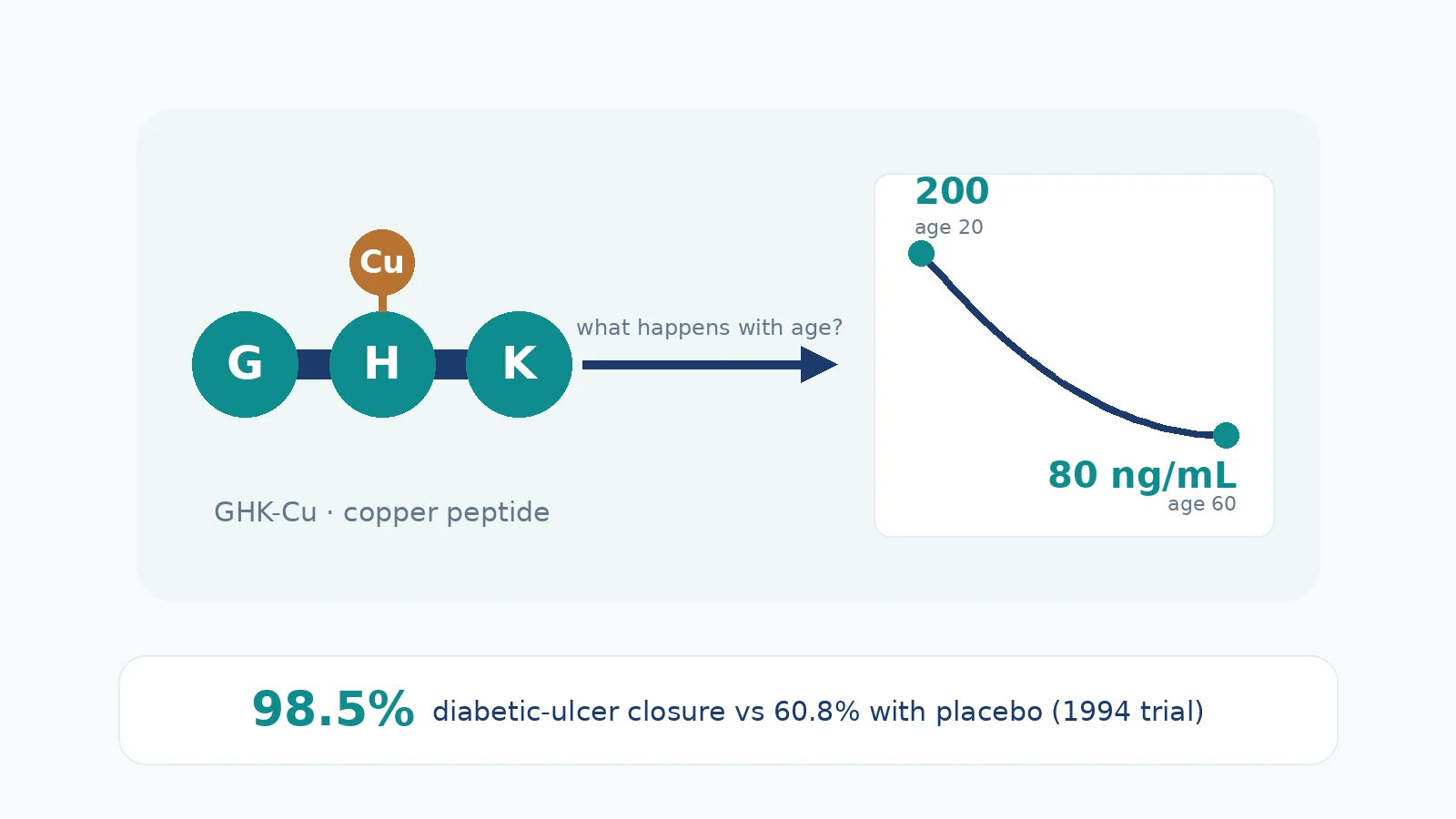
In 1973, a biochemist named Loren Pickart noticed something odd in human blood. When he exposed liver tissue from older people to blood from younger people, that tissue started making proteins the way young tissue does. The substance responsible turned out to be tiny: three amino acids joined together, glycine, histidine and lysine. From their initials it's called GHK. And because it grabs copper very tightly, in the body it almost always travels attached to a copper atom. That's GHK-Cu, the "copper peptide."
Fifty years later, GHK-Cu is in drugstore creams, in $200 serums, in aesthetic clinics and in wellness programs that sell it as an injection. It gets credit for everything: firmer skin, scars that fade, hair that comes back, joints that heal, even "reprogramming your DNA." Part of that has studies behind it. Part of it is marketing. And the line between the two isn't always clear, even to the people selling it.
This article is the starting point of our GHK-Cu series. Here we explain what it is, how it works, the single strongest study in people, what the FDA says in 2026, and the difference between putting it on your skin and injecting it. With real numbers and sources you can verify. If your interest is skin or hair specifically, the dedicated guides are linked at the end.
Key points
- GHK is a natural peptide made by the body, found in blood, saliva and urine. It was discovered in 1973 and declines with age: according to reviews from the group that discovered it, it drops from about 200 ng/mL at age 20 to about 80 ng/mL at 60 (Journal of Biomaterials Science, 2008).
- Its natural job is tissue repair: it draws immune cells to a wound, stimulates collagen and elastin production, and modulates the enzymes that remodel skin (BioMed Research International, 2015).
- The best evidence in people is a randomized trial in diabetic foot ulcers: a GHK-Cu gel achieved 98.5% closure versus 60.8% with placebo, with fewer infections, 7% versus 34% (Wound Repair and Regeneration, 1994).
- For skin and hair, the evidence comes from the lab, from animals and from small cosmetic studies. There are no large clinical trials of injected GHK-Cu for aesthetics, recovery or "anti-aging."
- The FDA has not approved any GHK-Cu drug. In April 2026 it removed GHK-Cu from its lists of substances nominated for compounding because the nomination was withdrawn. That is not an approval: the advisory committee will review it before February 2027.
- The claim that it "regulates 4,000 genes" comes from a computational analysis in cultured cells, done by the discoverer's company. It's an interesting finding, not proof of an effect in people.
In this article
- What GHK-Cu is, explained without jargon
- It declines with age: the number that started it all
- What it does in the lab: collagen, remodeling and the "4,000 genes"
- The best evidence in people: diabetic ulcers
- Skin and hair: what actually exists
- Cream or injection: what changes
- What the FDA says in 2026
- Safety: what's known and what isn't
- What changes if you're on a GLP-1 program
- What this evidence does NOT say
- Who is this NOT for?
- Frequently asked questions
What GHK-Cu is, explained without jargon
A peptide is a short chain of amino acids. Proteins are long chains, hundreds of links. GHK has only three. That's why it's called a tripeptide. Its full name is glycyl-L-histidyl-L-lysine, but nobody says it that way. On cream labels it shows up as "copper tripeptide-1" or "copper peptide."
The body makes it on its own. It's in blood, saliva and urine. Some of it is released when collagen breaks down, for example when there's a wound. It's as if the damaged tissue sends a signal: "repair needed here." That signal draws in the cells that clean up and rebuild.
What makes GHK special is its relationship with copper. The histidine in the middle has a shape that traps copper very tightly, about as tightly as albumin, the protein that carries copper in the blood. So in the body, GHK almost always travels with a copper atom. That complex is GHK-Cu.
Why the copper matters
Copper isn't a decorative ingredient. It's a mineral that many enzymes need in order to work. One of them, lysyl oxidase, is what "stitches" collagen and elastin fibers together so skin has firmness. Another, superoxide dismutase, is one of the body's main defenses against free radicals. Without enough copper, those enzymes work at half speed. The idea behind GHK-Cu is that it delivers copper right where cells need it, in a form they can use, and that the peptide itself also sends repair signals.
One detail that often gets forgotten: the body also regulates copper carefully, because in excess it's toxic. We'll come back to that in the safety section.
It declines with age: the number that started it all
The most common sales pitch for GHK-Cu rests on a single number. The amount of GHK in the blood falls with the years. According to reviews published by Pickart, at age 20 there are about 200 nanograms per milliliter and at 60 about 80 remain. That's a drop of more than 60%. From there comes the idea of "replenishing" what the body no longer makes.
Here you have to be careful. The fact that something declines with age doesn't mean replacing it reverses aging. Many things decline with age, and replacing them doesn't always help. We saw it with growth hormone, with DHEA, with testosterone in healthy men. The decline in GHK is a measured fact. That supplementing it does anything in a healthy person is a hypothesis. Those are two different things.
It's also worth knowing who produced the data. Loren Pickart discovered the molecule, patented its uses and founded a company that sells GHK-Cu products. That doesn't invalidate his work, which is extensive and published in peer-reviewed journals. But it does mean that most of what's known about GHK-Cu comes from a single source with a commercial interest, and that there are few large independent studies confirming it. When you read "studies show," ask which studies and whose.
What it does in the lab: collagen, remodeling and the "4,000 genes"
When GHK-Cu is put in contact with skin cells in a culture dish, several measurable things happen. Fibroblasts, the cells that make collagen, produce more collagen, more elastin and more of some molecules called glycosaminoglycans, which hold water in the skin. Decorin also goes up, a small protein that organizes collagen fibers so they line up properly.
The interesting part is that GHK-Cu doesn't just stimulate construction. It also regulates demolition. It activates enzymes called metalloproteinases, which break down old collagen, and at the same time raises their inhibitors. In a 2015 review in BioMed Research International, Pickart and colleagues describe it as a modulator of remodeling: not "more collagen, no matter what," but a balance between removing what's damaged and laying down what's new. That's what a healing wound does, and it's what gets lost with age.
A group at Seoul National University studied something else: what happens to keratinocytes, the cells of the outer layer of skin. In an artificial skin model, GHK-Cu increased the proliferation of those cells and raised the expression of integrins and of p63, a marker of skin stem cells (Archives of Dermatological Research, 2009). Three years later, the same group found that GHK without copper did almost the same thing (Journal of Peptide Science, 2012). In other words: part of the effect belongs to the peptide, not just the copper.
The 4,000-gene figure, in context
This is the claim that circulates most. It comes from an analysis with a Broad Institute tool called the Connectivity Map. The tool compares how gene expression changes in cultured cells when they're exposed to different substances. According to Pickart's group, GHK changed the activity of about 4,000 genes: raised some, lowered others. Many of those changes point in the direction of young tissue: less inflammation, more repair, more antioxidants.
What it means and what it doesn't. It's a real finding and it's published. But it's an experiment in cells, in a database, with one substance at one fixed concentration. It doesn't measure what happens when a person applies a cream or injects the peptide. The phrase "reprograms your DNA" is marketing. GHK doesn't change your DNA. In the lab, it changes how active some genes are. Exercise, good sleep and food do that too. It's interesting, not magic.
The best evidence in people: diabetic ulcers
If you had to keep just one study of GHK-Cu in people, it would be this one. A group led by Gerit Mulder of the Wound Healing Institute tested a GHK-Cu gel, called Iamin, on foot ulcers in people with diabetes and nerve damage. It was a multicenter, randomized, placebo-controlled trial with evaluators who didn't know which treatment each patient received. All participants got demanding standard care: surgical cleaning of the wound at the start, special footwear to relieve pressure and education on diabetes control.
The results were clear. Ulcers treated with the gel closed 98.5% of their area at the median, versus 60.8% with the gel without peptide. Large ulcers, over 100 square millimeters, were where it showed most: 89.2% closure versus a 10.3% worsening in the placebo group. And there were fewer infections: 7% versus 34%. The authors noted the effect was greatest when the gel was applied immediately after cleaning the wound.
What this means for you
First, that GHK-Cu isn't smoke. In a real wound, in real people, applied to the skin, it sped up healing. Second, that context matters. These were open wounds, in people with diabetes, with intensive medical care around them. It wasn't healthy skin that wanted to look younger. Extrapolating from an ulcer that closes to a wrinkle that softens is a leap the science hasn't made with the same quality.
Third, that the study is more than 30 years old. That gel never became an FDA-approved drug. In medicine, when a result that good isn't repeated in larger trials over three decades, you have to ask why. We don't know whether it was lack of commercial interest, patent problems or failure to replicate. The honest thing is to say it: it's a positive, well-designed and solitary trial.
Skin and hair: what actually exists
For skin, what exists are 12-week cosmetic studies with creams. The most cited ones, from the 2000s, were presented at dermatology conferences and never published as full papers. In one, 71 women with sun damage used a GHK-Cu cream for 12 weeks and improved in firmness, fine lines and skin density measured by ultrasound. In another, with 20 women, the cream increased collagen production more than vitamin C or retinoic acid over the same period. These are small, industry studies with limited access. The 2015 review summarizes them.
There is more recent evidence, with caveats. In August 2026, Skin Research and Technology published a study from a Chinese cosmetics company in which a cream combining GHK-Cu with a fermentation extract reduced wrinkles and improved the skin barrier in volunteers. It's a combination product, funded by the manufacturer, and it doesn't separate the effect of GHK-Cu from the rest. But it confirms a pattern: applied to skin, at cosmetic concentrations, GHK-Cu produces measurable, modest changes. We cover the details in our Spanish guide on GHK-Cu and skin.
For hair, the evidence is weaker. There are studies in cultured follicle cells and in mice, where GHK-Cu increased follicle size and stimulated growth. In people, the company ProCyte ran trials in the 1990s with a GHK-Cu derivative, but the results were never fully published and the product never reached the market as a drug. Minoxidil, by contrast, has trials with hundreds of people. We compare them with numbers in GHK-Cu and hair loss.
Cream or injection: what changes
This is the most important distinction in the whole article, and the one that gets explained least.
| Aspect | Cream / serum | Injection |
|---|---|---|
| Main use | Cosmetic (skin) | "Recovery," aesthetics, anti-aging |
| Time on the market | Over 25 years | Recent, in wellness programs |
| Studies in people | Small cosmetic studies + ulcers (1994) | None published for those uses |
| Established dose | Yes, at cosmetic concentrations | No validated dose |
| FDA status | Cosmetic ingredient | Not approved; compounding under review |
All the human evidence described above is for GHK-Cu applied to the skin: gel on wounds, cream on the face. There, the peptide acts where it's placed, at known concentrations, with decades of use and a reasonable safety record.
Injection is a different story. The idea is that injected under the skin, GHK-Cu reaches the whole body and acts on deep tissues: joints, muscles, organs. It's a plausible idea. Animal studies with injected GHK-Cu show faster healing in skin, bone and intestine. But there are no published clinical trials in people using injected GHK-Cu for aesthetics, injury recovery or aging. We don't know the right dose, how long it lasts in the blood, or what happens with the copper that comes in with each injection over months.
When someone tells you "GHK-Cu has a lot of evidence" and offers you an injection, they're using the cream's evidence to sell the injection. They are different products with different evidence. We offer both in our catalog, and that's exactly why we think you should know this before deciding.
What the FDA says in 2026
There is no FDA-approved GHK-Cu drug for any use. What exists are two pathways. The first is cosmetic: "copper tripeptide-1" is a permitted ingredient in creams, and as a cosmetic it doesn't need to prove efficacy, only that it isn't harmful. The second is compounding: pharmacies that prepare the injectable peptide under prescription, without the product going through FDA approval.
That second pathway has changed several times. In September 2023, the FDA placed a list of peptides, including injectable GHK-Cu, in "Category 2" of substances nominated for compounding. That category is for substances the agency judges to raise significant safety risks, and in practice it barred compounding them. In April 2026, the FDA announced it was removing 12 peptides from that category, including GHK-Cu, because the parties who nominated them withdrew the nominations. It also removed non-injectable GHK-Cu from "Category 1," the category for substances under evaluation with no identified risks.
It's important to understand what that means. Leaving Category 2 is not an approval. It does not place GHK-Cu on the list of substances authorized for compounding. It leaves it in a gray zone while an FDA advisory committee, the PCAC, reviews it. That committee evaluated six other peptides in July 2026 and is scheduled to review GHK-Cu before the end of February 2027. Until then, any GHK-Cu injection sold in the United States is a compounded product, without FDA approval, and its regulatory status can change.
We say this plainly because we sell it: the GHK-Cu products we offer are cosmetic or compounded, not FDA-approved drugs. And a licensed physician decides whether it makes sense in your case.
Safety: what's known and what isn't
As a cream, GHK-Cu has over 25 years of cosmetic use and a quiet safety record. Reported reactions are mild irritation, redness or itching in a few people. Pickart's reviews describe no serious effects with topical use. As with any new cosmetic, the practical advice is to test it on a small area first.
As an injection, the honest answer is that there are no long-term safety data in people. What gets reported in forums and in clinical practice are injection-site reactions: pain, redness, sometimes a lump that lasts for days. No studies have followed people for years to find out whether there are cumulative effects.
There are three theoretical concerns worth knowing. The first is copper. Each dose of GHK-Cu brings copper, and although the amounts are small, the body regulates this mineral carefully. People with Wilson's disease, who accumulate copper, should not use it. The second is angiogenesis: GHK-Cu stimulates the formation of new blood vessels, which is what you want in a wound but not necessarily what you want if you have a tumor. It's paradoxical, because Pickart himself has proposed GHK as a treatment for certain cancers. The science hasn't resolved that contradiction, which is why anyone with a cancer history should talk to their oncologist first. The third is pregnancy and breastfeeding: there are no data, and without data the rule is not to use it.
And one practical concern: product quality. Because there's no FDA approval, purity, actual dose and sterility depend on who prepares it. A peptide bought online "for research" may not contain what the label says. If you're going to use injectable GHK-Cu, it should come from a licensed pharmacy, with a prescription and a certificate of analysis.
What changes if you're on a GLP-1 program
Many people arrive at GHK-Cu by a specific route: they lost weight fast and now they're worried about their skin or hair. It's a valid concern. When you lose weight, skin that had stretched doesn't always tighten at the same pace, and hair can shed more for two or three months because of the abrupt change. We explain both in Loose skin after weight loss and in GHK-Cu and hair loss.
What the evidence allows us to say is this. A GHK-Cu cream may modestly improve the firmness and texture of facial skin, according to small cosmetic studies. There are no studies of GHK-Cu, cream or injection, on excess skin of the abdomen or arms after weight loss. And for hair that sheds because of the weight change, what matters most is time and protein: that kind of shedding stops on its own when the body stabilizes.
The tools with strong evidence for protecting skin and muscle while you lose weight are less glamorous: losing at a reasonable pace, eating enough protein, strength training two or three times a week, sleeping well and not smoking. GHK-Cu can be a cosmetic complement. It doesn't replace any of those things.
Once you start your program, a licensed physician reviews your case — habits, stress, sleep and medical history — and orders labs only if they consider it necessary. If you're interested in GHK-Cu as part of your plan, that physician decides whether it makes sense in your case, in what form and with what expectations. Eligibility is determined by medical evaluation.
GLP-1 programs from $88.99 a month. Cancel anytime, one click.
What this evidence does NOT say
Let's be explicit, because GHK-Cu is a topic where real research gets mixed with promises that have no backing.
It doesn't say GHK-Cu is useless. There's a positive randomized trial in wounds, decades of cosmetic use and plausible biology. Dismissing it as "pure hype" would be as unrigorous as selling it as a miracle.
It doesn't say it rejuvenates. That GHK declines with age and activates "young" genes in the lab doesn't prove that replacing it makes you younger. No study in people has measured that.
It doesn't say the injection works. All the human evidence is topical. What's claimed for the injection is extrapolated from animals and from the cream.
It doesn't say it's safe long-term when injected. It simply hasn't been studied.
It doesn't say it replaces minoxidil, retinol or sunscreen. Those have large trials and approval. GHK-Cu doesn't.
It doesn't say it "reprograms your DNA." It modulates gene expression in cultured cells. Your DNA stays the same.
Who is this NOT for?
- People who are pregnant or breastfeeding: there are no safety data.
- People with Wilson's disease or another disorder of copper metabolism.
- People with a history of active or recent cancer, without first discussing it with their oncologist.
- People with a known allergy to copper or to any component of the formula.
- Anyone under 18.
- Anyone looking to "fix" excess skin after major weight loss: there's no evidence for that, and sometimes the answer is surgical.
- Anyone who wants guaranteed results. They don't exist, with this or any other peptide.
Frequently asked questions
What exactly is GHK-Cu?
It's a three-amino-acid peptide, glycine, histidine and lysine, that the body makes naturally and that binds copper tightly. It's found in blood, saliva and urine. It was discovered in 1973 and its natural job is tissue repair: it draws immune cells to wounds and stimulates collagen production.
Is GHK-Cu FDA approved?
No. There is no FDA-approved GHK-Cu drug. As a cream it's used as a cosmetic ingredient. As an injection it's sold as a compounded product. In April 2026 the FDA removed it from its list of substances with significant safety risks for compounding, but that isn't an approval: an advisory committee will review it before February 2027.
What's the best evidence that it works?
A 1994 randomized trial in diabetic foot ulcers. The GHK-Cu gel achieved 98.5% closure versus 60.8% with placebo, and cut infections from 34% to 7% (Wound Repair and Regeneration). It's a well-designed study, but it's in wounds, not healthy skin, and it wasn't replicated in large trials afterward.
Is the cream or the injection better?
For facial skin, all the evidence in people is for the cream. The injection has no published clinical trials in people for aesthetics, recovery or aging. If someone offers you the injection "because it has a lot of evidence," they're showing you the cream's evidence.
Does GHK-Cu regulate 4,000 genes?
According to a computational analysis in cultured cells, done with the Broad Institute's Connectivity Map and published by Pickart's group, it does change the activity of about 4,000 genes in the lab. It doesn't change your DNA, and that analysis doesn't measure what happens in a person using the product.
Does it work for hair?
The evidence is from the lab and from mice. There are no published trials in people comparing it with minoxidil, which is approved and has studies with hundreds of participants. We explain it with numbers in our guide on GHK-Cu and hair loss.
Does it have side effects?
As a cream, mild irritation in a few people. As an injection, reactions at the injection site, and no long-term data. It isn't recommended in pregnancy, breastfeeding, Wilson's disease or in people with cancer without consulting their oncologist.
What labs are ordered for this?
That's a clinician's decision. Once you start your program, a licensed physician reviews your case — habits, medical history, goals — and orders labs only if they consider it necessary. Eligibility is determined by medical evaluation.
Do you offer care in Spanish?
Yes. All our content and care are available in both Spanish and English.
Sources
- Pickart L, Vasquez-Soltero JM, Margolina A. GHK Peptide as a Natural Modulator of Multiple Cellular Pathways in Skin Regeneration. BioMed Research International. 2015;2015:648108. — DOI · via PubMed
- Pickart L. The human tri-peptide GHK and tissue remodeling. Journal of Biomaterials Science, Polymer Edition. 2008;19(8):969-988. — DOI · via PubMed
- Pickart L, Vasquez-Soltero JM, Margolina A. The human tripeptide GHK-Cu in prevention of oxidative stress and degenerative conditions of aging. Oxidative Medicine and Cellular Longevity. 2012;2012:324832. — DOI · via PubMed
- Mulder GD, Patt LM, Sanders L, et al. Enhanced healing of ulcers in patients with diabetes by topical treatment with glycyl-l-histidyl-l-lysine copper. Wound Repair and Regeneration. 1994;2(4):259-269. — DOI · via PubMed
- Kang YA, Choi HR, Na JI, et al. Copper-GHK increases integrin expression and p63 positivity by keratinocytes. Archives of Dermatological Research. 2009;301(4):301-306. — DOI · via PubMed
- Choi HR, Kang YA, Ryoo SJ, et al. Stem cell recovering effect of copper-free GHK in skin. Journal of Peptide Science. 2012;18(11):685-690. — DOI · via PubMed
- Pickart L, Vasquez-Soltero JM, Margolina A. The Effect of the Human Peptide GHK on Gene Expression Relevant to Nervous System Function and Cognitive Decline. Brain Sciences. 2017;7(2):20. — DOI · via PubMed
- Wang J, Tao K, Huang H, Chang H. Augmented Skin Beneficial Effects of Thermus Thermophilus and Bacillus Subtilis Mixed-Culture Ferment Extract by Tripeptide GHK-Cu. Skin Research and Technology. 2026;32(8):e70360. — DOI · via PubMed
- Orrick. FDA Announces Removal of 12 Peptides from Category 2 and Schedules PCAC Meetings to Consider Adding Peptides to 503A Bulk Drug Substances List. April 16, 2026. — Orrick
- McDermott Will & Schulte. Bulk-list bound? PCAC backs majority of peptides in two-day public meeting (July 23–24, 2026). — McDermott
Related articles
GHK-Cu and hair loss → Loose skin after weight loss → Strength training on a GLP-1 →Your trust is worth more than a sale.
This article is informational and is not medical advice. SCTS1 does not prescribe medication. All medical care, prescriptions, and treatment plans are provided by licensed healthcare providers through our partner platform. Treatment eligibility is determined by a licensed provider. Compounded medications contain the same active ingredient class but are not FDA-approved finished pharmaceuticals. Individual results vary and are not guaranteed.