GHK-Cu Injections: Dose, Side Effects and What the Evidence Really Says
En español: GHK-Cu inyectable — los estudios en animales que existen, los cero ensayos en personas, por qué no hay dosis validada, cuánto cobre entra con cada inyección, los efectos secundarios reportados y seis preguntas antes de aceptarla.
Search "GHK-Cu injection" and you land in two worlds. In one, forums where people trade protocols like "1 mg a day for 30 days" as if they were recipes. In the other, clinics and wellness programs offering it for recovery, joints, skin and "anti-aging," almost always with the line "it has a lot of evidence." What almost nobody tells you is where that evidence comes from, or what happens to the peptide and to the copper once they are inside your body.
This guide answers that. We won't repeat what GHK-Cu is or its history since 1973: that's in our main guide to the copper peptide. Here we focus on the injection: which studies actually exist, in which animals and at what doses, how many trials there are in people, what is known about side effects, why there is no validated dose, and which questions to ask before you let anyone inject it.
We write it under one rule we apply to everything we publish: evidence first, sale second. We offer GHK-Cu in our catalog, and that's exactly why we think you have the right to know what follows before you decide.
Key points
- Studies of injected GHK-Cu are in animals: rats with wound chambers under the skin, dogs with paw-pad wounds, rats after cruciate-ligament surgery, mice with lung fibrosis. Nearly all injected the peptide at the site of the injury, not body-wide (Journal of Clinical Investigation, 1993; Journal of Orthopaedic Research, 2015).
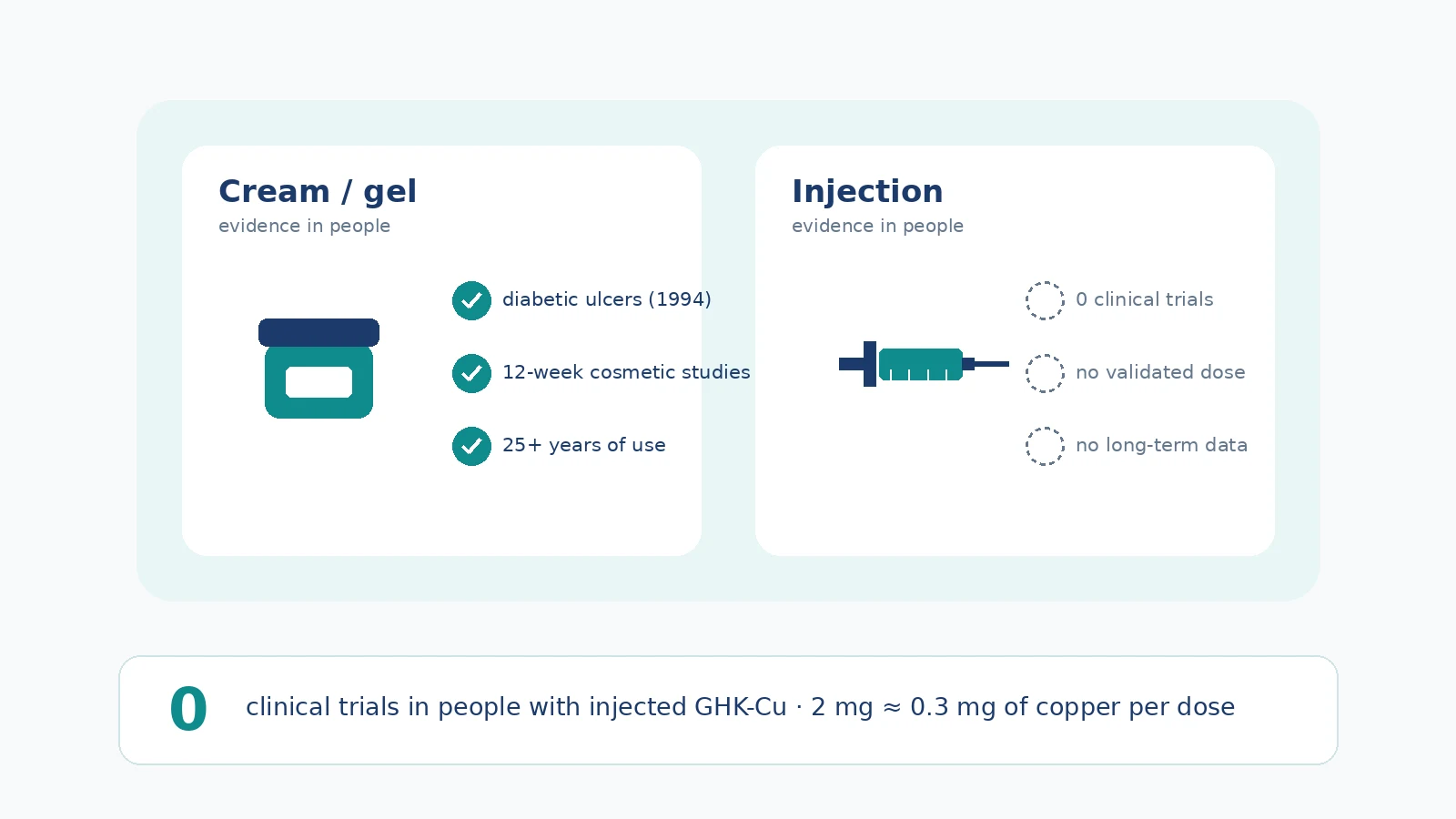
- In people, there is no published clinical trial of injected GHK-Cu for aesthetics, recovery, joints or aging. All human evidence is gel or cream applied to the skin.
- In the rat ligament study, the benefit was there at 6 weeks and gone by 12, once the injections stopped. The effect did not hold on its own.
- Injected into a vein, GHK breaks down fast in blood: in rats it turns into the histidine-lysine fragment and is cleared quickly (Journal of Chromatography B, 1997). No one has measured this in people.
- There is no validated dose. The "protocols" going around are extrapolations from animals or forum habit, not the result of dose-finding trials.
- In animals, high repeated doses of GHK suppressed the immune response in a dose-dependent way and, at the highest dose, altered the liver (Bulletin of Experimental Biology and Medicine, 2002). It's a lab signal, not human data, but it's the reason "more" is not better.
In this article
- Why the injection is sold and what it promises
- The animal evidence: what actually exists
- The human evidence: zero trials with the injection
- What happens to the peptide once you inject it
- Dose: why there is no validated dose
- Side effects: what's reported and what's theoretical
- The quality problem: "research use only"
- What the FDA says in 2026
- Six questions before you accept an injection
- What changes if you're on a GLP-1 program
- What this evidence does NOT say
- Who is this NOT for?
- Frequently asked questions
Why the injection is sold and what it promises
The commercial logic is simple. GHK-Cu in a cream works where you put it: on the skin. The injection promises something bigger: that the peptide travels through the blood and repairs deep tissue, such as joints, tendons, muscle, lungs, even the brain. On the market it's offered for injury recovery, for "rejuvenating from the inside," for knee pain, for the skin of the whole body and as a companion to weight-loss programs.
The idea isn't absurd. GHK is a peptide the body makes and that circulates naturally in the blood. Its level falls with age. Replacing it by injection sounds reasonable. The problem isn't the idea: it's that nobody has tested it in people with the rigor a medical decision requires. And when a plausible idea is sold as a proven fact, the person paying the difference is you.
To make the distinction clear from the start: the cream has decades of cosmetic use, small skin studies and one randomized wound trial. The injection has animal studies and none in people. When someone shows you "the GHK-Cu evidence" to sell you an injection, they are almost always showing you the cream's evidence. We explain that in detail in the main guide; here we go to what actually exists for the injection.
The animal evidence: what actually exists
Let's be fair: the animal studies with injected GHK-Cu are real, published in serious journals, and they show effects. These are the main ones.
Rats with wound chambers (1993)
The classic study comes from a French group led by François-Xavier Maquart. They implanted stainless-steel mesh cylinders under the skin of rats, a model that mimics a wound, and injected GHK-Cu directly into those cylinders. The tissue that formed had more collagen, more protein and more glycosaminoglycans than in rats given saline. Collagen production was stimulated twice as much as other proteins. A control peptide with a different sequence did nothing (Journal of Clinical Investigation, 1993).
Note the detail that matters: the peptide was injected into the wound, not into the abdomen or a vein. It acted where it was placed, just like the cream. Later studies by the same group, with 2 mg per injection into those chambers, showed how GHK-Cu modulates the enzymes that remodel tissue (Journal of Investigative Dermatology, 1999 and 2000).
Dogs with paw-pad wounds (1996)
A veterinary team at Auburn University made 6-by-8-millimeter wounds in the paw pads of 12 dogs and injected them with the copper complex on days 0, 3 and 6. The treated wounds had more type I collagen at 6 and 14 days than controls (American Journal of Veterinary Research, 1996). Again: local injection, into the wound.
Rats after cruciate-ligament surgery (2015)
This is the study most often cited to sell the injection "for joints," so it's worth reading in full. Researchers in Hong Kong performed anterior cruciate ligament reconstruction on 72 rats and split them into three groups: saline, GHK-Cu at 0.3 mg/mL, and GHK-Cu at 3 mg/mL. The injections went into the knee, once a week for 4 weeks.
The authors themselves sum it up: the effect was "transient" and "could not last as treatment discontinued." What's more, the low dose worked better than the high dose on graft stiffness, another sign that more peptide doesn't mean more effect. That is the joint study. It's positive, it's in rats, it's local, and the benefit left when the injections stopped.
Mice with lung fibrosis (2019 and 2024)
Here there was a genuinely "systemic" injection: into the animal's abdomen, not the lung. In a model of bleomycin-induced pulmonary fibrosis, intraperitoneal GHK-Cu on alternate days reduced inflammation and collagen deposition in the lung (Life Sciences, 2019). In 2024 another group tested it in a mouse model of silicosis and reported less inflammation and fibrosis "without significant systemic toxicity" (Redox Biology, 2024). These are interesting studies of a serious disease with no good treatment. They are not studies of aesthetics, athletic recovery or aging, and they are in mice.
What these studies have in common
- Almost all inject the peptide at the site of damage: the wound, the knee. That is not the same as a subcutaneous shot in the abdomen hoping it reaches the whole body.
- The animals had an active injury or disease. None was a healthy animal trying to age more slowly.
- When measured longer term, the effect was lost after stopping treatment.
- Doses range from micrograms per kilo to milligrams per local injection, depending on the model. There is no "animal dose" that translates directly to a person.
The human evidence: zero trials with the injection
This is the heart of the article, so we say it plainly. We searched PubMed, the medical database of the U.S. National Library of Medicine, for clinical trials of GHK-Cu in people. What comes up is topical: the 1994 diabetic foot ulcer trial, a 1992 trial in venous ulcers, 12-week cosmetic studies, and a 2006 study on laser-treated skin. None with an injection.
And the topical evidence isn't all positive either, something that rarely gets mentioned. In the 1992 trial, with 86 patients with venous leg ulcers, a 0.4% GHK-Cu cream was no better than placebo; silver sulfadiazine, a classic treatment, did shrink the ulcers (Journal of Vascular Surgery, 1992). In the 2006 study, with 13 patients treated with CO2 laser around the mouth, the GHK-Cu cream showed no significant differences versus care without the peptide (Archives of Facial Plastic Surgery, 2006). The positive 1994 diabetic-ulcer trial exists and it's good. But it isn't "all the evidence": it's the best result in a mixed set.
Why does that matter for the injection? Because if even the cream, with 30 years of studies, doesn't produce consistent results in every wound, extrapolating from there to an injection in healthy people is a double leap: from cream to injection, and from wound to aesthetics. Science hasn't made either one.
What happens to the peptide once you inject it
A question almost nobody asks: how long does GHK-Cu last in the blood after you inject it? The only published data we found are in rats. A Japanese group developed a method to measure GHK in plasma and applied it after an intravenous dose. The result: GHK was rapidly degraded to histidine-lysine, a two-amino-acid fragment, which was itself cleared quickly (Journal of Chromatography B, 1997). To measure it at all they had to add an enzyme blocker to the samples; without it, the peptide vanished in the tube.
That fits what's known about small peptides in general: enzymes in the blood cut them up within minutes. It's one reason many peptides are given locally or with chemical modifications. For GHK-Cu injected into people, there are no studies of how long it lasts, where it goes or in what concentration. When you're told "it reaches the joints," that's an assumption, not a measurement.
Then there's the copper. GHK gives up its copper easily, and the body handles copper with a system of its own: transport proteins, the liver, bile. At small doses, that system probably absorbs it without trouble. But "probably" is not "measured." Nobody has published what happens to the copper from daily GHK-Cu injections over months in people.
Dose: why there is no validated dose
A validated dose comes from studies that test several amounts in people, measure the effect and the side effects of each, and pick the best trade-off. That has not been done with injected GHK-Cu. What circulates, "1 mg a day," "2 mg three times a week," "30-day cycles," comes from three sources: extrapolations from animal studies, forum habit, and what compounding pharmacies can package. None of those is a dose-finding trial.
Still, we can do a useful calculation about the copper. GHK-Cu weighs about 404 daltons, of which about 64 are the copper atom. In other words, roughly 16% of the peptide's weight is copper. With a 2 mg dose of GHK-Cu, about 0.3 mg of copper comes in. For reference, the tolerable upper intake level for copper by mouth in adults, set by the U.S. Institute of Medicine, is 10 mg a day, and typical intake from food is around 1 mg.
On paper, 0.3 mg looks small. But the comparison has a catch: that 10 mg limit is for copper that passes through the gut, where the body regulates how much it absorbs. An injection skips that filter. We don't know whether 0.3 mg injected equals 0.3 mg eaten, and in people with disordered copper metabolism, as in Wilson's disease, any extra amount is a problem. So this calculation is for perspective, not reassurance.
And the signal that "more is not better" comes from the studies themselves: in the rat ligament, 0.3 mg/mL worked better than 3 mg/mL. In a Russian series with repeated GHK injections in rats, immune suppression grew with the dose, and at the highest dose blood liver values were altered and changes were seen in liver tissue (Bulletin of Experimental Biology and Medicine, 2002; Patologicheskaia Fiziologiia, 2003). We don't know whether that happens in people. What we do know is that raising the dose "so it works more" has no support, and has a signal against it.
Side effects: what's reported and what's theoretical
What's reported in practice
Since there are no trials, there is no official side-effect table with percentages. What clinicians who use it and people who post about it describe are injection-site reactions: pain on injection, redness, itching, sometimes a lump that lasts a few days. Some people describe tiredness or a headache on injection day. None of this is quantified, so we can't tell you "it happens to 5%" or "it's rare." It isn't known.
The theoretical concerns
- Copper build-up. Explained above. Contraindicated in Wilson's disease and any disorder of copper metabolism.
- Immune system. In rats, repeated doses suppressed antibody production and delayed-type hypersensitivity in a dose-dependent way. It's lab data, but it's a reason not to combine it with immunosuppressants or use it during active infections without supervision.
- New blood vessels. GHK-Cu stimulates angiogenesis, which you want in a wound and not in a tumor. Anyone with a cancer history should discuss it with their oncologist first.
- Pregnancy and breastfeeding. Zero data. With no data, it isn't used.
- Interactions. There are no interaction studies with any medication. That doesn't mean there are none: it means nobody has looked.
A point that sometimes gets forgotten: the absence of serious reports is not the same as evidence of safety. Nobody is required to report adverse effects of an unapproved compounded product, and there is no follow-up registry. If something happened to one in a thousand people, we'd have no way of knowing today.
The quality problem: "research use only"
Here is a more concrete risk than any theoretical side effect. A huge share of the injectable GHK-Cu in circulation comes from online vendors selling vials labeled "for research use only, not for human use." That label isn't a technicality: it means nobody has verified the vial is sterile, that it contains the amount it claims, that it's free of endotoxins, or that the peptide is even the right one.
Injecting under your skin a liquid with no guarantee of sterility is a real risk of infection and abscesses, and that has nothing to do with GHK-Cu: it happens with anything. The other route is a licensed compounding pharmacy that prepares the peptide under a medical prescription, in sterile conditions, and can provide a certificate of analysis. The product is still not FDA-approved, but at least you know what's in the vial.
Our position is simple and we apply it to everything we sell: no prescription from a licensed physician, no licensed pharmacy and no certificate of analysis, no. And even when all three are met, it is still a product with no trials in people. That doesn't change because the vial looks nice.
What the FDA says in 2026
The FDA has not approved any GHK-Cu drug, cream or injection. In September 2023 it placed injectable GHK-Cu in "Category 2" of bulk substances for compounding, the category for significant safety risks. In April 2026 it removed it from that category along with 11 other peptides, because those who had nominated it withdrew the nomination. That is not an approval or a safety declaration: it leaves it under review by the PCAC advisory committee, which is scheduled to evaluate it before the end of February 2027. Until then, any GHK-Cu injection in the United States is an unapproved compounded product whose status can change. The regulatory details are in the main guide.
Six questions before you accept an injection
If someone offers you injectable GHK-Cu, these questions tell you in two minutes whether they know what they're talking about.
- "Which trial in people supports this?" The honest answer is "none with the injection." If they cite the diabetic ulcer trial, that was a gel on wounds.
- "Where does the dose you're proposing come from?" If the answer is "it's the standard dose," ask standard according to which study.
- "Who prepares the product, and is there a certificate of analysis?" Licensed pharmacy and a prescription, or no.
- "How will you measure whether it's working for me?" If there's no concrete goal and no way to measure it, there's no way to know when to stop.
- "What happens when I stop?" In the rat ligament study, the effect left when treatment stopped. Nobody knows what happens in people.
- "Did you review my cancer history, pregnancy status and copper metabolism?" If they didn't ask, they didn't do a medical evaluation.
What changes if you're on a GLP-1 program
Many people asking about injectable GHK-Cu are losing weight and want to help their skin, the joints that carried extra weight for years, or recovery from exercise. Those are legitimate goals. The honest thing to say is that for none of the three is there a study of injected GHK-Cu in people, and that the tools with strong evidence are different ones: losing at a reasonable pace, eating enough protein, strength training, sleeping well and not smoking. For loose skin, the answer is in Loose skin after weight loss, and it isn't an injection.
Once you start your program, a licensed physician reviews your case — habits, stress, sleep and medical history — and orders labs only if they consider it necessary. If injectable GHK-Cu comes up in the conversation, that physician decides whether it makes sense in your case, with what expectations and with what product. And if they decide it doesn't, that's a medical answer too. Eligibility is determined by medical evaluation.
GLP-1 programs from $88.99 a month. Cancel anytime, one click.
What this evidence does NOT say
It does not say injected GHK-Cu doesn't work. It says it hasn't been tested in people. Those are different things, and the gap between them is exactly where the marketing lives.
It does not say it's dangerous. Animal studies at reasonable doses show no serious toxicity. It says there are no long-term safety data in humans, and there are animal signals that a high dose is not harmless.
It does not say animal studies are worthless. They're a starting point. A rat study is a hypothesis for a trial in people, not a substitute for one.
It does not say cream and injection are the same. We repeat it because it's the most common mistake and the most profitable one.
It does not say an internet "protocol" has a basis. It doesn't, no matter how many people repeat it.
Who is this NOT for?
- People who are pregnant or breastfeeding: no safety data.
- People with Wilson's disease or another disorder of copper metabolism.
- People with active or recent cancer who haven't discussed it with their oncologist.
- People who are immunosuppressed, on immunosuppressive treatment, or with an active infection.
- People with a known allergy to copper or any component of the formula.
- Anyone under 18.
- Anyone planning to buy "research" vials and inject them at home without supervision. That's the most real risk of all.
- Anyone who wants a guaranteed result. There isn't one.
Frequently asked questions
Is there evidence for injectable GHK-Cu?
In animals, yes: studies in rats, dogs and mice, almost all with direct injection into the wound or joint. In people, there is no published clinical trial with the injection. All human evidence is cream or gel on the skin.
What is the correct dose of injectable GHK-Cu?
There is no validated dose because a dose-finding study in people has never been done. The protocols in circulation are extrapolations and habit. In animals, the lowest dose sometimes worked better than the highest.
What are the side effects of injectable GHK-Cu?
What's reported are injection-site reactions: pain, redness, itching, lumps. There are no quantified or long-term data. The theoretical concerns are copper build-up, the immune suppression seen in rats at high doses, angiogenesis in people with cancer, and the lack of data in pregnancy.
How much copper comes in with each injection?
About 16% of GHK-Cu's weight is copper. With 2 mg of the peptide, about 0.3 mg of copper comes in. The tolerable upper intake for adults is 10 mg a day, but that limit is for copper that passes through the gut; injection skips that regulation, and there are no accumulation studies in people.
How long does GHK-Cu last in the blood?
In rats, after an intravenous dose, it was rapidly degraded to a two-amino-acid fragment that was also cleared quickly. In people it hasn't been measured.
Does it help joints or injury recovery?
The only study is in rats after cruciate-ligament reconstruction: it improved laxity at 6 weeks and the effect disappeared by 12, after the injections stopped. There are no studies in people.
Is injectable GHK-Cu legal in the United States?
It is not FDA-approved. In April 2026 it came off compounding Category 2, but that isn't an approval; the PCAC committee reviews it before February 2027. It's sold as a compounded product under prescription, and "research use only" vials are not for human use.
What labs are ordered for this?
That's a clinician's decision. Once you start your program, a licensed physician reviews your case and orders labs only if they consider it necessary. Eligibility is determined by medical evaluation.
Do you offer care in Spanish?
Yes. All our content and care are available in Spanish and English.
Sources
- Maquart FX, Bellon G, Chaqour B, et al. In vivo stimulation of connective tissue accumulation by the tripeptide-copper complex glycyl-L-histidyl-L-lysine-Cu2+ in rat experimental wounds. Journal of Clinical Investigation. 1993;92(5):2368-2376. — DOI · via PubMed
- Siméon A, Emonard H, Hornebeck W, Maquart FX. Expression and activation of matrix metalloproteinases in wounds: modulation by the tripeptide-copper complex glycyl-L-histidyl-L-lysine-Cu2+. Journal of Investigative Dermatology. 1999;112(6):957-964. — DOI · via PubMed
- Siméon A, Wegrowski Y, Bontemps Y, Maquart FX. Expression of glycosaminoglycans and small proteoglycans in wounds: modulation by the tripeptide-copper complex glycyl-L-histidyl-L-lysine-Cu2+. Journal of Investigative Dermatology. 2000;115(6):962-968. — DOI · via PubMed
- Swaim SF, Vaughn DM, Kincaid SA, et al. Effect of locally injected medications on healing of pad wounds in dogs. American Journal of Veterinary Research. 1996;57(3):394-399. — PubMed
- Fu SC, Cheuk YC, Chiu WY, et al. Tripeptide-copper complex GHK-Cu(II) transiently improved healing outcome in a rat model of ACL reconstruction. Journal of Orthopaedic Research. 2015;33(7):1024-1033. — DOI · via PubMed
- Ma WH, Li M, Ma HF, et al. Protective effects of GHK-Cu in bleomycin-induced pulmonary fibrosis via anti-oxidative stress and anti-inflammation pathways. Life Sciences. 2020;241:117139. — DOI · via PubMed
- Bian Y, Deng M, Liu J, et al. The glycyl-l-histidyl-l-lysine-Cu tripeptide complex attenuates lung inflammation and fibrosis in silicosis by targeting peroxiredoxin 6. Redox Biology. 2024;75:103237. — DOI · via PubMed
- Endo T, Miyagi M, Ujiie A. Simultaneous determination of glycyl-L-histidyl-L-lysine and its metabolite, L-histidyl-L-lysine, in rat plasma by HPLC with post-column derivatization. Journal of Chromatography B. 1997;692(1):37-42. — DOI · via PubMed
- Smakhtin MY, Sever'yanova LA, Konoplya AI, Shveinov IA. Tripeptide Gly-His-Lys is a hepatotropic immunosuppressor. Bulletin of Experimental Biology and Medicine. 2002;133(6):586-588. — DOI · via PubMed
- Smakhtin MY, et al. Pharmacological correction of immuno-metabolic disorders with the peptide Gly-His-Lys in hepatic damage induced by tetrachloromethane. Patologicheskaia Fiziologiia i Eksperimental'naia Terapiia. 2003;(2):19-21. — PubMed
- Bishop JB, Phillips LG, Mustoe TA, et al. A prospective randomized evaluator-blinded trial of two potential wound healing agents for the treatment of venous stasis ulcers. Journal of Vascular Surgery. 1992;16(2):251-257. — DOI · via PubMed
- Mulder GD, Patt LM, Sanders L, et al. Enhanced healing of ulcers in patients with diabetes by topical treatment with glycyl-l-histidyl-l-lysine copper. Wound Repair and Regeneration. 1994;2(4):259-269. — DOI · via PubMed
- Miller TR, Wagner JD, Baack BR, Eisbach KJ. Effects of topical copper tripeptide complex on CO2 laser-resurfaced skin. Archives of Facial Plastic Surgery. 2006;8(4):252-259. — DOI · via PubMed
- Institute of Medicine. Dietary Reference Intakes for Vitamin A, Vitamin K, Arsenic, Boron, Chromium, Copper, Iodine, Iron, Manganese, Molybdenum, Nickel, Silicon, Vanadium, and Zinc. National Academies Press; 2001. (Copper tolerable upper intake level: 10 mg/day in adults.) — NCBI Bookshelf
- Orrick. FDA Announces Removal of 12 Peptides from Category 2 and Schedules PCAC Meetings to Consider Adding Peptides to 503A Bulk Drug Substances List. April 16, 2026. — Orrick
Related articles
GHK-Cu: what the copper peptide is → GHK-Cu and hair loss → Loose skin after weight loss → Strength training on a GLP-1 →Your trust is worth more than a sale.
This article is informational and is not medical advice. SCTS1 does not prescribe medication. All medical care, prescriptions, and treatment plans are provided by licensed healthcare providers through our partner platform. Treatment eligibility is determined by a licensed provider. Compounded medications contain the same active ingredient class but are not FDA-approved finished pharmaceuticals. Individual results vary and are not guaranteed.