GHK-Cu and Hair Loss: What the Science Says, and What It Doesn't
En español: GHK-Cu y la caída del cabello — qué puede y qué no puede hacer el péptido de cobre, por qué se cae el cabello en un programa GLP-1, y qué respalda la evidencia.
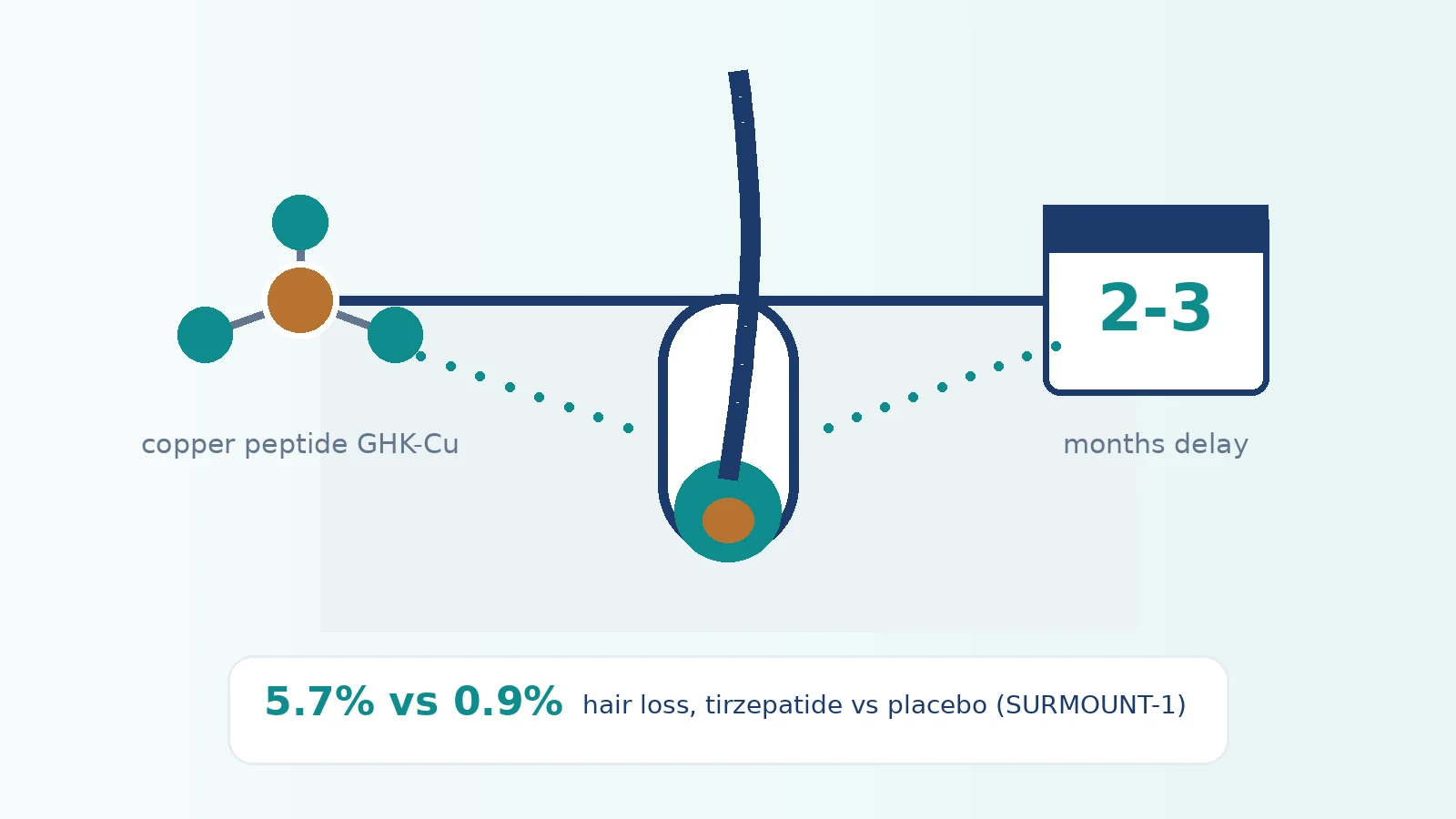
In the SURMOUNT-1 trial, published in The New England Journal of Medicine, between 4.9% and 5.7% of people taking tirzepatide reported hair loss, compared with 0.9% on placebo. And a 2026 systematic review in Science Progress that pooled 24 studies concluded that hair loss is a real effect, uncommon, and almost always tied to how fast weight comes off.
If you're on a GLP-1 program and you've noticed more hair in the brush or the shower drain, you're not imagining it. And if you went looking for a fix, you probably ran into GHK-Cu, the "copper peptide," with promises of every kind. This article separates three questions that usually get tangled together: why hair sheds when you lose weight, what GHK-Cu can do according to the studies that actually exist, and what really has solid evidence in people.
By the end you'll know what to expect, what not to expect, and when the honest answer is "we don't know yet." With real numbers and sources you can verify.
Key points
- In SURMOUNT-1 (tirzepatide, 2,539 adults), hair loss was reported in 5.1%, 4.9% and 5.7% at 5, 10 and 15 mg, versus 0.9% on placebo. In the semaglutide 2.4 mg trials it was 3% versus 1%, rising to 5.3% among people who lost more than 20% of their body weight.
- The main mechanism is telogen effluvium: a sudden change in the body pushes more follicles into the resting phase, and the hair sheds 2 to 3 months later. It usually recovers on its own once weight stabilizes, according to a review in Cureus.
- A study of more than 218,000 patients in JAAD found that the risk of telogen effluvium with tirzepatide was similar to that after bariatric surgery. In other words: rapid weight loss, not direct damage to the follicle.
- The evidence for GHK-Cu and hair comes from the lab and from animals: cultured human follicles that grew longer with a copper peptide (Archives of Pharmacal Research, 2007) and follicles that enlarged in rats (Journal of Investigative Dermatology, 1993). There are no large clinical trials in people.
- The topical treatment with strong evidence and FDA approval is minoxidil: in a trial of 393 men, 5% minoxidil produced 45% more regrowth than 2% at 48 weeks.
- GHK-Cu is not FDA-approved for hair loss or for any medical use. None of this is a diagnosis or a treatment. Individual results vary and are not guaranteed.
In this article
- How hair grows, without the jargon
- Why hair sheds on a GLP-1 program
- The real numbers from the trials
- What GHK-Cu is
- What the GHK-Cu hair studies actually show
- The honest comparator: minoxidil
- What you can do in the meantime
- What changes if you're on a GLP-1 program
- What this evidence does NOT say
- Who is this NOT for?
- Frequently asked questions
- Sources
How hair grows, without the jargon
Every hair grows out of a follicle, a small structure in the skin that works in cycles. There are three phases. The growth phase (anagen) lasts two to six years and holds 85% to 90% of your hair on any normal day. Then comes a short transition phase (catagen), and finally a resting phase (telogen) of about three months, at the end of which the old hair lets go and a new one starts growing from the same follicle.
That's why losing 50 to 100 hairs a day is normal. It's the turnover of follicles finishing their rest. The problem starts when something pushes many follicles into the resting phase at the same time.
What telogen effluvium is
When the body goes through a sudden change — surgery, a high fever, childbirth, a very strict diet, intense stress, rapid weight loss — a share of the follicles that were growing enter rest early. Because the resting phase lasts about three months, the visible shedding arrives two or three months after the event. That's called telogen effluvium, and a review published in Cureus (2020) describes it as diffuse, temporary and reversible: once the trigger is gone, follicles start growing again, although full recovery can take six months to a year.
That two-to-three-month delay explains a very common confusion: someone starts a program, loses weight quickly in the first months, and right when they're feeling better the shedding begins. It looks like "the medication caused it," but the real cause was the change three months earlier.
What androgenetic alopecia is
That's something different. It's patterned hair loss — receding temples and crown in men, diffuse thinning on top in women — driven by genetics and by how sensitive the follicles are to hormones. The follicles get smaller over the years. A telogen effluvium can unmask or speed up an androgenetic alopecia that was already on its way. The Science Progress review notes that these two forms are precisely the ones most often reported with GLP-1s.
Why hair sheds on a GLP-1 program
This is where it pays to be very clear, because two extreme versions circulate: that "GLP-1s make you bald" and that "there's no way they cause shedding." Neither is what the data say.
The systematic review by Gupta and colleagues (2026) screened 133 studies and selected 24 with usable data: clinical trials, pharmacovigilance databases and cohorts. Its conclusion was that there is a real hair-loss signal with semaglutide and tirzepatide, that it is uncommon, that it is more frequent with the high doses used for weight than with the low doses used for diabetes, that it affects women more, and that rapid weight loss stands out as the most likely driver, especially for telogen effluvium.
The bariatric surgery clue
The single most useful piece of data for understanding the mechanism comes from a cohort study published in the Journal of the American Academy of Dermatology (2025) with more than 218,000 patients with obesity from the TriNetX database. The risk of telogen effluvium with tirzepatide was 2.65 times higher than with other weight-loss medications. But when compared with bariatric surgery — the classic trigger for shedding from rapid weight loss — the difference was no longer significant. And no increased risk was found with semaglutide or liraglutide in that cohort.
Translation: hair doesn't react to the drug as such, but to how fast the body changes. Tirzepatide produces the largest and fastest weight loss of the current medications, which is why it's the one most associated with telogen effluvium.
What happens while you eat less
There's a second factor the review also mentions. When appetite drops a lot, it's easy to eat too little protein, iron and zinc without noticing. The follicle is one of the fastest-dividing tissues in the body and among the first to feel a shortfall. It isn't an automatic diagnosis, but it's one of the things a clinician checks when there's shedding on a weight program.
The real numbers from the trials
In the weekly semaglutide 2.4 mg trials for weight (the STEP trials, more than 2,100 people treated), hair loss was reported in 3% versus 1% on placebo. And when broken down by result, people who lost more than 20% of their body weight reported it at 5.3%, versus 2.5% among those who lost less. That number is the one that most supports the idea that the speed and size of the change are what matter.
With high-dose oral semaglutide (50 mg a day, the OASIS 1 trial), it was 7% versus 3%. With the low doses used in diabetes (0.25 to 2 mg), several studies found no difference.
There's an important sex difference. In the tirzepatide trials, hair loss was reported by 7.1% of women and 0.5% of men. The review acknowledges nobody knows for certain why. One reasonable hypothesis is that women notice and report changes in hair volume more, but that isn't confirmed.
A meta-analysis of randomized trials cited in the same review calculated an incidence of 6.0 cases per 1,000 patient-years with GLP-1s versus 0.8 with placebo, about three times higher. The absolute number is still low: most people on a program don't lose hair.
What GHK-Cu is
GHK is a very small peptide: three amino acids — glycine, histidine and lysine — that circulate naturally in your blood. When it binds copper it's called GHK-Cu. Its plasma levels drop with age, which is why it's been studied for decades in skin, wound healing and, more recently, hair. For the full background on what it is and what it shows in skin, see our guide GHK-Cu y la piel (in Spanish).
Here we get specific: hair. And it has to be said from the start. GHK-Cu is not FDA-approved for hair loss or for any other medical use. It's sold as a cosmetic ingredient in serums and shampoos, and as a compounded product in some programs. The evidence that exists is what we describe below, no more and no less.
What the GHK-Cu hair studies actually show
Cultured human follicles (2007)
The most-cited study is by Pyo and colleagues, published in Archives of Pharmacal Research. They took human hair follicles and cultured them in the lab with a copper peptide. Treated follicles grew longer than untreated ones, and the dermal papilla cells — the follicle's "engine" — multiplied more. The peptide also slightly reduced programmed death of those cells, although that reduction was not statistically significant.
Two details sales pages usually leave out. First, the peptide in that study was AHK-Cu (alanine-histidine-lysine), a very close cousin of GHK-Cu, not exactly the same molecule. Second, it's an ex vivo study: follicles in a culture dish, not people. A follicle that grows in a dish doesn't guarantee hair on a head.
Rats and macaques (1993)
Uno and Kurata, in the Journal of Investigative Dermatology, reviewed the chemical agents that affect hair growth in animal models. They reported that a copper-binding peptide enlarged follicles in the skin of "fuzzy" rats, turning fine vellus-type follicles into thicker ones, with an effect they described as similar to topical minoxidil. It's an interesting result, in animals, from more than thirty years ago.
The Pickart review (2018)
Loren Pickart, the biochemist who discovered GHK-Cu in the 1970s, published a review with Anna Margolina in the International Journal of Molecular Sciences. It gathers gene-expression data — GHK changes the activity of a large number of genes, some up and some down — and mentions small studies from the 1990s in which the peptide appeared to improve graft survival in hair transplants. Those transplant studies are small, old and mostly not in high-level peer-reviewed journals, so they should be read with caution. And the review is authored by the compound's discoverer, which doesn't invalidate it, but is worth knowing.
What's missing
We found no randomized, placebo-controlled clinical trials with a reasonable number of people measuring hair counts with topical GHK-Cu. That's what exists for minoxidil and doesn't exist for GHK-Cu. With the current evidence, the honest statement is that GHK-Cu is a peptide with promising lab and animal data and insufficient clinical evidence in people. Emerging means emerging.
The honest comparator: minoxidil
When someone asks "what works for hair?", the answer with the most evidence is boring and familiar: topical minoxidil. It's FDA-approved for androgenetic alopecia in men and women, sold over the counter, and backed by large trials. In the one by Olsen and colleagues (2002), 393 men aged 18 to 49 used 5% minoxidil, 2% minoxidil or placebo twice a day for 48 weeks. The 5% was superior in hair count, in patient rating and in investigator rating, and the response showed up earlier.
Minoxidil also has limits that need saying. It works while you use it: stop, and the benefit fades within months. It can irritate the scalp. And in the first weeks it can temporarily increase shedding, because it speeds up the turnover of follicles that were already resting. That discourages a lot of people right before it starts working.
Why mention it in an article about GHK-Cu? Because it serves as the yardstick. When a copper product promises "more than minoxidil," ask where its 393-person, 48-week trial is. Today it doesn't exist.
What you can do in the meantime
If you're on a weight program and you notice shedding, this is what the evidence does support.
Give it time and context
Telogen effluvium from weight loss usually starts two or three months after the change and improves on its own once weight stabilizes. If you're still actively losing, it's expected that the shedding continues for a few more weeks. That doesn't mean the hair won't come back; it means the cycle hasn't finished yet.
Watch protein and micronutrients
The follicle needs protein to make keratin. If your appetite dropped a lot, it's easy to fall short without noticing. We already explained how much protein fits on a real plate in our guide section and, in Spanish, in Proteína en tu plato. Iron, zinc and vitamin D are what a clinician usually checks when there's shedding; don't supplement them blindly, because excess iron and zinc have effects of their own.
Don't make it harder on yourself
Hard pulling, excessive heat, bleaching and very tight hairstyles break the hair you do have. They don't cause telogen effluvium, but they make it more visible.
If you want to treat, start with what has data
For androgenetic alopecia, topical minoxidil is the first step with evidence. If you decide to try topical GHK-Cu as a cosmetic, do it knowing you're using a product with preliminary evidence, not a proven treatment, and avoid combining it with strong acids or vitamin C in the same application, because copper can react with them.
What changes if you're on a GLP-1 program
First: the fact that shedding is possible doesn't mean it's likely. In the largest trials, 19 out of 20 people didn't report it. Second: if it shows up, in most cases it's the telogen effluvium of rapid weight loss, which recovers once the body stabilizes. And third: a change in your hair during a program is a valid reason to talk to the clinician, because it can signal that the pace of loss or your protein intake needs adjusting.
Once you start your program, a licensed physician reviews your case — habits, medical history, goals — and orders labs only if they consider it necessary. Eligibility is determined by medical evaluation.
GLP-1 programs with FDA-approved medications (Wegovy®, Foundayo™, Ozempic®) from $149 a month, by telemedicine, in Spanish and English.
What this evidence does NOT say
Let's be explicit, because hair is a topic where promises sell themselves.
It does not say GHK-Cu grows hair in people. It says it lengthens follicles in a culture dish and enlarges follicles in rats. That's a starting point for research, not a clinical result.
It does not say GLP-1s damage the follicle. The most consistent signal is rapid weight loss, with a risk comparable to bariatric surgery. The mechanism is the same as any sudden change in the body.
It does not say the shedding is permanent. Telogen effluvium is, by definition, reversible. What can happen is that it unmasks an androgenetic alopecia that was already coming, and that one has its own course.
And it does not say minoxidil works for telogen effluvium. Its evidence is for androgenetic alopecia. For shedding from weight loss, what works is time, stability and correcting whatever deficits exist.
Who is this NOT for?
This article is not for you if you have hair loss in round patches, with itching, pain, heavy scaling or scarring on the scalp. That may be alopecia areata, an infection or a scarring alopecia, and it needs a dermatologist, not a general guide or a copper serum.
It's also not for you if you have a diagnosed or uncontrolled thyroid problem, known anemia, or if you're pregnant or breastfeeding. In those cases, the cause and the management are for your specialist to decide. Minoxidil, in addition, is not recommended in pregnancy.
And it's not for you if you're looking for a product that brings your hair back in weeks. It doesn't exist, with copper or without it. Sometimes the answer is no, and that answer is worth as much as a prescription.
It is for you if you're on a GLP-1 program, or thinking about one, and want to understand with real data how likely hair shedding is, why it happens, what to do, and where GHK-Cu fits in that conversation.
Frequently asked questions
Does GHK-Cu grow hair?
In the lab, yes: a copper peptide lengthened cultured human follicles and increased dermal papilla cells (Archives of Pharmacal Research, 2007), and enlarged follicles in rats (Journal of Investigative Dermatology, 1993). In people, there are no large controlled clinical trials confirming it. The evidence is preliminary and should be treated that way.
Do GLP-1s cause hair loss?
It can happen, in a minority. In SURMOUNT-1, hair loss was reported in about 5% on tirzepatide versus under 1% on placebo; with semaglutide 2.4 mg it was 3% versus 1%. The main cause appears to be rapid weight loss, not a direct effect on the follicle, according to a 2026 systematic review and a study of more than 218,000 patients.
When does it start and when does it stop?
Telogen effluvium appears two or three months after the change that triggers it and usually improves on its own once weight stabilizes, although getting full volume back can take six months to a year. If shedding continues after weight has been stable for months, other causes should be checked.
Which is better, GHK-Cu or minoxidil?
They're different things. Topical minoxidil is FDA-approved for androgenetic alopecia and has large trials: in one with 393 men, the 5% gave 45% more regrowth than the 2% at 48 weeks. GHK-Cu is not approved for any use and has no trials of that kind. If you're going by evidence, the order is clear.
What's the catch with GHK-Cu?
That almost all the hair evidence is from the lab or animals, that the most-cited study used a cousin peptide (AHK-Cu) and not GHK-Cu, and that the most complete review is authored by the compound's discoverer. None of that rules it out, but it does mean saying "promising," not "proven."
Should I take biotin or collagen?
Biotin only helps if there's a deficiency, which is rare. Collagen has very limited evidence for hair. Before supplementing, the reasonable move is to make sure you're eating enough protein and check with a clinician whether iron, zinc, vitamin D or thyroid need measuring.
What labs are ordered for this?
That's a clinician's decision. Once you start your program, a licensed physician reviews your case — habits, medical history, goals — and orders labs only if they consider it necessary. Eligibility is determined by medical evaluation.
Do you offer care in Spanish?
Yes. All of our content and our care are available in Spanish and English.
Sources
- Gupta AK, Teasell EM, Economopoulos V, Mirmirani P. GLP-1 therapies and hair loss: A systematic review of current evidence and implications for counseling. Science Progress. 2026;109(2). — DOI · via PubMed Central
- Jastreboff AM, Aronne LJ, Ahmad NN, et al. Tirzepatide Once Weekly for the Treatment of Obesity (SURMOUNT-1). The New England Journal of Medicine. 2022;387:205-216. — DOI · via PubMed
- Neubauer Z, Ong MM, Singal A, Lipner SR. Increased risk of telogen effluvium with tirzepatide compared to other weight loss medications: A retrospective cohort TriNetX database study. Journal of the American Academy of Dermatology. 2025;93(6):1612-1614. — PubMed · DOI 10.1016/j.jaad.2025.08.033
- Asghar F, Shamim N, Farooque U, et al. Telogen Effluvium: A Review of the Literature. Cureus. 2020;12(5):e8320. — DOI · via PubMed Central
- Pyo HK, Yoo HG, Won CH, et al. The effect of tripeptide-copper complex on human hair growth in vitro. Archives of Pharmacal Research. 2007;30(7):834-839. — DOI · Springer
- Uno H, Kurata S. Chemical agents and peptides affect hair growth. Journal of Investigative Dermatology. 1993;101(1 Suppl):143S-147S. — PubMed
- Pickart L, Margolina A. Regenerative and Protective Actions of the GHK-Cu Peptide in the Light of the New Gene Data. International Journal of Molecular Sciences. 2018;19(7):1987. — PubMed Central
- Olsen EA, Dunlap FE, Funicella T, et al. A randomized clinical trial of 5% topical minoxidil versus 2% topical minoxidil and placebo in the treatment of androgenetic alopecia in men. Journal of the American Academy of Dermatology. 2002;47(3):377-385. — PubMed
Related articles
Managing GLP-1 side effects → Loose skin after weight loss → Semaglutide vs. tirzepatide →Your trust is worth more than a sale.
This article is informational and is not medical advice. SCTS1 does not prescribe medication. All medical care, prescriptions, and treatment plans are provided by licensed healthcare providers through our partner platform. Treatment eligibility is determined by a licensed provider. Compounded medications contain the same active ingredient class but are not FDA-approved finished pharmaceuticals. Peptides such as GHK-Cu are not FDA-approved for these uses. Individual results vary and are not guaranteed.