Fiber and GLP-1: The Nutrient Your Gut Uses to Make Its Own GLP-1
En español: Fibra y GLP-1 — el nutriente que tu intestino usa para fabricar su propio GLP-1, y por qué importa el doble en un programa.
Watch the related video
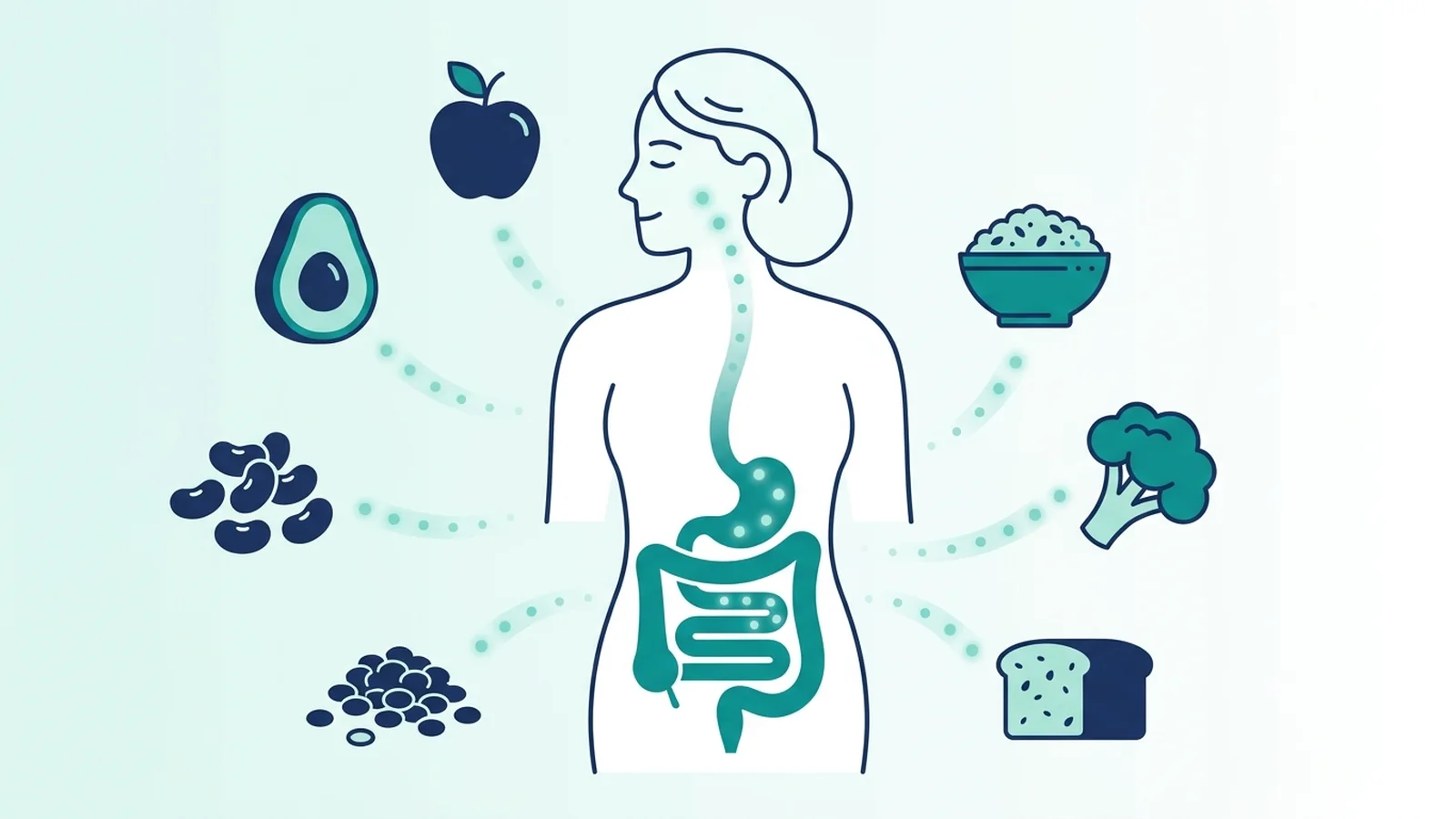
When people talk about GLP-1, they almost always mean an injection or a tablet. But your body already makes GLP-1 every day. It's produced by cells in your gut called L cells. And one of the strongest signals that gets those cells working comes from something very simple: the fiber in your food.
That detail changes the conversation. Fiber isn't just "for regularity." It's the fuel for a process that ends in natural GLP-1, more fullness, and a gut that works better. And if you're on a GLP-1 program, fiber has a second job: helping with constipation, one of the most common digestive effects of treatment.
This article explains how that connection works, how much fiber you need according to the evidence, why almost nobody reaches that number, and how to increase it without feeling awful. With real numbers and sources you can verify at the end.
Key points
- When colon bacteria ferment fiber, they produce short-chain fatty acids. Those acids activate receptors on the gut's L cells, which release GLP-1 and PYY, two fullness hormones, according to reviews published in Digestion and Proceedings of the Nutrition Society.
- A series of reviews in The Lancet (185 studies and 58 clinical trials) found 15% to 30% lower mortality, coronary heart disease, type 2 diabetes and colorectal cancer among the highest fiber eaters. The benefit was greatest at 25 to 29 grams a day.
- More than 90% of women and 97% of men in the United States don't reach the recommended fiber intake. The average is 8.1 g per 1,000 calories, versus the 14 g recommended.
- In a trial of 240 adults with metabolic syndrome, a single change — raising fiber to 30 g a day — produced -2.1 kg in a year, close to the -2.7 kg of a much more complicated full diet.
- In the STEP 1 semaglutide trial, digestive effects (nausea, diarrhea, vomiting, constipation) appeared in 74.2% of people on the medication versus 47.9% on placebo. Almost all were mild to moderate and temporary. Fiber and water are the first tool against constipation.
- Raising fiber too fast causes gas and bloating. The practical rule is about 5 grams more per week, plus more water.
- None of this is a diagnosis or a treatment. Individual results vary and are not guaranteed.
In this article
- Your body already makes GLP-1, and fiber is part of the recipe
- What fiber is, explained without jargon
- How much fiber you need, according to the evidence
- Why almost nobody gets there
- One change: the 240-adult study
- Fiber and the digestive effects of GLP-1
- Fiber and protein on the same plate
- How to raise fiber without feeling awful
- What changes if you're on a GLP-1 program
- What this evidence does NOT say
- Who is this NOT for?
- Frequently asked questions
- Sources
Your body already makes GLP-1, and fiber is part of the recipe
GLP-1 is a hormone. It's made by L cells, found mostly in the last part of the small intestine and in the colon. When you eat, those cells release GLP-1 into the bloodstream. GLP-1 tells the pancreas to release insulin, slows stomach emptying, and sends the brain a clear message: "you've eaten, you can stop."
GLP-1 medications mimic that hormone with a version that lasts far longer in the body. But your natural GLP-1 is still there, and it still responds to what you eat. That's where fiber comes in.
Part of the fiber you eat isn't digested in the stomach or the small intestine. It reaches the colon intact. There, the bacteria living in your gut ferment it. The product of that fermentation is short-chain fatty acids: acetate, propionate and butyrate. They're small molecules, and the colon makes them in enormous quantities.
Those molecules have specific "locks" on L cells: the FFAR2 and FFAR3 receptors. When short-chain fatty acids fit into those locks, L cells release GLP-1 and another fullness hormone called PYY. That's how a review in the journal Digestion by researchers at Hokkaido University describes it, and so does another in Proceedings of the Nutrition Society from the Imperial College London group.
In plain words: fiber feeds your bacteria, your bacteria produce short-chain fatty acids, and those acids tell your gut to release GLP-1. It's a natural pathway — slow and modest compared with a medication. But it's real, and it works in your favor every day.
What fiber is, explained without jargon
Fiber is the part of plants your body can't digest. It's in fruits, vegetables, beans, lentils, whole grains, seeds and nuts. It's not in meat, fish, eggs or dairy.
There are two main types, and it helps to know both:
- Soluble fiber: dissolves in water and forms a gel. It's in oats, beans, lentils, apples, pears, chia and avocado. It's the type your bacteria ferment most, so it produces the most short-chain fatty acids. It also slows food down, which helps you feel full.
- Insoluble fiber: doesn't dissolve. It's in fruit skins, leafy greens, bran and whole grains. It adds bulk to stool and keeps things moving. It's the most useful type against constipation.
Almost every fiber-rich food brings a mix of both. That's why the practical recommendation isn't "look for soluble fiber" but "eat variety": beans, vegetables, fruit with the skin on, oats and seeds cover both types.
How much fiber you need, according to the evidence
In 2019, a group from the University of Otago published in The Lancet one of the largest reviews ever done on fiber and health. They pooled 185 prospective studies and 58 clinical trials, with nearly 135 million person-years of data. The question was simple: how much fiber makes the difference?
The clinical trials they reviewed showed something else that matters: higher fiber intake was linked to lower body weight, lower systolic blood pressure and lower total cholesterol. And the dose-response curves suggest that above 29 g the benefit may keep growing, though with less certainty.
Official U.S. guidance points the same way. The Dietary Guidelines for Americans recommend about 25 g a day for women and 38 g for men, or 14 g for every 1,000 calories you eat. If you eat 1,600 calories a day, as many people on a weight program do, the target would be about 22 g.
Why almost nobody gets there
Here's the uncomfortable number. According to the official guidelines themselves, more than 90% of women and 97% of men in the United States don't reach the recommended fiber intake. And it's not a small miss. The gap is close to half.
Why does it happen? Because the most common foods today — white bread, white rice, sugary cereals, fast food, packaged snacks — have very little fiber. Refined grains lose most of their fiber in processing. And many people eat fruits and vegetables only occasionally, not at every meal.
This matters twice as much on a GLP-1 program. When you eat less, every bite counts more. If your food was already low in fiber and now you're eating half as much, fiber drops even further. And your gut notices.
One change: the 240-adult study
One of the most useful questions in nutrition is this: what happens if, instead of changing your whole diet, you change just one thing? A team at the University of Massachusetts tested it in a clinical trial published in Annals of Internal Medicine in 2015.
They recruited 240 adults with metabolic syndrome and split them into two groups. One group got the full American Heart Association diet: more than a dozen targets for fats, sugar, sodium, fruits, vegetables, grains and more. The other group got a single instruction: reach 30 g of fiber a day. Nothing else.
The authors were clear: the full diet may deliver up to 1.7 kg more, and the study wasn't designed to prove the two are equal. But the practical takeaway holds: for someone who struggles to follow a complicated plan, focusing on fiber alone is a reasonable alternative. One change, easy to remember, that pulls other good changes along without you noticing.
One clarification: that study did not include GLP-1 medications. The -2.1 kg came from fiber alone, in people who weren't on treatment. You can't simply add it to what a medication does. But it shows that fiber, by itself, moves the number.
Fiber and the digestive effects of GLP-1
If you're on a GLP-1 program, you probably already know the stomach is the first thing that adjusts. The STEP 1 semaglutide trial, published in The New England Journal of Medicine in 2021 with 1,961 adults, measured it precisely.
Constipation has a logical explanation. GLP-1 slows stomach emptying and gut movement. Add to that: you're eating less volume, often drinking less water without realizing it, and fiber drops because food dropped. The result is a gut that moves slowly with little material to move.
Fiber attacks that problem from two sides. Insoluble fiber adds bulk to stool. Soluble fiber keeps it soft by holding water. But watch one detail: fiber without water makes constipation worse. If you raise fiber, you have to raise water. There's no shortcut.
Another important point: if you have nausea, soluble fiber — oats, chia, well-cooked beans, pears — is usually tolerated better than a huge plate of raw salad. Starting with small portions and cooked foods is kinder to a stomach that's already working slowly.
Fiber and protein on the same plate
In our protein guide we explained why protein protects muscle while you lose weight. Fiber is its natural partner. And the good news is that several foods bring both at once.
| Food (serving) | Approx. fiber |
|---|---|
| Cooked lentils, 1 cup | 15 g |
| Cooked black beans, 1 cup | 15 g |
| Chia seeds, 2 tablespoons | 10 g |
| Avocado, 1 medium | 10 g |
| Raspberries, 1 cup | 8 g |
| Medium pear with skin | 5.5 g |
| Cooked broccoli, 1 cup | 5 g |
| Medium apple with skin | 4.5 g |
| Dry oats, ½ cup | 4 g |
| Whole-grain bread, 1 slice | 2 g |
Approximate values per USDA FoodData Central. They vary by brand and preparation.
Look at the first two. A cup of lentils or black beans brings about 15 g of fiber and also 15 to 18 g of protein. That's one of the most efficient combinations there is, and it's already on many tables. You don't have to invent anything new. You just have to serve it more often, in portions that count.
A practical plate for someone on a program: half a cup of beans, a palm-sized portion of chicken or fish, cooked vegetables and half an avocado. That plate brings protein, about 15 g of fiber and good fat, in a volume a stomach on GLP-1 can handle.
How to raise fiber without feeling awful
The most common mistake is going from 10 g to 30 g in two days. The result is almost always gas, bloating and the urge to quit. Your colon bacteria need time to adapt to the new amount of "food" arriving.
- Add about 5 g per week. If you eat 12 g today, aim for 17 next week. In a month you'll be near 30 without suffering.
- Water, always. Fiber holds water. Without enough water, it hardens stool instead of softening it. An extra glass with each fiber-rich meal is an easy rule.
- Start with cooked foods. Beans, lentils, oats, steamed vegetables. Raw and very fibrous foods (raw cabbage, raw broccoli, raw onion) can wait until your gut adapts.
- Spread it across the day. 30 g in one meal is a lot for anyone. 8 to 10 g per meal is easier to digest and keeps fullness steadier.
- Chew and eat slowly. On GLP-1, the stomach empties more slowly. Eating fast and a lot is the recipe for nausea. Eating slowly with fiber is the recipe for feeling full on less.
- Supplements are plan B. Psyllium works for constipation and can help. But fiber from food brings vitamins, minerals and variety for your bacteria that a powder doesn't. Food first, supplement second if a clinician recommends it.
If constipation doesn't improve with fiber and water, or if you have severe abdominal pain, don't let it slide. Talk to your provider. There are other options, and other causes need to be ruled out.
What changes if you're on a GLP-1 program
Everything above applies to anyone. But on a GLP-1 program, fiber stops being general advice and becomes a concrete tool. It helps you eat less without going hungry, feeds the natural GLP-1 your body already makes, protects your gut from the digestive effects of treatment, and gives back the volume your smaller meals lost.
Once you start your program, a licensed physician reviews your case — habits, stress, sleep and medical history — and orders labs only if they consider it necessary. Eligibility is determined by medical evaluation.
GLP-1 programs with FDA-approved medications (Wegovy®, Foundayo™, Ozempic®) from $149 a month, by telemedicine, in Spanish and English.
What this evidence does NOT say
Let's be explicit, because fiber lends itself to exaggerated promises.
It does not say fiber replaces a GLP-1 medication. The natural GLP-1 that fiber triggers is modest and lasts minutes. A medication lasts days. They're different things, even if they work in the same direction.
It does not say 30 g of fiber will make you lose 2 kg. The 240-adult study was in people with metabolic syndrome, without medication, with support sessions for a year. Your result depends on your starting point and everything else you do.
It does not say more fiber is always better. The strongest evidence sits between 25 and 29 g. Above 40 or 50 g, without adaptation, many people get discomfort and no confirmed extra benefit.
And it does not say fiber cures constipation in every case. It's the first tool, not the only one. If it doesn't work, a clinician needs to take a look.
Who is this NOT for?
This article is not for you if you have a diagnosed bowel disease — Crohn's disease, ulcerative colitis, an intestinal stricture or gastroparesis. In those cases, the amount and type of fiber is decided by your specialist, not by a general guide.
It's also not for you if you have intense abdominal pain, bleeding, persistent vomiting, or haven't been able to have a bowel movement in several days. That calls for medical attention, not a diet change.
It is for you if you're on a GLP-1 program, or considering one, and want to understand with real data why a change as simple as eating more beans, oats and fruit with the skin on works in your favor every single day.
Frequently asked questions
Does fiber really produce GLP-1?
Yes, indirectly. Colon bacteria ferment fiber and produce short-chain fatty acids. Those acids activate the FFAR2 and FFAR3 receptors on the gut's L cells, which release GLP-1 and PYY. That's how reviews published in Digestion (2014) and Proceedings of the Nutrition Society (2015) describe it. It's a natural, modest effect, not comparable in strength to a medication.
How much fiber should I eat a day?
The strongest evidence, per the 2019 Lancet review, points to 25 to 29 g a day. U.S. guidelines recommend 25 g for women and 38 g for men, or 14 g per 1,000 calories. If you eat fewer calories on a weight program, the per-calorie target is a useful reference.
Why does GLP-1 make me constipated, and how does fiber help?
GLP-1 slows stomach emptying and gut movement. You also tend to eat less volume and drink less water. Insoluble fiber adds bulk to stool and soluble fiber keeps it soft. With enough water, it's the first tool against constipation. In STEP 1, digestive effects appeared in 74.2% on semaglutide versus 47.9% on placebo, almost all mild and temporary.
Can I take a fiber supplement instead of eating it?
You can, and psyllium in particular has evidence for constipation. But fiber from food brings vitamins, minerals and variety for your bacteria. The practical recommendation is food first, supplement second, if your provider finds it useful.
Which everyday foods have the most fiber?
Black, red and pinto beans, lentils, chickpeas, avocado, guava, raspberries, oats, chia and whole corn. A cup of cooked beans brings about 15 g of fiber plus protein. It's one of the most efficient combinations there is.
Will I get gas if I eat more fiber?
At first, probably yes. It's normal and passes in a week or two while your bacteria adapt. Adding about 5 g per week, drinking more water and starting with cooked foods reduces that discomfort a lot.
What labs are ordered for this?
A clinician decides that. Once you start your program, a licensed physician reviews your case — habits, medical history, goals — and orders labs only if they consider it necessary. Eligibility is determined by medical evaluation.
Do you offer care in Spanish?
Yes. All our content and our care are available in Spanish and English.
Sources
- Reynolds A, Mann J, Cummings J, et al. Carbohydrate quality and human health: a series of systematic reviews and meta-analyses. The Lancet. 2019;393(10170):434-445. — DOI · via PubMed
- Kaji I, Karaki S, Kuwahara A. Short-chain fatty acid receptor and its contribution to glucagon-like peptide-1 release. Digestion. 2014;89(1):31-36. — DOI · via PubMed
- Chambers ES, Morrison DJ, Frost G. Control of appetite and energy intake by SCFA: what are the potential underlying mechanisms? Proceedings of the Nutrition Society. 2015;74(3):328-336. — DOI · via PubMed
- Ma Y, Olendzki BC, Wang J, et al. Single-component versus multicomponent dietary goals for the metabolic syndrome: a randomized trial. Annals of Internal Medicine. 2015;162(4):248-257. — DOI · via PubMed
- Wilding JPH, Batterham RL, Calanna S, et al. Once-Weekly Semaglutide in Adults with Overweight or Obesity (STEP 1). The New England Journal of Medicine. 2021;384:989-1002. — DOI · via PubMed
- U.S. Department of Agriculture, Economic Research Service. Dietary fiber consumption per 1,000 calories, 2017-2018. — ers.usda.gov
- Quagliani D, Felt-Gunderson P. Closing America's Fiber Intake Gap. American Journal of Lifestyle Medicine. 2017;11(1):80-85; and Dietary Guidelines for Americans 2020-2025. — PMC · Dietary Guidelines, pulses and fiber
Your trust is worth more than a sale.
This article is informational and is not medical advice. SCTS1 does not prescribe medication. All medical care, prescriptions, and treatment plans are provided by licensed healthcare providers through our partner platform. Treatment eligibility is determined by a licensed provider. Compounded medications contain the same active ingredient class but are not FDA-approved finished pharmaceuticals. Individual results vary and are not guaranteed.