Fatty liver: the organ that complains in silence
Hígado graso: el órgano que se queja en silencio
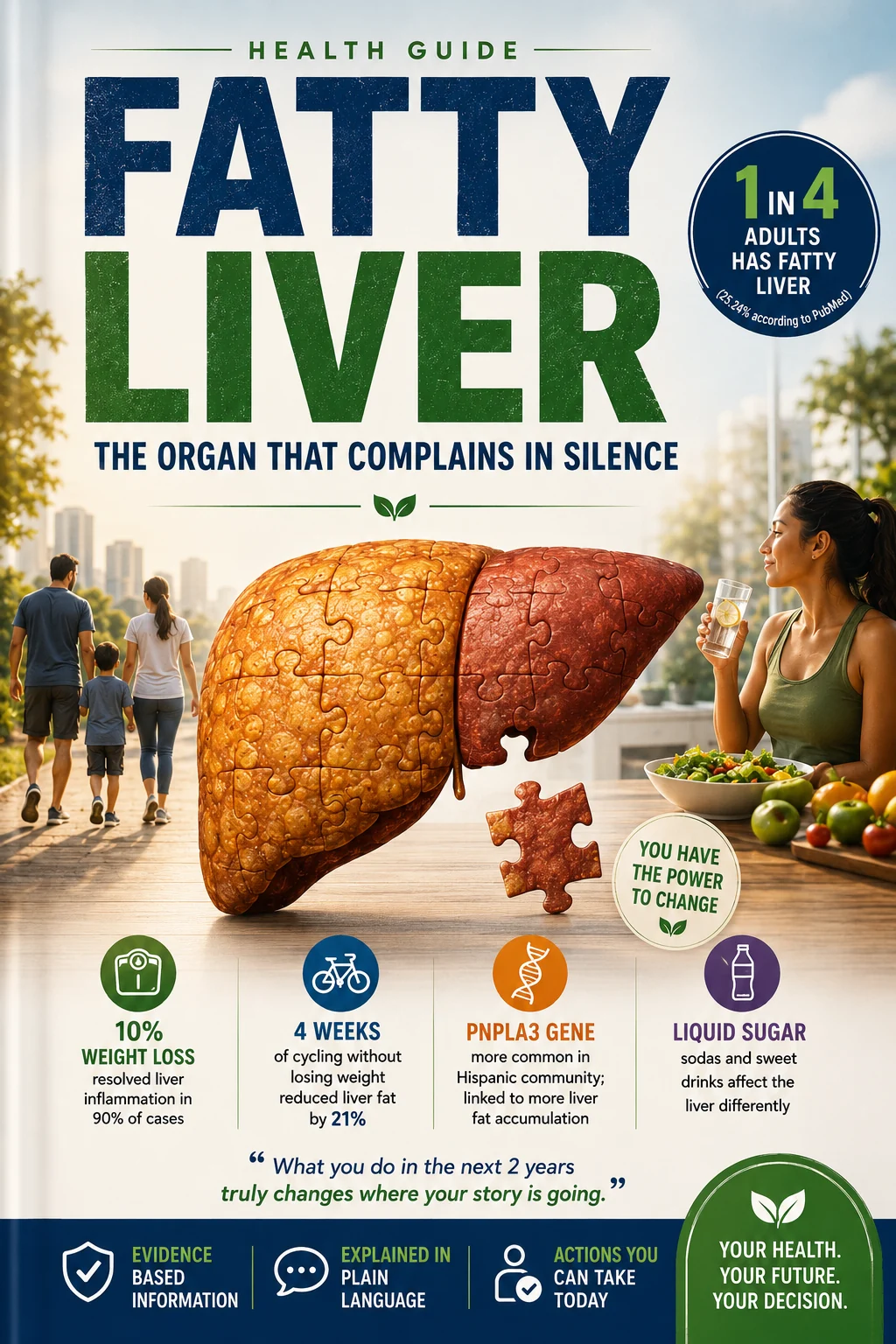
The liver has no nerves inside it that hurt. That sounds like a throwaway piece of anatomy, but it is exactly why millions of people carry a liver problem for fifteen years without ever knowing.
The news almost always arrives by accident. Someone gets an ultrasound for something else — a gallstone, a routine check — and the report contains a sentence nobody explained: increased hepatic echogenicity, consistent with steatosis. Or the doctor mentions in passing, "your liver looks a little fatty, don't worry about it."
That "don't worry about it" is both true and false. True because right now, today, it probably isn't doing anything to you. False because this is one of the few conditions where what you do over the next two years genuinely changes where the story goes.
This article is about that. What fatty liver actually is in plain language, why it hits some families harder than others, and what researchers found when they measured — with biopsies, not opinions — what happens when someone changes their habits.
Key points
- Fatty liver is fat stored inside the liver's own cells. It is not an infection, it is not cirrhosis, and in its early stage it does no structural damage.
- According to PubMed, a global analysis of 8.5 million people across 22 countries estimated that roughly 1 in 4 adults (25.24%) has fatty liver.
- Among those who have it, 51% live with obesity, 22.5% with type 2 diabetes and 39% with high blood pressure. It almost never travels alone.
- A variant of the PNPLA3 gene shifts how much fat the liver stores. People carrying two copies had more than twice the liver fat of non-carriers.
- In a study of 293 people biopsied before and after: those who lost 10% or more of their body weight saw liver inflammation resolve in 90% of cases, and 45% saw scarring (fibrosis) improve.
- Four weeks of cycling, without losing a single pound, cut liver fat by 21% and belly fat by 12%.
- None of this is a diagnosis or a treatment. Individual results vary and are not guaranteed.
In this article
- What fatty liver is, in plain language
- Why it doesn't hurt (and why that's the problem)
- One in four adults
- Why it runs harder in some families
- Liquid sugar: why soda lands differently
- The number that changes everything: 10%
- Four weeks of cycling, no weight lost
- How it's detected
- Seven things you can do this week
- What changes if you're in a GLP-1 program
- What this evidence does NOT say
- Who is this NOT for?
What fatty liver is, in plain language
The liver is the body's warehouse and kitchen at the same time. Everything you eat passes through it before it gets distributed. It decides what gets used now, what gets stored, and what gets turned into something else.
Fatty liver happens when that organ starts storing fat inside its own cells instead of shipping it out. A healthy liver holds less than 5% of its weight as fat. Past that line, it's called fatty liver.
Think of a closet. At first you stash away the clothes you don't wear and nothing happens — there's room. But keep putting things in without taking anything out, and eventually the door won't close and the hinges start to give. The liver does the same. It stores fat without complaining for years. And in some people — not all — that stored fat ends up irritating the tissue.
That's where the name changes. When there's only fat, it's called steatosis. When inflammation joins in and cells start getting damaged, it's steatohepatitis. And if the inflammation continues for many years, the liver defends itself the way any repeatedly injured tissue does: it scars. That scarring is called fibrosis, and when there's a great deal of it, cirrhosis.
This needs to be said clearly, because the word "cirrhosis" frightens people into closing the page: most people with fatty liver never get there. But the path exists, it's slow, and it's silent — which is exactly why it's worth knowing about early.
A note on naming. For years this was called "non-alcoholic fatty liver disease." In recent years medical societies changed the term to one that describes the cause better: metabolic dysfunction-associated steatotic liver disease, or MASLD. Same problem; the new name simply acknowledges that it almost always comes from metabolism, not alcohol.
Why it doesn't hurt (and why that's the problem)
The liver has almost no pain endings inside it. The only sensitive part is the capsule that wraps around it, and that capsule only speaks up when the organ swells enough to stretch it. By then, the process has been running a long time.
This creates a trap. Most of us use pain as a traffic light: if it doesn't hurt, keep going. With the liver, that light doesn't exist. You can have stored fat, inflammation, even early scarring, and feel exactly the same as always.
The signs that do show up are so ordinary that nobody connects them to the liver:
- Tiredness that sleep doesn't fix
- A vague pressure on the right side, under the ribs
- Slightly elevated liver enzymes on routine bloodwork (ALT, AST)
- A waistline that grows even when the number on the scale barely moves
None of these is a diagnosis. All of them are reasonable reasons to ask a doctor — not to panic, and not to self-diagnose on the internet.
One in four adults
According to PubMed, an analysis published in Hepatology pooled 86 studies from 22 countries, with a combined sample of more than 8.5 million people. It is one of the most complete pictures of this problem that exists.
But the number that says the most isn't that one. It's what comes with it. In that same analysis, among people with fatty liver:
| Condition present alongside | Share |
|---|---|
| High cholesterol or triglycerides | 69% |
| Obesity | 51% |
| Metabolic syndrome | 43% |
| High blood pressure | 39% |
| Type 2 diabetes | 22.5% |
That table explains something that gets lost in the conversation: fatty liver almost never arrives alone. It arrives with the rest of the metabolic picture. It's why many doctors see it less as a liver disease and more as a signal that the whole metabolism is under pressure.
It's the same conversation we had yesterday about insulin resistance. They're two faces of one thing: when cells respond less to insulin, the liver receives more raw material and more instruction to store. So it stores.
Why it runs harder in some families
This part is uncomfortable, and it has to be said in full, because half of it gets misread.
According to PubMed, a study published in Nature Genetics examined genetic variation across a population of Hispanic, African American and European American individuals, looking for why liver fat isn't distributed evenly between groups. They found a variant in a gene called PNPLA3.
The results were clear. That variant was strongly associated with more liver fat and with more inflammation. It was most common in Hispanic participants — the same group with the highest rate of fatty liver. People who inherited two copies had more than twice the liver fat of non-carriers. At the other end, a different variant of the same gene, more common among African American participants, was associated with less liver fat.
Now the part that almost never gets said, and it's the part that actually matters.
A gene is not a sentence. It's a different starting line. It means two people can eat nearly the same food and store different amounts of fat in the liver. It means that if this repeats in your family, it isn't because your uncle is lazy or your mother doesn't take care of herself. And above all it means it's worth checking early rather than late, because the starting line is different.
What genetics does not do is decide the ending. The habit studies you'll read below were run in populations where this variant is common, and they worked.
Liquid sugar: why soda lands differently
Of everything that enters through the mouth, the liver has a special relationship with fructose. The body processes glucose in many tissues; fructose gets sent almost entirely to the liver.
According to PubMed, a review published in the Journal of the American College of Cardiology gathered what's known about sugar-sweetened beverages and metabolic health. The mechanisms they describe are three, and all three point to the same place:
- The body doesn't compensate for liquid calories. Eat 200 calories of food and you eat less afterward. Drink 200 calories and you barely do. The body doesn't register them the same way.
- The liver converts excess fructose into fat — a process called de novo lipogenesis, which in plain language means "building fat from scratch."
- That fat gets stored where it shouldn't be: in the liver and around the organs, not under the skin.
The practical conclusion isn't "sugar is poison." It's simpler and more useful: the sugar you drink lands differently from the sugar you chew. A plain fruit juice, a soda, a sweet tea, a coffee with condensed milk — they all come through the same door.
And this is one of the few things on this list you can change today without buying anything, without anyone's permission, and without spending a dollar.
The number that changes everything: 10%
Here is the best news in this article, and it comes with biopsies, not testimonials.
According to PubMed, a study published in Gastroenterology followed 293 people with biopsy-confirmed liver inflammation for 52 weeks. All of them were supported through habit changes. At the end, they were biopsied again. What was compared was actual tissue, before and after.
The result depended almost entirely on how much weight each person lost:
| Weight lost | Inflammation resolved |
|---|---|
| Less than 5% | Few cases |
| 5% or more | 58% |
| 10% or more | 90% |
That last line deserves a pause. For a long time fibrosis was taught as a one-way street: once the liver scars, the scar stays. This study showed that in nearly half of the people who lost 10% or more, the scarring regressed.
Now the honest part, which the study also reports without decoration: of the 293 people, only 30% managed to lose 5% or more. Fewer still reached 10%. The study does not say it's easy. It says that when it happens, the liver responds.
To put 10% in real numbers: for a 200-pound person, that's 20 pounds. For someone at 180, it's 18. That isn't a small figure, and it doesn't happen in a month. But it isn't an impossible number either — and now you know exactly what it buys.
Four weeks of cycling, no weight lost
Almost every piece of liver advice starts and ends with "lose weight." That advice is correct, but it leaves a lot of people out: those who've already tried several times, those who've stalled, those who can't right now in this season of their life.
According to PubMed, a study published in Hepatology tested exactly that. They took 19 sedentary adults with obesity and asked for four weeks of cycling — nothing exotic, the amount of activity current guidelines recommend. They measured liver fat with magnetic resonance before and after. There was no diet. Body weight did not change.
It was the first study to demonstrate this directly: exercise lowers liver fat even when the scale doesn't move.
If you've been walking or moving and it frustrates you that the scale won't respond, this is for you. The scale is measuring one thing, and it isn't the thing that matters most here. Something was happening inside that the scale has no way to see.
The study's own honesty matters too: 19 people, four weeks. It's small and it's short. What it shows isn't a promise of results, it's a direction — and one that later studies have pointed the same way.
How it's detected
There is no single test. A doctor usually assembles the picture from several pieces:
- Liver blood tests (ALT, AST). Useful but not enough on their own: many people with fatty liver have normal values.
- Abdominal ultrasound. The most commonly used. It sees fat, but doesn't measure scarring well.
- Elastography (sometimes called FibroScan). Measures liver stiffness, which is the indirect way to estimate scarring. No pain, no needle.
- Calculated scores such as FIB-4, which combine age, platelets and enzymes to estimate fibrosis risk with no extra test.
- Biopsy. Still the reference standard, but today it's reserved for cases where it will change the treatment decision.
What matters for you isn't memorizing the list. It's knowing it exists, so you can ask. A line that works in the exam room: "can you check my liver and tell me whether I need anything beyond the ultrasound?"
Seven things you can do this week
None of these is a treatment. They're things with reasonable support behind them that require no permission, no prescription and no money.
- Swap one sugary drink a day for water. One. Leave the hardest one for later; start with the easiest.
- Walk 20 or 30 minutes, five days. The cycling study used roughly that volume. No gym required.
- Add protein to breakfast. It helps keep hunger from returning two hours later — which is exactly when sugary drinks show up.
- Sleep seven hours. Short sleep worsens insulin sensitivity, and that lands directly on the liver.
- Measure your waist, not just your weight. The waist tracks the fat around your organs, which is the fat tied to the liver.
- Look at alcohol honestly. Even though this type of fatty liver isn't caused by alcohol, alcohol adds work to a liver that's already loaded.
- Ask about your liver at your next visit. Especially if diabetes runs in your family, if your waist is high, or if anyone ever told you "your liver looks a little fatty."
What changes if you're in a GLP-1 program
If you're in a supervised weight program, the 293-biopsy study is the most useful reference you have, because its conclusion didn't depend on how someone lost weight: it depended on how much.
That means the 10% target stops being an abstract number and becomes something concrete you can discuss with your clinician. It also means exercise isn't redundant just because you're in a program: in the cycling study, liver fat dropped without any weight change — it's an effect that adds, not one that gets replaced.
And to be clear: SCTS1 does not prescribe medications. All medical care, prescriptions and treatment plans are provided by licensed physicians through our partner platform, and eligibility is determined by medical evaluation.
What this evidence does NOT say
- It doesn't say every fatty liver turns serious. Most people never develop cirrhosis.
- It doesn't say losing 10% is easy. In the biopsy study, only 30% managed 5% or more over a full year of support.
- It doesn't say exercise replaces weight loss. It says exercise contributes on its own, with or without a change on the scale.
- It doesn't say the gene is to blame. It explains part of the risk. The rest still sits in things that can be moved.
- It doesn't say you can diagnose yourself. None of the signs in this article confirms anything on its own.
- It doesn't say a supplement fixes this. None of these studies tested supplements.
Who is this NOT for?
This information doesn't replace a medical evaluation in any case, and least of all in these:
- If your skin or eyes are yellow, your abdomen is swollen with fluid, you're confused, or you're vomiting blood — that's medical care today, not an article.
- If you've already been diagnosed with cirrhosis or hepatitis: your plan belongs to your specialist.
- If you're pregnant or breastfeeding.
- If you drink heavily: the picture is different and so is the conversation with your doctor.
- If you have an eating disorder or a history of one, any weight goal should be handled with your care team.
Frequently asked questions
Can fatty liver be reversed?
In its early stage, yes, and there's biopsy evidence behind that. In the 293-person study, those who lost 10% or more of their body weight had liver inflammation resolve in 90% of cases, and 45% showed improvement in scarring. This does not guarantee any individual result — that's determined case by case through medical evaluation.
Can you have fatty liver while being thin?
Yes. It's less common but it happens, and the PNPLA3 genetic variant is one of the reasons it can show up in people without obesity. Weight helps estimate risk, but it doesn't fully determine it.
Does fatty liver hurt?
Almost never. The liver has no pain endings inside it; only the capsule around it signals, and only when the organ swells enough. That's why fatty liver is nearly always discovered by accident.
Does fruit juice count as sugar?
The liver processes fructose the same whether it comes from a soda or from plain fruit juice with nothing added. Eating whole fruit is different: it arrives with fiber and in smaller amounts at once.
What tests should I ask for?
Your doctor decides that based on your case. What you can do is mention your family history and ask whether, beyond liver enzymes, you need an ultrasound or a stiffness measurement. SCTS1 does not diagnose or order labs.
Do you serve patients in Spanish?
Yes. All of our content and care is available in both Spanish and English.
Sources
- Younossi ZM, Koenig AB, Abdelatif D, Fazel Y, Henry L, Wymer M. Global epidemiology of nonalcoholic fatty liver disease—meta-analytic assessment of prevalence, incidence, and outcomes. Hepatology. 2016;64(1):73-84. — DOI · via PubMed
- Romeo S, Kozlitina J, Xing C, et al. Genetic variation in PNPLA3 confers susceptibility to nonalcoholic fatty liver disease. Nat Genet. 2008;40(12):1461-1465. — DOI · via PubMed
- Vilar-Gomez E, Martinez-Perez Y, Calzadilla-Bertot L, et al. Weight loss through lifestyle modification significantly reduces features of nonalcoholic steatohepatitis. Gastroenterology. 2015;149(2):367-378.e5. — DOI · via PubMed
- Johnson NA, Sachinwalla T, Walton DW, et al. Aerobic exercise training reduces hepatic and visceral lipids in obese individuals without weight loss. Hepatology. 2009;50(4):1105-1112. — DOI · via PubMed
- Malik VS, Hu FB. Fructose and cardiometabolic health: what the evidence from sugar-sweetened beverages tells us. J Am Coll Cardiol. 2015;66(14):1615-1624. — DOI · via PubMed
Related articles
Losing weight after 40 → Stress, cortisol and weight: what stress does to your body → Menopause, estradiol, and weight →Your trust is worth more than a sale.
This article is informational and is not medical advice or a diagnostic tool. SCTS1 does not prescribe medications. All medical care, prescriptions and treatment plans are provided by licensed physicians through our partner platform. Eligibility is determined by medical evaluation. Compounded medications contain the same class of active ingredient but are not FDA-approved finished pharmaceutical products. Individual results vary and are not guaranteed. If your skin or eyes are yellow, your abdomen is swollen, you are confused, or you are vomiting blood, seek medical care immediately.