Eczema: it isn't poor hygiene — it's a barrier you can repair
Eccema: no es falta de higiene, es una barrera que sí se repara
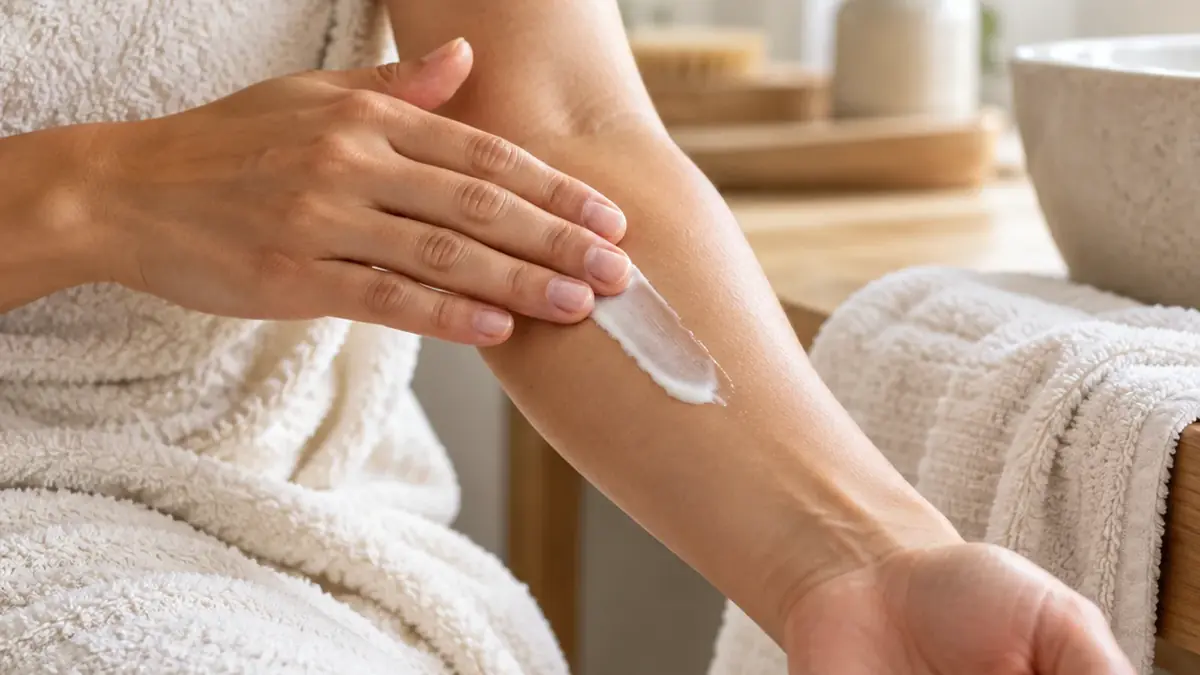
Illustrative image. Does not represent guaranteed results.
Key points
- Eczema isn't dirt and it isn't contagious. It's a skin barrier that holds water poorly, with an immune system that overreacts right there.
- The best-proven option is also the cheapest. In six trials with 607 people, plain moisturizer cut flares by 67% compared with not using it.
- And no moisturizer beat another. The Cochrane review pooled 77 trials and 6,603 people and found no reliable evidence that one brand is better. What counts is using it.
- Moisturizer also saves steroid cream: almost 10 grams less to reach the same result.
- Topical steroids get a strong recommendation in the 2023 guidelines. Steroids by mouth, by contrast, get a recommendation against.
- Some pharmacy products the guidelines advise avoiding: antihistamine creams and topical antiseptics.
- Video medical visit, $59.99, in English or Spanish. If this is an emergency, call 911.
In this article
- What your skin is already doing right
- What eczema is, plainly
- How many people have it
- Plain moisturizer: the best-proven tool
- How to use it so it actually works
- Bathing: what helps and what scrapes
- What a physician can add
- What doesn't work and still costs you money
- Is it food?
- When it's more than cream
- The signs that don't wait
- The video visit: what it does and doesn't do
- Setting the right expectations
- Who is this NOT for?
- Frequently asked questions
- Sources
What your skin is already doing right
Your skin is rebuilding itself right now. The outer layer renews on its own, from the bottom up, in about four weeks: it makes its own fats, its own cement between cells and its own film that keeps water in. Nobody asks it to, and it never stops.
That matters because it changes what this article is about. If skin remakes itself every month, a barrier that works poorly isn't a life sentence: it's a construction site you can help. And that is exactly the good news about eczema. What works best isn't rare, new or expensive. It's giving your skin the materials it's missing and no longer stripping them away.
For years, people with eczema heard the opposite: that it was nerves, poor hygiene, something in their food. None of that is what moves the numbers. What moves them can be bought at any pharmacy for a few dollars, and what a physician adds on top works better once that foundation is in place.
What eczema is, plainly
Eczema and atopic dermatitis are, in practice, two names for the same thing: the most common form of eczema. It looks like dry, rough skin that's red or darker depending on your skin tone, sometimes cracked, and it itches. It really itches. It shows up mostly in the folds — behind the knees, inside the elbows, the neck, the hands — and in babies, on the cheeks.
Underneath, three things happen at once, and understanding them explains everything else.
One: the barrier leaks water. In the outer layer there's a protein with a hard name, filaggrin, that helps bind the dead surface cells into a tight brick wall. Many people with eczema carry a version of that protein that only half works. The result is measurable: more water escapes through the skin, the skin dries out and the surface pH shifts.
Two: that shifted pH switches on what it shouldn't. Healthy skin is slightly acidic. When it turns more alkaline — and harsh soaps and detergents push it exactly that way — enzymes switch on that break down even more of the cement between cells, and that sets off inflammation.
Three: the skin's immune system overreacts. With the barrier open, things get in that would normally stay out, and the immune response in that area tilts toward a type of inflammation that itches. And the itch closes the loop: you scratch, scratching breaks more barrier, and more broken barrier itches more. That loop is called the itch-scratch cycle, and breaking it is half the battle.
Notice what is not on that list: dirt, contagion, blame. Eczema doesn't spread. You can sleep next to your child, bathe them, hug them. Nothing is passed on.
How many people have it
More than you'd think, and that's useful information too: nothing strange is happening to you.
In an international survey designed to measure it with diagnostic criteria, adult atopic dermatitis had a prevalence of 4.9% in the United States, with 3.9% receiving treatment. It was 3.5% in Canada, 4.4% in the European Union and 2.1% in Japan. About one in twenty adults, and more common in women than in men.
That last point is the one worth underlining. On every scale they used and in every region, the share with severe eczema was smaller than the share with mild or moderate. Most people with eczema are in the zone where a home routine, plus a prescription cream when needed, is enough to live comfortably. Global burden reviews point the same way: it's very common, it costs a lot of money in aggregate, and most of it isn't severe.
Plain moisturizer: the best-proven tool
Here's the finding that should headline every article about eczema.
The Cochrane review of moisturizers and emollients for eczema pooled 77 randomized trials and 6,603 participants. It is, by far, the best-studied question on the whole topic. And comparing moisturizer against placebo, vehicle or nothing, here's what it found:
- 67% fewer flares. The risk ratio was 0.33 (95% confidence interval: 0.17 to 0.62), in 6 studies with 607 participants, with moderate-quality evidence.
- Lower severity as measured by the assessor, in 12 studies with 1,281 participants, and this part with high-quality evidence.
- Almost 10 grams less topical steroid to reach the same improvement (mean difference −9.30 g).
- More time between one flare and the next. In the two small studies that measured it this way — 87 participants in total, so: a hint, not a law — the median time to the next flare was 180 days with moisturizer versus 30 days without.
- And moisturizer added to active treatment worked better than active treatment alone. It isn't the alternative to prescription cream. It's what makes it go further.
Now the part that saves you money. The same review states plainly that it found no reliable evidence that one moisturizer is better than another. They tested creams with urea, with glycerol, with oatmeal, with branded formulas. Several showed some benefit. None proved better than the rest.
Put another way: the $40 bottle on the top shelf has no evidence of being better than the big fragrance-free $8 tub. What has evidence is using it. So the right question at the pharmacy isn't which one is best, but which one you'll actually use twice a day, without fail, for months. That's the best one.
How to use it so it actually works
Almost everyone uses moisturizer. Far fewer people use it the way it was used in the trials. The difference comes down to four things.
How much. Far more than you'd imagine. Skin should be left shiny and slick, not matte. If the cream vanishes when you rub it in, you didn't apply cream: you just ran your hand over your skin. An adult with widespread eczema can go through several hundred grams a month, and that's normal, not waste.
When. One application goes on within the first few minutes after bathing, while the skin is still damp. The water stays trapped underneath instead of evaporating. Drying off completely and then applying cream wastes half the effect.
Where. All over the skin, not just on the patch. The barrier works poorly everywhere, not only where it looks red. Treating only what you can see is putting out the smoke and leaving the embers.
When to stop. Never completely. Moisturizer isn't for the flare: it's what stretches the time between flares. When skin looks good is exactly when people stop using it, and exactly when it's doing its job.
As for which type: the thicker it is, the more it holds in. Ointments hold more than creams, and creams more than lotions, which are mostly water. If thick products bother you during the day, use them at night. And fragrance-free, since fragrances and some preservatives are among the irritants the literature names specifically.
Bathing: what helps and what scrapes
The advice to "bathe less" circulated for years without a firm basis. The 2023 American Academy of Dermatology guidelines include bathing with a conditional recommendation in favor — meaning there's a benefit, with lower certainty in the evidence — and the useful practice isn't bathing less, it's bathing differently.
- Lukewarm water, not hot. Hot water feels wonderful on an itch and strips the fats from your skin. It soothes for five minutes and makes you pay later.
- Short. Five to ten minutes is enough.
- A gentle, fragrance-free cleanser, not harsh soap. Alkaline detergents push skin pH the wrong way and switch on the enzymes that break down the barrier. This isn't marketing: it's the mechanism described in the disease literature.
- Pat dry, don't rub, and put moisturizer on right away.
- Dilute bleach baths appear in the 2023 joint allergy guidelines as one of the options evaluated for cases that get infected often. It's a measure with precise concentration instructions, and it's decided with a provider, not from an internet recipe.
What a physician can add
When the foundation is in place and flares still happen, there's a next step with solid evidence. The 2023 American Academy of Dermatology guidelines for managing adult eczema with topical therapies give a strong recommendation to four drug families, in addition to moisturizers:
- Topical corticosteroids. Steroid cream, used well, is still the central tool for a flare.
- Topical calcineurin inhibitors. Steroid-free, useful in delicate areas like the face and eyelids.
- Topical PDE-4 inhibitors. Another steroid-free route.
- Topical JAK inhibitors. The newest in the group.
The fear of steroids deserves a pause, because it does real harm. Fear makes people use the cream late, too little and for too few days, which is exactly how it doesn't work; then they conclude it's useless and the flare drags on for weeks. Potency, body area and number of days are decisions for a licensed provider, and with those three defined, the safety profile is well known. What these guidelines recommend against is something else: steroids by mouth for eczema.
The guidelines also describe maintenance treatment — continuing to apply the topical to the usual areas a few days a week even when they're calm — and wet-wrap therapy, with a conditional recommendation, for difficult flares.
What doesn't work and still costs you money
This part is short and saves money. The same 2023 guidelines make conditional recommendations against three things sitting right at eye level in the pharmacy:
- Antihistamine creams. They don't switch off eczema itch from the outside, and some can sensitize the skin.
- General-purpose topical antiseptics on eczema.
- Topical antimicrobials when there's no infection to treat. Irritated eczema isn't the same as infected eczema.
And one more, on the systemic side: steroids by mouth or by injection for an eczema flare get a recommendation against in the 2023 systemic therapy guidelines. They work fast, and the rebound when they end often leaves you worse off than when you started.
Is it food?
It's parents' number-one question, and it deserves an honest answer rather than a reassuring one.
Eczema starts in the skin barrier and the skin's immune system. Food allergy shows up alongside eczema more often than in other people — they go hand in hand — but going together isn't causing. Cutting foods from a child's diet on your own has its own cost: nutrition, growth, a family's social life, and in some cases the risk of losing tolerance to a food that was dropped.
One trial helps sort this out, even though it answers a neighboring question. The BEEP study followed 1,394 babies with a family history of atopic disease, randomly assigned to daily moisturizer during the first year of life or usual care, and followed them to age five. Result: daily moisturizer did not prevent eczema (31% versus 28%; adjusted risk ratio 1.10, interval 0.93 to 1.30), nor food allergy, asthma or hay fever.
That result reads two ways, and both matter. First: moisturizing treats eczema, and it's among the best treatments there are, but it doesn't prevent it in a baby who doesn't have it yet. Second: if daily moisturizer for an entire year didn't shift food allergy in either direction, the idea that eczema gets solved on the plate is shakier than it sounds in online groups.
The 2023 joint allergy guidelines include food avoidance and elimination among the 25 recommendations they evaluated. The practical takeaway for a family: that's decided with a provider, with a medical history in front of them, not by trial and error in the kitchen.
When it's more than cream
For a minority of people, eczema covers much of the body, steals their sleep and doesn't yield to topicals. For that group everything changed in the last ten years, and it's worth knowing even if it isn't your case, because people sometimes endure it for years without knowing these options exist.
The 2023 guidelines for phototherapy and systemic therapies give a strong recommendation to five medications: two antibodies — dupilumab and tralokinumab — and three oral JAK inhibitors: abrocitinib, baricitinib and upadacitinib. And a conditional recommendation in favor of phototherapy and several older immunomodulators.
Two clarifications, because these are serious medications. First: this isn't decided in a fifteen-minute video visit; it's dermatology or allergy territory, with follow-up. Second: they have side effects and their own monitoring, and one of them — dupilumab — is under active follow-up in population studies over a lymphoma risk signal. That doesn't rule it out at all: it means the decision belongs to a specialist who knows your case and the current evidence, not to an article.
The signs that don't wait
Eczema itself isn't an emergency. What can become one is an infection on top of broken skin. Get care the same day if you see:
- Yellow or honey-colored crusts, pus, or red streaks spreading from the area.
- Fever along with worsening skin.
- Small clustered blisters, all the same size, that hurt, on an area of eczema, especially on the face or around the eyes. That can be the herpes virus on top of eczema, and it's the one that truly can't wait.
- Redness over almost the whole body, with chills or feeling generally unwell.
- Pain that doesn't match what you see, or an area that becomes hot and swollen.
- In a baby under three months old, any rash with fever is evaluated in person that same day.
And as always: if there's swelling of the lips or tongue, difficulty breathing, or the skin peels off in sheets, that's 911, not an internet search.
The video visit: what it does and doesn't do
We put this here, in the middle and not hidden at the end, because if you're going to use it we want you to know exactly what you're buying.
SCTS1 offers a $59.99 video medical visit, in English or Spanish, for the usual reasons: eczema, acne, rashes, colds, sore throat and several more.
Eczema is, in fact, one of the reasons that works best on a screen: it can be seen.
What a video visit can handle
- A licensed provider looks at the areas on camera and hears the history: since when, where it started, what makes it worse, what you've tried and how much sleep it costs you.
- Separates eczema from its look-alikes — a fungal infection, contact dermatitis from something you're putting on, psoriasis, scabies, a drug reaction — which is exactly what can't be decided by reading a symptom list.
- Builds your moisturizer plan with specific names and amounts, which is the part most people are doing halfway.
- Prescribes the right cream, at the right potency for that body area and for how many days, and explains when to stop.
- Gives you a plan for the next flare, so you don't start from zero every time.
- Reviews what you're already using: often there's a fragranced product or an antihistamine cream working against you.
- And handles the boring but real part: the note for work or school.
What it can't
- Skin can't be touched through a screen, and in dermatology touch is information. If the decision needs it, the video visit tells you so; it doesn't do it.
- No cultures, biopsies or allergy tests by camera.
- It isn't the place for eczema with an advanced infection or for anything on the warning-signs list above.
- It isn't where a biologic or an oral JAK inhibitor gets started. That's dermatology with follow-up.
- It isn't the place to start an elimination diet up front.
The order, no fine print: the visit costs $59.99 and you start it. Then a licensed provider reviews your case and decides what's appropriate, including whether a test or a medication is needed. Eligibility is determined by medical evaluation. The visit has a price, and we don't promise an outcome. And there's no free evaluation: what there is is a clear price, stated up front.
Start a visit — $59.99 →Licensed provider, in English or Spanish. If this is an emergency, call 911.
Setting the right expectations
One. This is control, not a cure. Eczema comes and goes. What the evidence offers — and it offers a lot — is fewer flares, more time between them, milder flares and less medication to calm them. That truly changes lives. Anyone who promises to make it disappear forever is selling you something.
Two. Moisturizing treats; it doesn't prevent. That's the honest lesson of the BEEP trial, with 1,394 babies: daily moisturizer during the first year didn't stop eczema from appearing. If you already have it, moisturizer is among the best there is. If your baby doesn't have it, the cream isn't insurance against getting it.
Three. It takes weeks, not days. Your skin's outer layer renews in about four weeks. A barrier that has been working halfway for years doesn't get fixed in a weekend of cream. Moisturizer trials lasted almost seven weeks on average; give it that long before deciding it doesn't work.
Four. The figures in this article are averages from the populations studied, not a forecast for you. Individual results vary and are not guaranteed.
Who is this NOT for?
This section isn't negotiable, and we write it in full even though it doesn't sell.
The video visit isn't for you if:
- You have any of the signs on the list above: crusts with pus, fever with worsening skin, clustered painful blisters, or redness over almost the whole body. That's in-person care today, or 911.
- The patient is a baby under three months old. They're evaluated in person.
- You suspect herpes on top of eczema, especially on the face or near the eyes. That doesn't wait for an appointment.
- You're on chemotherapy, take immunosuppressants or have a condition that lowers your defenses. Your bar for going in person is much lower, and your primary care physician needs to be in the conversation.
- Your eczema is widespread and resistant to topicals, or you've already been told about a biologic. That's dermatology with follow-up, not a one-off visit.
- What you want is a steroid by mouth to shut the flare down fast. The guidelines recommend against it, and we won't pretend otherwise to close a sale.
- What you want is an elimination diet without an evaluation, or allergy testing by camera. That's not what this is.
- The rash doesn't look like eczema: it appears suddenly all over the body, comes with joint pain, or started days after a new medication. That's evaluated in person.
Frequently asked questions
Is eczema contagious?
No. Eczema doesn't spread. It isn't a fungus or a bacterium passed from one person to another: it's a skin barrier that holds water poorly and an immune system that overreacts in that area. You can hug, share a bed with and bathe a child with eczema with no risk of catching it. What can happen is that skin broken by scratching gets infected later, and that's a separate problem that does get treated.
Do I need to buy an expensive cream for eczema?
No. The Cochrane review that pooled 77 trials and 6,603 people says it outright: it found no reliable evidence that one moisturizer is better than another. What changed the numbers was using it, not which one. A thick, fragrance-free, inexpensive cream you'll actually use every day beats the expensive one that stays in the cabinet.
Is food causing my child's eczema?
It's rarely the cause, and cutting foods on your own carries its own risk. Eczema starts in the skin barrier and the skin's immune system; food allergy shows up alongside it more often than in other people, but going together isn't causing. In the BEEP trial, with 1,394 babies, daily moisturizer during the first year lowered neither eczema nor food allergy. Elimination diets are done with a provider, never by trial and error at home.
How much moisturizer should I use?
Much more than most people use. Skin should be left shiny and slick, not with the cream vanishing as you rub. It goes on all the skin, not just the patch, at least twice a day, and once within the first few minutes after bathing, while the skin is still damp. In the trials, moisturizer groups needed almost 10 grams less steroid cream to reach the same result.
Is it bad to use steroid cream?
The 2023 American Academy of Dermatology guidelines give topical corticosteroids a strong recommendation: they're part of treatment, not a last resort. Fear of using them leads many people to apply them late, too little and for too short a time, which is exactly how they don't work. Potency, area and number of days are decided by a licensed provider. What those same guidelines recommend against is steroids by mouth for eczema.
What does the $59.99 visit include?
An evaluation with a licensed provider, in English or Spanish, by video: your history, a look at the affected areas on camera, separating eczema from its look-alikes, a moisturizer plan and prescription cream if appropriate, what to do when a flare comes and the signs to watch. Eligibility is determined by medical evaluation. If this is an emergency, call 911.
Sources
- van Zuuren EJ, Fedorowicz Z, Christensen R, Lavrijsen A, Arents BWM. Emollients and moisturisers for eczema. Cochrane Database Syst Rev. 2017;2(2):CD012119. — DOI
- Barbarot S, Auziere S, Gadkari A, et al. Epidemiology of atopic dermatitis in adults: results from an international survey. Allergy. 2018;73(6):1284-1293. — DOI
- Sidbury R, Alikhan A, Bercovitch L, et al. Guidelines of care for the management of atopic dermatitis in adults with topical therapies. J Am Acad Dermatol. 2023;89(1):e1-e20. — DOI
- Davis DMR, Drucker AM, Alikhan A, et al. Guidelines of care for the management of atopic dermatitis in adults with phototherapy and systemic therapies. J Am Acad Dermatol. 2024;90(2):e43-e56. — DOI
- Chu DK, Schneider L, Asiniwasis RN, et al. Atopic dermatitis (eczema) guidelines: 2023 AAAAI/ACAAI Joint Task Force on Practice Parameters GRADE- and Institute of Medicine-based recommendations. Ann Allergy Asthma Immunol. 2023;132(3):274-312. — DOI
- Bradshaw LE, Wyatt LA, Brown SJ, et al. Emollients for prevention of atopic dermatitis: 5-year findings from the BEEP randomized trial. Allergy. 2023;78(4):995-1006. — DOI
- Boothe WD, Tarbox JA, Tarbox MB. Atopic dermatitis: pathophysiology. Adv Exp Med Biol. 2024;1447:21-35. — DOI
- Puerta Durango K, Chiesa Fuxench ZC. Global burden of atopic dermatitis: examining disease prevalence across pediatric and adult populations world-wide. Dermatol Clin. 2024;42(4):519-525. — DOI
- Ma KS, Brumbaugh B, Saff RR, et al. Dupilumab and lymphoma risk among patients with asthma: a population-based cohort study. Eur Respir J. 2025;66(3):2500139. — DOI
Related articles
Your trust is worth more than a sale.
This article is informational and is not medical advice, and does not replace an in-person evaluation. SCTS1 does not prescribe or dispense medication: all medical care, prescriptions and treatment plans are provided by licensed providers through our partner platform, and eligibility is determined by a licensed provider through medical evaluation. The figures cited are averages from studied populations and are not a forecast for your case; individual results vary and are not guaranteed. A video visit does not replace emergency care: if you have difficulty breathing, swelling of the lips or tongue, high fever with worsening skin, or skin that peels off, call 911.