LONGEVITY
Cocoa isn't a sin: across 35 trials flavanols lowered blood pressure — by about 4 mmHg in people who already had hypertension
El cacao no es un pecado: en 35 ensayos los flavanoles bajaron la presión, y unos 4 mmHg en quien ya la tenía alta
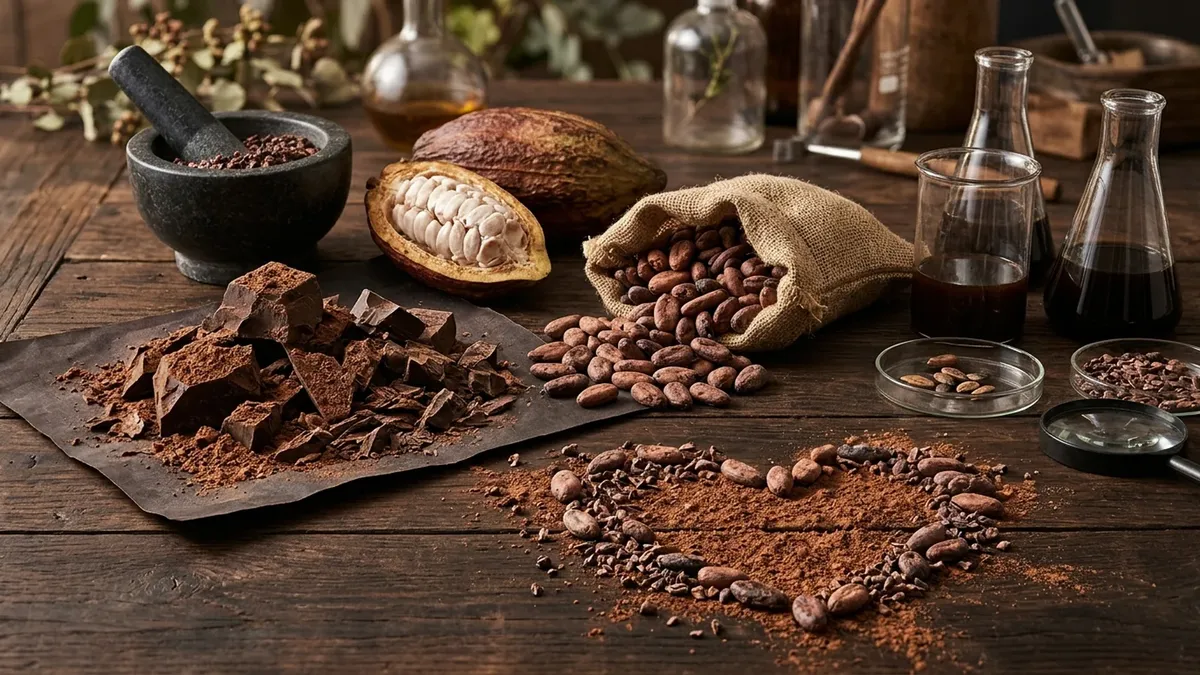
Illustrative image. Not a representation of guaranteed results.
Key points
- The part of cocoa that looks after your heart has a name: flavanols. Not the sugar, not the cocoa butter, not "chocolate" in general. A group of compounds in the cocoa bean that help your blood vessels relax.
- And that has been measured in real trials. A Cochrane review pooled 35 randomized trials with 1,804 people: flavanol-rich cocoa lowered blood pressure by about 2 mmHg versus control, and in people who already had high blood pressure, systolic pressure fell by about 4 mmHg.
- The large trial is called COSMOS: 21,442 older adults, 500 mg of flavanols a day, 3.6 years. Here you have to be precise, because the easy headline gets it wrong.
- COSMOS's PRIMARY endpoint did not reach significance: total cardiovascular events came in at 0.90 (95% CI 0.78 to 1.02), P = 0.11. It points the right way, but chance could not be ruled out.
- The "27% lower" figure is a SECONDARY endpoint: death from cardiovascular causes fell 27% (0.73; 0.54 to 0.98). That is a real and encouraging result, but a secondary endpoint does not carry the weight of a primary one. Anyone selling it to you as the trial's conclusion is stretching the data.
- In the same trial, cocoa did NOT improve memory and did NOT lower type 2 diabetes. That is part of the story too.
- A chocolate bar is not what was tested. Alkali processing — the "cocoa processed with alkali" on the label — reduces flavanols, and no US label tells you how many are left.
- Some people need to be careful, and the list is specific. It is complete further down.
In this article
- What cocoa does to your blood vessels
- 35 trials, 1,804 people: the honest blood-pressure number
- COSMOS: the big trial, and the distinction almost nobody reports
- What COSMOS looked for and did not find
- The FDA chose its words very carefully
- Why a chocolate bar is not the cocoa from the trial
- How to choose it, and how much
- So your expectations are the right ones
- Who is this NOT for?
- Where this fits if you are losing weight
- Frequently asked questions
- Sources
What cocoa does to your blood vessels
Let's start with the good part, which also happens to be the best-understood part.
On the inside, your arteries are lined with a layer of cells so thin it is almost invisible: the endothelium. That layer is not passive plumbing. It is an organ that decides, minute by minute, how open or how tight your vessels are. To open them it makes a small molecule, nitric oxide. When there is enough of it, the muscle in the vessel wall relaxes, the vessel widens, and blood meets less resistance. Less resistance is, quite literally, less pressure.
Cocoa flavanols — especially one called epicatechin — appear to give that system a hand. In studies that measure endothelial function directly, taking flavanol-rich cocoa is associated with more available nitric oxide and with vessels that open better in response to the same stimulus.
Notice what just happened there: cocoa did not teach your body anything new. Your endothelium already knew how to make nitric oxide; it has been doing it every day since you were born. What flavanols do, at best, is help it do that job a little better. That is the right scale for this conversation, and it is also why the numbers you are about to see are modest rather than spectacular. A helper, not a new engine.
35 trials, 1,804 people: the honest blood-pressure number
This is where the evidence stops being theory. The Cochrane review on cocoa and blood pressure pooled 35 randomized trials (40 treatment comparisons) with 1,804 participants, mostly healthy. Each trial ran between two and eighteen weeks, nine on average. One group got a flavanol-rich cocoa product; the other got a flavanol-free or very low-flavanol product.
Two millimeters of mercury. It sounds small, and at the individual level it is. But two things make it more interesting than it looks.
First: not everyone responded the same. When the authors split people by their starting blood pressure, the picture changed. In people who already had high blood pressure, systolic pressure fell by about 4 mmHg (9 comparisons, 401 people). In people with prehypertension there was a trend toward lower pressure. And in people whose pressure was normal (23 comparisons, 1,063 people) there was no significant difference.
That makes complete sense: it is hard to lower the blood pressure of someone whose pressure is already fine. The body does not let it drop for no reason. But it also means something practical for you: if your blood pressure is normal, cocoa probably will not change it, and that is as it should be.
The second point is about how much to trust the number. The authors downgraded the quality of the evidence from "high" to "moderate" because the trials were heterogeneous in ways they could not explain. And when they repeated the analysis excluding trials whose authors were employed by the sponsoring industry, the effect got smaller. That points to some reporting bias. It does not cancel the result, but it is worth knowing: this is a field where the cocoa industry has funded a great deal of research.
The doses used ran from 30 to 1,218 mg of flavanols a day (mean 670 mg), in amounts of cocoa product ranging from 1.4 to 105 grams daily. Hold on to that 670 mg figure — it matters when we get to the supermarket bar.
On safety, the review was reassuring: cocoa products were well tolerated, with gastrointestinal complaints or nausea reported by 1% of the cocoa group versus 0.4% of controls.
COSMOS: the big trial, and the distinction almost nobody reports
Lowering blood pressure by two millimeters is fine, but the question that matters is a different one: do people who take cocoa flavanols have fewer heart attacks and strokes? Only a large, long trial can answer that. One exists.
It is called COSMOS, for the Cocoa Supplement and Multivitamin Outcomes Study. It is a randomized, double-blind, placebo-controlled trial run in the United States from June 2015 to December 2020. It enrolled:
- 21,442 adults — 12,666 women aged 65 or older and 8,776 men aged 60 or older.
- None had major cardiovascular disease or a recently diagnosed cancer at entry.
- Half took a cocoa extract supplement providing 500 mg of cocoa flavanols a day, including 80 mg of (−)-epicatechin. The other half took placebo.
- Median follow-up was 3.6 years.
Now comes the part to read slowly, because this is where most headlines go wrong.
The primary endpoint
Before the trial began, the investigators declared what their primary endpoint would be: total confirmed cardiovascular events — myocardial infarction, stroke, coronary revascularization, cardiovascular death, carotid artery disease, peripheral artery surgery and unstable angina — all combined.
Translated: there were 10% fewer events in the cocoa group, but the margin of error is wide enough that the 10% could be chance. In trial language, COSMOS did not meet its primary endpoint. That is the honest sentence, and it is the one that should come first in any article on this subject.
The secondary endpoints
A trial also measures other things, declared in advance as secondary. Here the picture was more interesting:
| Secondary endpoint | Hazard ratio (95% CI) |
|---|---|
| Death from cardiovascular causes | 0.73 (0.54–0.98) |
| Myocardial infarction | 0.87 (0.66–1.16) |
| Stroke | 0.91 (0.70–1.17) |
| Coronary revascularization | 0.95 (0.77–1.17) |
| Death from any cause | 0.89 (0.77–1.03) |
The one that jumps out is the first: 27% fewer deaths from cardiovascular causes, with an interval that does not touch 1. It is a real result, it is published, and it is not nothing.
But it has to carry its label. A secondary endpoint in a trial that missed its primary is treated as hypothesis-generating, not as a proven conclusion. The reason is statistical and simple: when you measure many things, some will come out significant by chance. That is why trials declare a primary endpoint before they start — so nobody can pick the winner after seeing the results.
The authors wrote it that way themselves: cocoa extract supplementation did not significantly reduce total cardiovascular events, but it did reduce cardiovascular death by 27%, and further research is warranted to clarify it.
One more detail, and this one helps
There is an additional analysis worth knowing about. In the per-protocol analysis — the one that counts only the time people were actually taking the capsules, because in any long trial some people stop — total cardiovascular events did fall: 0.85 (0.72 to 0.99).
That suggests part of the weak primary result may come from people who stopped taking the supplement. It is a reasonable argument and the authors make it. It is also a less rigorous analysis than the primary one, because excluding people who dropped out no longer fully respects the random assignment. In short: a signal in favor, not a proof.
And a reassuring note: across 21,442 people over nearly four years, there were no safety concerns with cocoa extract.
What COSMOS looked for and did not find
The same trial measured two other things cocoa often gets credit for. In both, the result was flat. Saying so is part of telling this properly.
Memory. A study within COSMOS, called COSMOS-Mind, assessed cognitive function by telephone in 2,262 participants averaging about 73 years old, annually for three years. Cocoa extract had no effect on global cognition (mean z-score difference 0.03, 95% CI −0.02 to 0.08; P = 0.28). Interestingly, in that same study the multivitamin did show a small benefit. But cocoa did not.
Type 2 diabetes. Among the 18,381 participants without diabetes at entry, 801 new cases occurred over 3.5 years. Cocoa extract did not reduce the risk: 1.04 (0.91 to 1.20; P = 0.58). And that did not change when the results were split by sex, race, body mass index, smoking, physical activity or diet quality.
This matters especially if you came here thinking about your metabolism. Cocoa flavanols have a reasonable case in the territory of blood vessels and blood pressure. In the territory of blood sugar, the big trial said no.
The FDA chose its words very carefully
On February 3, 2023, the FDA responded to an industry petition and agreed not to object to a "qualified" health claim about cocoa flavanols and cardiovascular disease. It is worth looking at how the wording came out, because the wording is the message: the authorized sentence opens by acknowledging that the scientific evidence is very limited, and only then says that consuming cocoa flavanols in high-flavanol cocoa powder may reduce the risk of cardiovascular disease.
Two things to take from that:
- It is a "qualified" claim, not an approval. In the FDA's system that is the lowest rung: it means there is some evidence, not enough for a full authorized claim, and that if you use it you must say in the same sentence that the evidence is very limited.
- It applies to one very specific product: cocoa powder containing at least 4% naturally conserved cocoa flavanols. Not "chocolate." Not a bar. A cocoa powder whose processing preserved the flavanols.
That 4% is the hinge of this whole article, and it takes us to the next section.
Why a chocolate bar is not the cocoa from the trial
This is where we have to be straight with you without spoiling anybody's fun.
First, processing eats the flavanols. Most cocoa powder on the market is alkalized — what the label calls "processed with alkali" or "Dutch process." That treatment gives darker color, milder flavor and less bitterness, which is why it is so widely used. The price is chemical: when unalkalized cocoa is analyzed against medium- and high-alkalized cocoa, flavanol content falls as the degree of alkalization rises. Put another way: the smoother and darker it is, the less of what you came for.
Second, flavanols are not declared. In the United States no chocolate label is required to say how many milligrams of flavanols it contains, and almost none do. The cocoa percentage on the wrapper — 70%, 85% — tells you how much cocoa solid is in there, not how many flavanols survived fermentation, roasting, alkalizing and conching. Two 70% bars can contain very different amounts.
Third, the arithmetic. In COSMOS the dose was 500 mg of flavanols a day in a capsule, with no sugar, no cocoa butter and no meaningful calories. In the Cochrane review, the average was 670 mg. Trying to reach those figures by eating chocolate means eating a lot of chocolate every day, with its sugar, its fat and its calories. In that trade, what you gain on one side can leave through the other.
So should you throw the bar away? No — and here is the genuinely good news: dark chocolate has stopped being a sin. A couple of ounces of dark chocolate is not sabotage, it is not cheating on anything, and it happens to be something you enjoy. What it is not is the treatment that was tested in the trials. Those are two different conversations, and confusing them is what leads people to eat more chocolate than they meant to, under the impression that they are doing cardiology.
How to choose it, and how much
- If you are in it for the taste, any dark chocolate you enjoy is fine. An ounce or two, guilt-free. That is the most honest practical conclusion in this article.
- If you are in it for the flavanols, non-alkalized cocoa powder ("natural," "not processed with alkali") is the best bet in the supermarket. Read the ingredient list: if it says "processed with alkali," that one lost part of the journey.
- Look at the sugar before the percentage. A 70% bar with sugar as its first ingredient tells you more than the big number on the front.
- Count the calories honestly. An ounce of dark chocolate runs about 150–170 calories. Two ounces a day, every day, is roughly 1,000 calories a week that were not there before.
- Cocoa powder in a smoothie or in milk gives you the cocoa without the sugar and cocoa butter load of a bar. It is the closest thing to what was actually studied.
- On cocoa extract supplements: that is what COSMOS used, that is what showed no safety concerns, and that is also what missed its primary endpoint. If you are considering one, talk it over with your physician, especially if you take blood pressure or heart medication.
- Don't let it crowd out what really moves the needle. For blood pressure, cutting salt, moving, sleeping and body weight all have effects several times larger than 2 mmHg. Cocoa adds to that; it does not replace it.
So your expectations are the right ones
Three sentences to take with you, no fine print:
- The blood-pressure effect is small and real: about 2 mmHg overall, about 4 in people who already have hypertension, and essentially nothing in people whose pressure is normal. It is measured in randomized trials, which is the good news; the evidence is of moderate quality and shows signs of industry bias, which is the caveat.
- On heart attacks and strokes, the big trial did not prove it. The 27% lower cardiovascular death is a promising secondary endpoint that calls for another trial, not a closed conclusion.
- And on memory and diabetes, the answer was no. A clear no, from a large, well-run trial.
Put on its proper scale, this is a quietly good piece of news: something you enjoy, that is cheap, that has a credible mechanism and a small but measured effect, and that does no harm in healthy people. Alongside strength, sleep and weight — not above them — cocoa has earned its place with human data.
Who is this NOT for?
Cocoa is a food, not a medicine, but it is not neutral for everyone.
- Heavy metals: the real reason not to overdo the dose. Cocoa takes up cadmium and lead from the soil. In an analysis of cocoa and chocolate products bought at retail in the United States, carried out by FDA scientists, cadmium ranged from 0.004 to 3.15 mg/kg and lead from below the detection limit to 0.38 mg/kg. Both rose with the product's cocoa percentage, and cadmium was higher in products reported as originating in Latin America than in Africa. In practice: a little dark chocolate a day is not the problem; treating cocoa as a daily supplement by the spoonful for years is a different conversation. Vary the brands and don't chase large doses.
- Children and pregnancy. Because of heavy metals and caffeine, moderation applies here, and this is a question for your pediatrician or obstetrician, not for an article.
- If you are caffeine-sensitive or sleep poorly. Cocoa contains caffeine and theobromine. A dark bar at night can cost you sleep, and sleep outweighs 2 mmHg by a wide margin.
- Reflux or heartburn. Chocolate relaxes the lower esophageal sphincter and is one of the classic triggers. If you have reflux, you already know this.
- Migraine. For some people chocolate is a trigger. Not for everyone, but if it is for you, no blood-pressure benefit makes up for it.
- If you take blood pressure medication. The effect is small, but if you are already on several antihypertensives and you add daily cocoa, mention it to your physician. Never adjust your medication on your own.
- If you are watching calories. Chocolate is energy-dense and easy to overeat. "It's good for your heart" has become the most expensive permission slip in nutrition.
- If you have diabetes, remember the large trial found no benefit there, and that most bars contain sugar.
- If your dog hangs around the table: theobromine is toxic to dogs, and dark chocolate is the worst offender. This is not a joke.
Where this fits if you are losing weight
To be clear: cocoa is not a weight-loss treatment, and none of the evidence above measured that. The real overlap is a different one, and it is useful. Many people starting a weight plan experience it as a list of prohibitions, and that list is exactly what makes a plan get abandoned six weeks in. Knowing that a couple of ounces of dark chocolate fit inside your plan — counted, not ignored — is one of those small things that make a plan sustainable.
And what does share territory with your heart is weight itself: losing weight when there is excess moves blood pressure considerably more than any single food.
SCTS1 offers GLP-1 programs with FDA-approved medications (Wegovy®, Foundayo™, Ozempic®) from $149 a month, by telemedicine, in Spanish and English. The path is this: you pay and start your program first; then a licensed physician reviews your case — habits, stress, sleep and medical history — and orders labs only if they consider it necessary. There is no free evaluation.
Eligibility is determined by medical evaluation. Results vary from person to person.
Frequently asked questions
What cocoa percentage should I look for?
As a rule of thumb, 70% or higher gives you more cocoa and less sugar than a 50% bar. But the percentage does not measure flavanols: it tells you how much cocoa solid is in there, not how much survived processing. Two 70% bars can be very different inside, and no US label is required to tell you. If flavanols are what you want, natural non-alkalized cocoa powder is a better bet than any bar.
How much chocolate would I have to eat to reach the 500 mg used in the trial?
It depends on the bar so much that the question has no single answer — and that is precisely the answer. Flavanol content varies enormously between products depending on bean origin, fermentation, roasting and above all alkalizing, and it is not declared. The honest reply is that reaching that dose through chocolate means eating a lot of chocolate, with its sugar and its calories. In COSMOS those 500 mg came in a capsule, not in a bar.
So does chocolate lower blood pressure or not?
Flavanol-rich cocoa lowers it a little: around 2 mmHg across 35 trials, and about 4 mmHg systolic in people who already had high blood pressure. In people with normal pressure there was no significant difference. It is a small, real effect, not a substitute for treatment.
What about the 27% fewer heart deaths?
It is true, it is published, and it comes from a large, serious trial. But it is a secondary endpoint from a trial whose primary endpoint did not reach significance (0.90; 0.78 to 1.02; P = 0.11). In the hierarchy of evidence, that is a signal calling for another trial, not a closed conclusion. It is exactly the kind of data point used to sell supplements without telling you the other half.
Does milk chocolate work?
It has fewer cocoa solids and more sugar and milk fat, so it delivers less of what you want and more of what you don't. Enjoy it if you like it, but don't count it as part of this conversation.
Is it true that dark chocolate contains heavy metals?
Yes, and the data come from the FDA's own scientists: in products bought at retail in the United States, cadmium ranged from 0.004 to 3.15 mg/kg and lead from below the detection limit to 0.38 mg/kg, rising with cocoa percentage. It is not a reason to give up chocolate; it is a reason not to treat it as a high-dose daily supplement, and to rotate brands.
Does cocoa help memory?
In the study that measured it inside COSMOS, with 2,262 people averaging about 73 years old followed for three years, cocoa extract had no effect on global cognition. That is a fairly clear no.
I have high blood pressure. Should I swap my pill for chocolate?
No, and please don't do that without talking to your physician. The 4 mmHg in the hypertensive subgroup is a modest add-on; a blood pressure medication does considerably more. Cocoa can accompany your treatment, never replace it.
What is a "primary endpoint" and why does it matter so much?
It is the question the trial declares, before it starts, that it is going to answer. It is declared in advance precisely so nobody can pick the most flattering result afterward. When you measure twenty things, one will look good by pure chance; that is why a positive secondary endpoint in a trial whose primary failed is treated as a lead, not as proof. Knowing this difference protects you from half the supplement industry.
Sources
- Sesso HD, Manson JE, Aragaki AK, et al. Effect of cocoa flavanol supplementation for the prevention of cardiovascular disease events: the COcoa Supplement and Multivitamin Outcomes Study (COSMOS) randomized clinical trial. Am J Clin Nutr. 2022;115(6):1490-1500. — DOI
- Ried K, Fakler P, Stocks NP. Effect of cocoa on blood pressure. Cochrane Database Syst Rev. 2017;4(4):CD008893. — DOI
- Baker LD, Manson JE, Rapp SR, et al. Effects of cocoa extract and a multivitamin on cognitive function: a randomized clinical trial (COSMOS-Mind). Alzheimers Dement. 2023;19(4):1308-1319. — DOI
- Li J, Sesso HD, Kim E, et al. Cocoa extract supplementation and risk of type 2 diabetes: the COSMOS randomized clinical trial. Diabetes Care. 2023;46(12):2278-2284. — DOI
- Abt E, Fong Sam J, Gray P, Robin LP. Cadmium and lead in cocoa powder and chocolate products in the US market. Food Addit Contam Part B Surveill. 2018;11(2):92-102. — DOI
- Sioriki E, Tuenter E, Van de Walle D, et al. The effect of cocoa alkalization on the non-volatile and volatile mood-enhancing compounds. Food Chem. 2022;381:132082. — DOI
- Sesso HD, Rist PM, Aragaki AK, et al. Multivitamins in the prevention of cancer and cardiovascular disease: the COSMOS randomized clinical trial. Am J Clin Nutr. 2022;115(6):1501-1510. — DOI
- U.S. Food and Drug Administration. FDA announces qualified health claim for cocoa flavanols in high flavanol cocoa powder and reduced risk of cardiovascular disease. Constituent update, February 3, 2023. — FDA
Related articles
Your trust is worth more than a sale.
This article is informational and is not medical advice. SCTS1 does not prescribe or dispense medications. All medical care, prescriptions and treatment plans are provided by licensed physicians through our partner platforms. Eligibility for treatment is determined by a licensed provider through medical evaluation. Cocoa is a food, not a treatment: it is not intended to diagnose, treat, cure or prevent any disease. The COSMOS trial did not reach statistical significance on its primary endpoint; the 27% reduction in cardiovascular death is a secondary endpoint and should be interpreted as hypothesis-generating. The blood-pressure evidence is of moderate quality. Cocoa products may contain cadmium and lead. If you have hypertension, reflux, migraine, are pregnant, or take blood pressure or heart medication, talk to your physician before changing your cocoa intake, and never replace a prescribed treatment with a food. Results vary from person to person.