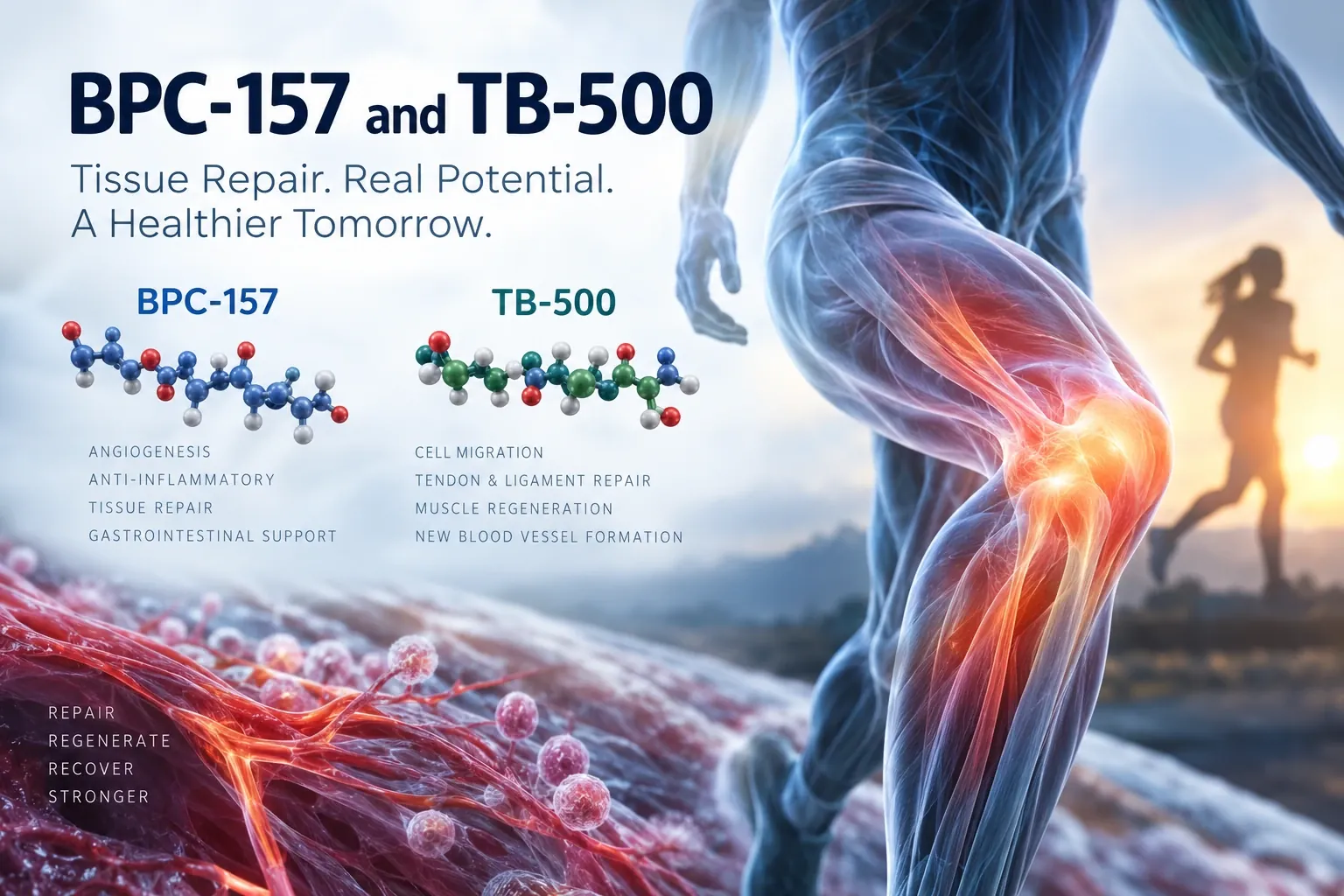
En español: qué son BPC-157 y TB-500, la evidencia alentadora en animales y personas, el avance regulatorio real de la FDA en 2026, y qué falta todavía antes de que cualquiera de los dos sea un medicamento aprobado.
Few compounds generate as much excitement in sports and musculoskeletal recovery as BPC-157 and TB-500. And there’s a real reason for that excitement: decades of preclinical research documenting a consistent repair effect on tendons, ligaments and muscle, a well-described biological mechanism, and in 2026 a genuine regulatory shift from the FDA that opened the door toward, someday, a clear legal compounding pathway.
This article tells that full story: what these two compounds are, what the evidence shows — starting with what’s actually working — what the first human study found, the 2026 regulatory progress, and what’s still left to prove before either one is a finished medicine.
Key points
- BPC-157 and TB-500 have one of the most consistent preclinical evidence bases in the entire recovery-peptide field: dozens of studies document repair of tendon, ligament, muscle and gastrointestinal tissue.
- In the one published human study so far, 7 of 12 patients with chronic knee pain reported relief lasting more than 6 months after BPC-157 injections — an encouraging first result, with no adverse events reported.
- A 2026 Achilles tendon study found that TB-500 produced a statistically significant improvement in tendon strength and scar tissue quality.
- The FDA made real regulatory progress in 2026: it withdrew both from its precautionary list, and its advisory committee is actively evaluating adding BPC-157 to the formal list of permitted substances.
- Neither is an FDA-approved drug yet, and both are banned for athletes under anti-doping testing (WADA) — useful context before considering either one.
In this article
- What BPC-157 and TB-500 actually are
- How they work: the science behind the excitement
- Decades of preclinical evidence
- The first human study: a positive signal
- The Achilles tendon study: a clear result for TB-500
- The FDA’s 2026 regulatory progress
- Important context: competitive sport
- What’s still left to confirm
- Weight and hormones: where your program fits in
- What this evidence does NOT say yet
- Who is this NOT for?
- Frequently asked questions
What BPC-157 and TB-500 actually are
BPC-157 stands for “Body Protection Compound-157,” a pentadecapeptide — a chain of just 15 amino acids — synthesized from a partial sequence of a protective protein found in human gastric juice. A research group at the University of Zagreb, led by pharmacologist Predrag Sikiric, first described it in the early 1990s, and it has since become one of the most extensively published recovery peptides in the scientific literature.
TB-500 is the name given to a synthetic fragment of a different natural protein: thymosin beta-4. It corresponds to the seven-amino-acid sequence LKKTETQ, the actin-binding region of thymosin beta-4. Full-length thymosin beta-4 is a protein the body produces naturally and that plays an active role in cell migration toward sites of injury and in the formation of new blood vessels during healing — a process the body already knows how to do, that this compound aims to support.
How they work: the science behind the excitement
According to a review published in Current Reviews in Musculoskeletal Medicine, BPC-157 activates the VEGFR2 receptor and nitric oxide synthesis through the Akt-eNOS axis, two pathways that promote new blood vessel formation (angiogenesis) toward injured tissue. It also activates ERK1/2 signaling, stimulates fibroblast activity — the cells that produce collagen — and has well-documented anti-inflammatory effects in animal models. This mechanism matters especially in tissues with limited blood supply of their own, like tendons, which is part of why they take longer to heal on their own (DOI).
TB-500 contributes a complementary mechanism: by binding to actin, it facilitates the migration of repair cells toward the site of injury and contributes to new blood vessel formation. It is, in essence, a way of speeding up a process the body already carries out naturally.
Both mechanisms are plausible and well characterized in the lab. What this article covers next is how much of that promise has already been confirmed in people, and how much is still on the way.
Decades of preclinical evidence
The volume of animal research on BPC-157 is, without overstating it, one of the largest evidence bases in the entire recovery-peptide field. The Zagreb group and collaborators have documented its repair effect on tendon, ligament, muscle and bone — including fully reattaching muscle to bone after surgical detachment (DOI) — on corneal ulcer healing and intraocular pressure control (DOI), on gastrointestinal protection and vascular recovery (DOI), and on multiple forms of muscle recovery, including cardiac muscle (DOI).
A 2025 study on quadriceps-to-bone reattachment in rats illustrates how consistent these results are: with daily oral BPC-157, treated animals fully recovered a normal walking pattern, where the untreated group showed a permanent healing failure (DOI).
A 2026 review in the American Journal of Sports Medicine evaluated BPC-157 and TB-500 alongside other emerging peptides and described their effects in animal models as “promising” across tendon, muscle, bone and ligament — the solid foundation the first human studies are now being built on (DOI).
The first human study: a positive signal
The human evidence is still young, but the first published result is encouraging. A clinical analysis of intra-articular BPC-157 injections in patients with chronic knee pain found that, of 12 patients treated, 7 reported pain relief lasting more than 6 months — with no adverse events reported — according to a systematic review published in 2025 in HSS Journal, the musculoskeletal surgery journal of the Hospital for Special Surgery (DOI).
7 of 12
Patients with chronic knee pain who reported relief lasting more than 6 months after intra-articular BPC-157 injections, with no adverse events reported. HSS J, 2025.
It’s a retrospective study with no comparison group — the simplest form of clinical research, and typically the kind that opens the door to larger, controlled studies — which is exactly the type of early signal that precedes a bigger clinical trial. The same review also describes how BPC-157 behaves in the body: it’s metabolized in the liver, with a short half-life under 30 minutes, and cleared renally, with preclinical safety studies finding no adverse effects across the organ systems tested in animals.
An independent review published in 2025 in Current Reviews in Musculoskeletal Medicine identified two additional pilot studies in people — one in interstitial cystitis and one on intravenous safety and pharmacokinetics — that also report a favorable profile, and concludes that the natural next step is a larger, well-designed clinical trial to confirm these early findings at scale (DOI).
The Achilles tendon study: a clear result for TB-500
One of the most common questions is whether BPC-157 and TB-500 work better together. A study published in 2026 in Joint Diseases and Related Surgery offers, so far, the most direct and best-controlled answer to that question.
Turkish researchers performed a surgical transection and repair of the Achilles tendon in 32 rats, split into four groups: control, BPC-157 alone, TB-500 alone, and the combination of both, over four weeks. At the end of the period, they measured the tendon’s biomechanical strength and scar tissue quality using several standardized histological scales.
Statistically significant improvement
The group treated with TB-500 showed a significant improvement (p<0.05) in tendon biomechanical strength and on two scar-tissue-quality scales versus control. Jt Dis Relat Surg, 2026.
The result was clear: TB-500 produced a statistically significant improvement in tendon strength and in the organization of scar collagen. The BPC-157 group showed a positive trend in the same direction. The one thing the study didn’t find was an additional benefit from combining the two over using TB-500 alone — the authors suggest both may converge on the same biological repair pathways, a hypothesis that lays the groundwork for understanding how they complement each other (DOI).
Put plainly: in the best-controlled study to date comparing the two compounds, there was a real, measurable improvement in tendon repair — that’s the finding worth taking away, that the repair effect worked.
The FDA’s 2026 regulatory progress
The regulatory status of BPC-157 and TB-500 took a real turn in 2026, and it’s worth understanding correctly, since it’s been explained poorly in a lot of places.
Compounding pharmacies operating under sections 503A and 503B of federal law may prepare customized medications using certain permitted substances. In September 2023, the FDA had placed a group of peptides — including BPC-157 and TB-500 — on a precautionary list, citing a lack of sufficient information to evaluate risk for the proposed routes of administration, rather than proven harm.
In 2026, the agency withdrew that classification for both compounds. Today, BPC-157 and TB-500 are no longer on that precautionary list. And the next step is already underway: on July 23–24, 2026, the FDA’s Pharmacy Compounding Advisory Committee met specifically to discuss whether BPC-157 should be formally added to the positive list of permitted substances under section 503A — the step that would define a legal, regulated compounding pathway for this compound. That evaluation is ongoing.
This is genuine regulatory progress, and it’s worth being precise about what it still represents: withdrawing the precautionary classification and evaluating inclusion on the positive list is not, yet, the approval of a finished drug. Neither compound currently has an FDA label setting dose, contraindications or agency-reviewed adverse effects, the way medications like testosterone or tesamorelin do. It’s, in the best sense, a regulatory process in motion — not a finish line already crossed.
Important context: competitive sport
For anyone subject to anti-doping testing — from a professional athlete to an amateur runner in a certified race — there’s an additional fact worth knowing. The World Anti-Doping Agency (WADA) classifies both BPC-157 and TB-500 under category S2 of its Prohibited List, and marks them as prohibited at all times, in and out of competition. This applies regardless of the FDA’s regulatory progress, and it’s something any competitive athlete should keep in mind before considering either one.
What’s still left to confirm
The excitement around these two compounds is real, and largely earned by the quality of the preclinical evidence. At the same time, there are pieces of the puzzle science is still completing, and they’re worth knowing to make an informed decision.
The first is about manufacturing, not the molecule itself: today, most of the market distributes BPC-157 and TB-500 as “research peptides,” outside the framework of a regulated compounding pharmacy. That means that until the FDA process described above is complete, purity and exact dosing depend entirely on the quality of the supplier.
The second is about the scale of human data: the 7-of-12-patient result is a positive signal, but a large, randomized, controlled trial — the standard that would confirm the benefit more definitively — hasn’t been published yet. A 2026 review evaluating BPC-157, TB-500 and other emerging peptides together documented that, within that broader category, some compounds show cardiovascular and metabolic risks warranting medical oversight; the most serious finding in that group — congestive heart failure — belongs specifically to ibutamoren (MK-677), not to BPC-157 or TB-500 (DOI).
So while the science and the regulatory process keep advancing, the safest way to approach any recovery compound — approved or under review — remains the same: under the supervision of a licensed physician who knows your full history.
Weight and hormones: where your program fits in
If your interest in peptides like these comes from wanting better recovery, less inflammation, or more overall energy, there’s a starting point with equally solid evidence that’s already available today: weight management and hormonal health. Excess weight directly fuels the systemic inflammation that slows recovery — and improving that doesn’t depend on any regulatory process finishing first.
That’s why at SCTS1 the order is this. Once you start your program, a licensed physician reviews your case — habits, stress, sleep and medical history — and orders labs only if they consider it necessary. That physician decides which approach makes sense for your case. Eligibility is determined by medical evaluation.