Food Noise and GLP-1: What the Science Actually Says About Quieting Food Thoughts
En español: Ruido alimentario y GLP-1 — qué dice realmente la ciencia sobre silenciar los pensamientos persistentes de comida.
Watch the related video
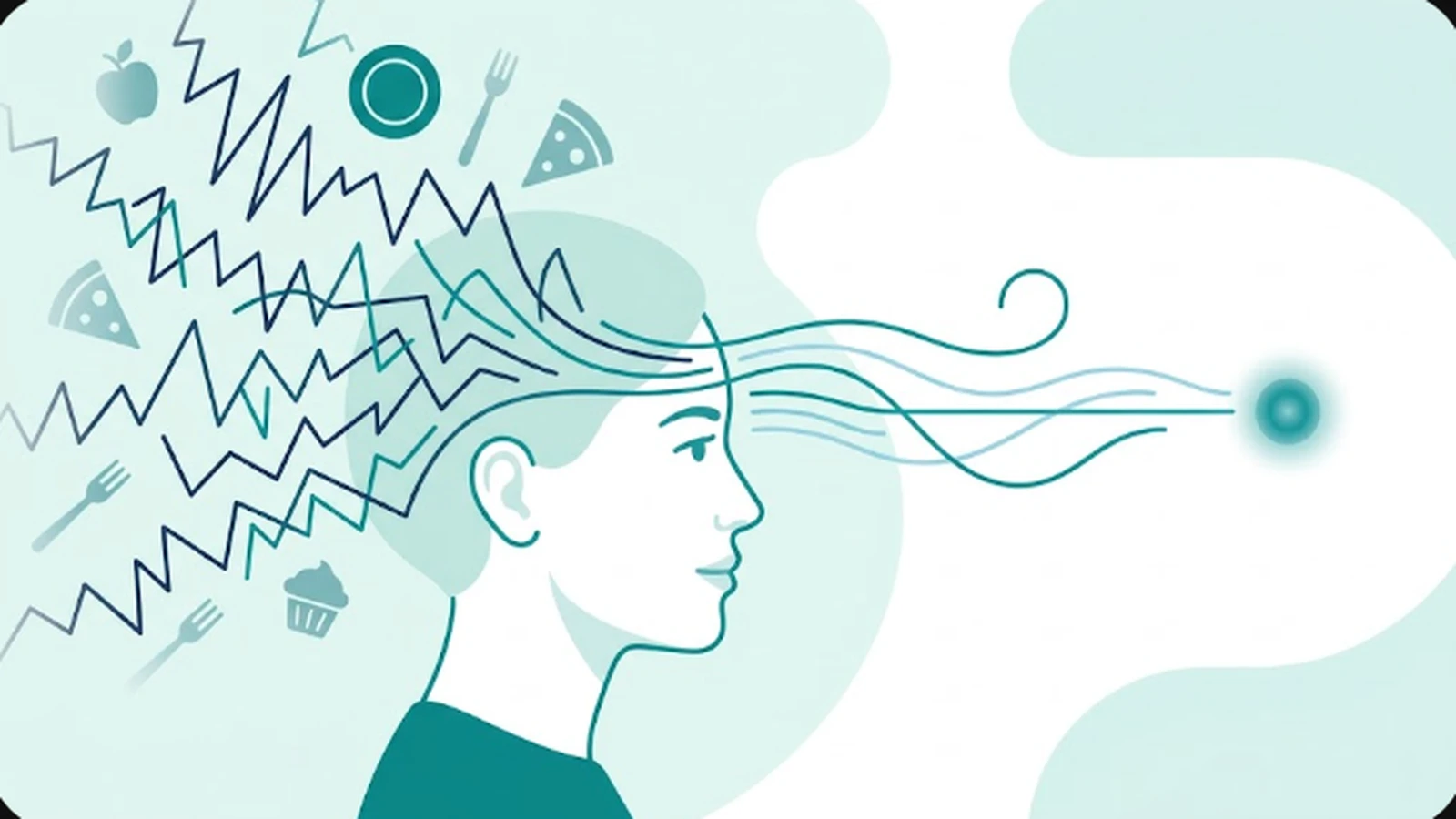
If you've ever felt like food occupies your head even after you've already eaten, researchers now have a name for it: "food noise." Until recently there wasn't even a formal scientific definition for it — an expert panel convened by Baylor College of Medicine published the first consensus definition only in July 2025, in the journal Nutrition & Diabetes.
The term went viral on social media tied to GLP-1 medications, with thousands of people describing that once they started treatment, that constant hum of thinking about food simply turned down. In May 2026, a study from the Pennington Biomedical Research Center presented at the European Congress on Obesity put an actual number on that experience for the first time.
This article explains what food noise is according to the evidence, what that study actually found, and — with the same honesty we always use — how solid the data really is and what we still don't know.
Key points
- "Food noise" is defined as persistent, intrusive thoughts about food that interfere with daily life, per the expert consensus panel published in 2025 in Nutrition & Diabetes.
- A study of 417 adults, presented as a poster at ECO2026, found a -4.05 point drop on the FNQ scale among GLP-1 users, versus -1.15 points in those following the behavioral program alone.
- The between-group difference was roughly 3 points on a validated scale with a maximum of 20 points, measured over just one month of follow-up.
- This is preliminary data: presented as a conference poster, without a full peer-reviewed manuscript yet, and with a GLP-1 group of only 92 people versus 325 in the comparison group.
- Food noise is not the same as hunger or a one-off craving — it's more like a constant background volume, as described by researchers at the University of Colorado Anschutz.
- The term's popularity on social media for self-diagnosis, especially among teens, has moved faster than what the science can confirm.
- None of this is a diagnosis or a treatment. Individual results vary and are not guaranteed.
In this article
- What food noise is, according to the science
- The study: what it measured and what it found
- How solid this data actually is
- Food noise isn't the same as hunger or craving
- Why this matters if you're losing weight
- The social media self-diagnosis problem
- What changes if you're on a GLP-1 program
- What this evidence does NOT say
- Who is this NOT for?
- Frequently asked questions
- Sources
What food noise is, according to the science
For years, people described this feeling without a formal word for it: thinking about food constantly, even without real hunger, to the point that deciding what or whether to eat felt exhausting. In June 2024, a group of researchers led by Baylor College of Medicine convened to try to define the concept with scientific rigor for the first time.
The result, published in 2025 in Nutrition & Diabetes, describes food noise as persistent, intrusive thoughts about food, perceived by the person as unwanted, that can interfere with daily life and make healthy behaviors harder. The same panel acknowledges at least three slightly different published definitions exist — a sign the field is still being built, not settled.
To measure it consistently, researchers at Pennington Biomedical Research Center developed the Food Noise Questionnaire (FNQ), a validated 5-item tool scored 0 to 4 per question, for a maximum of 20 points. It's the tool used in the study described below.
The study: what it measured and what it found
In May 2026, researcher Hanim Ecem Diktas presented at the 33rd European Congress on Obesity (ECO2026) the results of an observational cohort study of 417 adults enrolled in a digital weight management program. The goal was to compare one-month change in FNQ score between those using a GLP-1 medication as part of their plan and those following the behavioral program alone.
The between-group difference was roughly 3 points on a scale with a maximum of 20 — a measurable reduction, though not an elimination of food noise. The study was funded and conducted by Pennington Biomedical Research Center, part of Louisiana State University, one of the institutions that originally helped develop and validate the FNQ tool.
How solid this data actually is
This is where it's worth slowing the enthusiasm down before it turns into a promise. This result was presented as a conference poster — not as a published, peer-reviewed journal article. That means it hasn't yet gone through the full scrutiny science requires before being considered a reliable conclusion.
Follow-up was only one month, which says nothing about whether the effect holds, fades, or changes over time. The GLP-1 group was considerably smaller (92 people) than the comparison group (325 people), and the overall sample skewed heavily in one direction: 94% white, 93% female, average age 59, and average BMI of 34. That limits how far the finding can be generalized to other groups — men, younger people, or other ethnic backgrounds, for example.
The Pennington Biomedical team has indicated the full manuscript is still in preparation for publication. Until that happens, this is a promising result consistent with what many GLP-1 users report anecdotally — but not yet a settled conclusion.
Food noise isn't the same as hunger or craving
Researchers at the University of Colorado Anschutz, who study this phenomenon independently, insist on an important distinction: food noise isn't physiological hunger, and it isn't the same as a one-off craving for a specific food.
- Hunger: a clear physiological signal of energy need, normally resolved by eating.
- Craving: a one-off urge, often tied to a specific food, that can come and go.
- Food noise: more like a constant background volume — thoughts about food that persist even after eating, which can make simple decisions feel draining.
The CU Anschutz team describes the effect reported with GLP-1s as similar to noise-canceling headphones: they don't eliminate the background sound entirely, but they turn the volume down enough that a person can focus on something else.
Why this matters if you're losing weight
For years, most weight-loss conversations centered almost exclusively on calories, macronutrients, and exercise, leaving out a component many people described but that was rarely measured: the mental fatigue of thinking about food constantly, even while sticking to a plan exactly.
If food noise turns out to be a real, measurable mechanism by which GLP-1s help people sustain habit changes — not just by lowering physical appetite, but by lowering the cognitive load of thinking about food all the time — that would help explain why so many people describe treatment as something different from "just eating less through willpower." It's a hypothesis with early data behind it, not yet a confirmed mechanism.
The social media self-diagnosis problem
The term "food noise" became popular on TikTok and Instagram before a formal scientific definition even existed. That popularity brought a real problem: many posts oversimplify or overstate what the research actually describes, and some encourage self-diagnosis without any professional evaluation at all.
This is particularly delicate for teenagers, a group where rigorous food noise research is just beginning — a pediatric clinical trial is scheduled for 2027 to better understand how this phenomenon shows up in minors. Confusing food noise with a possible eating disorder, or the reverse, based on a short video, does not replace real clinical evaluation.
What changes if you're on a GLP-1 program
If you noticed your mental relationship with food shifted after starting treatment, you're not imagining something without basis — it's an experience research is starting to document and measure with tools like the FNQ. Even so, the experience varies widely from person to person, and no medication fully turns off thoughts about food.
When you start your program, a licensed physician reviews your case — habits, medical history, goals — and orders labs if deemed necessary. Eligibility is determined through medical evaluation.
GLP-1 programs with FDA-approved medications (Wegovy®, Foundayo™, Ozempic®) from $149/month, by telemedicine, in Spanish and English.
What this evidence does NOT say
Let's be explicit, because this is exactly the kind of topic that invites bigger promises than the science supports.
It does not say GLP-1s eliminate food noise entirely. The data show a measurable score reduction, not total or guaranteed silence.
It does not say the finding holds beyond one month. The study only measured one month of follow-up; we don't know if the effect grows, holds, or fades over time.
It is not yet a published, peer-reviewed study. It's a conference poster with a manuscript in preparation — an important step, but not the end of the scientific process.
And it does not say food noise looks the same for everyone. The study sample was mostly middle-aged white women; how this phenomenon behaves in other groups still needs dedicated research.
Who is this NOT for?
This article is not for you if you suspect you have an eating disorder — binge eating, severe restriction, purging, or obsessive preoccupation with food that already affects your daily life. That warrants evaluation from a mental health professional, not a read on a preliminary study.
It's also not for you if you're a minor trying to explain your relationship with food based on social media content without talking to a trusted adult or a health professional first — research in teenagers is only just beginning.
It is for you if you're on a GLP-1 program, or considering one, and want to understand with real data why that sense of "thinking less about food" so many people describe has, for the first time, some scientific evidence behind it — and how solid that evidence actually is right now.
Frequently asked questions
What exactly is "food noise"?
It's a fairly new term in the scientific literature. An expert panel convened by Baylor College of Medicine and published in 2025 in Nutrition & Diabetes describes it as persistent, intrusive thoughts about food that are hard to ignore and can interfere with daily life. It isn't the same as hunger or a one-off craving — it's the feeling that food occupies mental space constantly, even right after eating.
What exactly did the Pennington Biomedical study show?
An observational study of 417 adults in a digital weight management program, presented as a poster at the European Congress on Obesity (ECO2026) in May 2026, measured one-month change using the Food Noise Questionnaire (FNQ), a validated 5-item tool. The group using a GLP-1 medication (92 people) dropped an average of 4.05 points on the scale, versus 1.15 points in the comparison group (325 people) using the behavioral program alone. The between-group difference was roughly 3 points.
Is this a final result or still preliminary?
It's preliminary. It was presented as a conference poster, meaning it hasn't yet gone through full peer review or been published as a journal article. Follow-up was only one month, and the GLP-1 group was smaller and demographically different (mostly white women, average age 59) than the comparison group. This is data pointing in a direction, not a closed conclusion.
Is food noise the same as a craving or hunger?
No. Hunger is a physiological signal of energy need. A craving is usually a one-off urge tied to a specific food. Food noise, as researchers at the University of Colorado Anschutz describe it, is more like a constant background volume of food-related thoughts that persists even without real hunger, and that can make simple eating decisions feel exhausting.
Do GLP-1 medications fully turn off those thoughts?
There is no evidence they eliminate them entirely. Available data show a measurable drop in FNQ score, not total silence. Researchers at CU Anschutz describe the effect as turning down the volume on background noise, not turning it off completely, and note the experience varies widely from person to person.
Is it safe for a teenager to self-diagnose "food noise" from social media content?
It's not advisable. The term became popular on TikTok and Instagram in ways that often oversimplify or distort what the research actually describes. Food noise in minors is an area barely being studied rigorously, with a pediatric trial scheduled for 2027. A possible eating disorder in a teenager needs evaluation from a health professional, not a diagnosis based on a video.
What labs are ordered for this?
That's a clinical decision. When you start your program, a licensed physician reviews your case — habits, medical history, goals — and orders labs if deemed necessary. Eligibility is determined through medical evaluation.
Do you provide care in Spanish?
Yes. All of our content and care are available in both English and Spanish.
Sources
- Diktas HE, et al. Changes in Food Noise in Two Weight Management Programs: Effects of GLP-1 Receptor Agonists. Poster presented at the 33rd European Congress on Obesity (ECO2026), May 2026. Pennington Biomedical Research Center. — Press release · Pennington Biomedical
- Allison DB, et al. Food noise: definition, measurement, and future research directions. Nutrition & Diabetes. 2025;15:24. — DOI · via PubMed
- Food Noise Questionnaire (FNQ) — validated measurement tool. Pennington Biomedical Research Center. — pbrc.edu
- University of Colorado Anschutz Medical Campus. Food Noise Research and GLP-1 Medications — researcher perspective on mechanism and definition. — news.cuanschutz.edu
Related articles
Strength training on GLP-1 → What happens when you stop a GLP-1 → Loose skin after weight loss →Your trust is worth more than a sale.
This article is informational and is not medical advice. SCTS1 does not prescribe medication. All medical care, prescriptions, and treatment plans are provided by licensed healthcare providers through our partner platform. Treatment eligibility is determined by a licensed provider. Compounded medications contain the same active ingredient class but are not FDA-approved finished pharmaceuticals. Individual results vary and are not guaranteed.